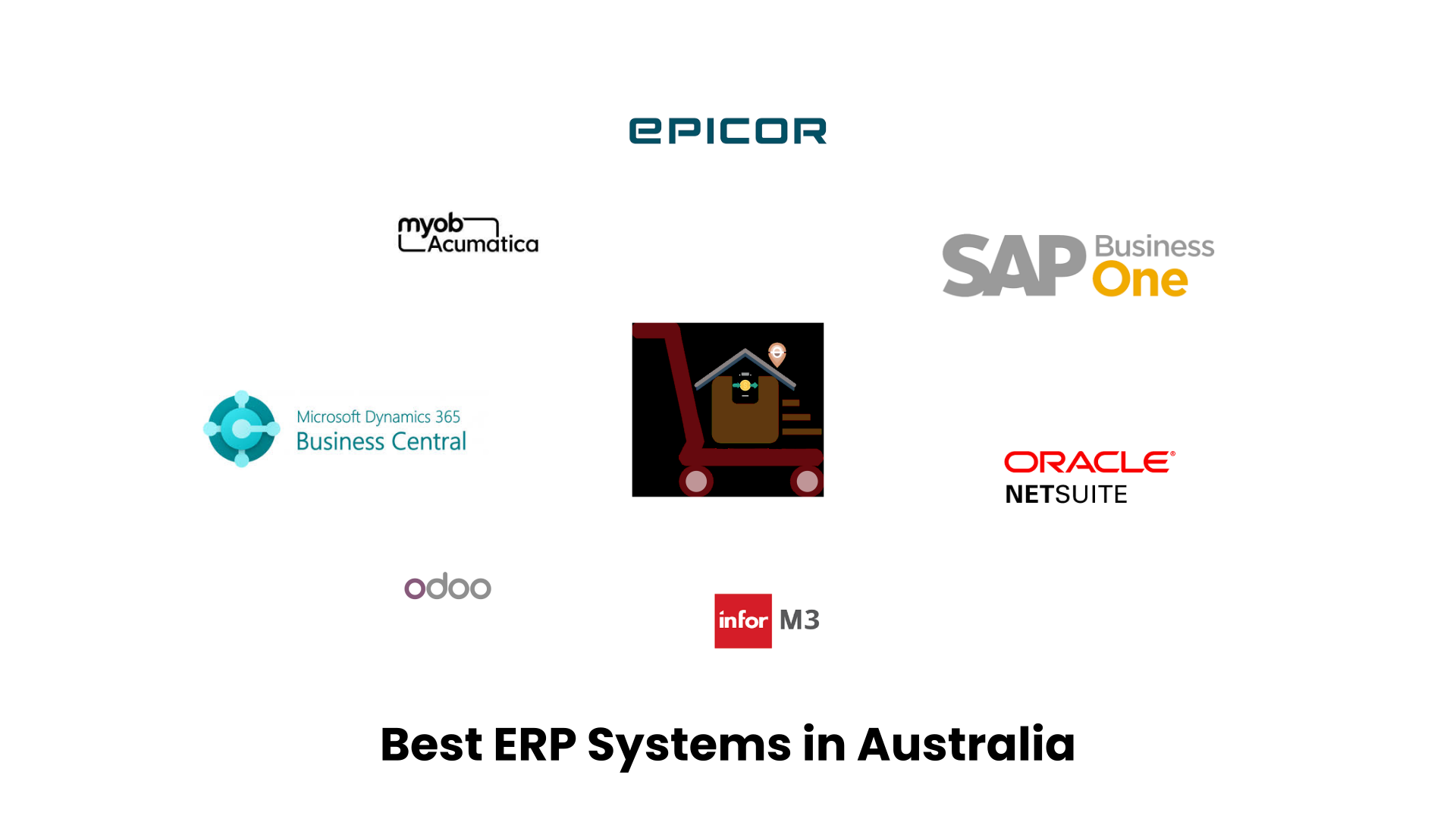
The Best ERP Systems in Australia for Manufacturing & Distribution
1. MYOB Acumatica — Best Overall for Australian Mid-Market Manufacturers
Best for: Mid-market Australian manufacturers and distributors seeking local compliance with enterprise-grade functionality.
MYOB Acumatica has earned the top position in the iStart ERP Buyer’s Guide 2025–26 as the #1 ERP system across Australian and New Zealand organisations, specifically noted for its Manufacturing edition. Built on the internationally recognised Acumatica cloud platform and localised by MYOB specifically for the Australian market, it combines genuine manufacturing depth with built-in GST, STP, and compliance tools.
Key Strengths:
- Dedicated Manufacturing Edition with MRP, BOM, production scheduling, and shop floor control
- True cloud architecture with unlimited user pricing (no per-seat cost penalty as you scale)
- Native Australian compliance including GST, STP Phase 2, and Payroll
- Strong distribution and WMS capabilities with real-time inventory tracking
- Robust API and integration marketplace
Pricing: Contact MYOB for custom quote; no per-user fees — pricing is based on consumption and modules.
Ideal Company Size: AUD $5M – $200M revenue
2. Microsoft Dynamics 365 Business Central — Best for Microsoft-Integrated Environments
Best for: Australian SMEs already using Microsoft 365 who want a scalable ERP with deep ecosystem integration.
Microsoft Dynamics 365 Business Central consistently ranks as the most widely adopted mid-market ERP in Australia. For manufacturers and distributors already operating within the Microsoft ecosystem — using Teams, Outlook, Excel, and Power BI — Business Central offers a uniquely frictionless integration path.
Key Strengths:
- Native integration with Microsoft 365, Power BI, Teams, and Azure
- Strong manufacturing capabilities including production orders, routing, and capacity planning
- Robust supply chain and warehouse management tools
- Extensive partner network across Australia for local implementation support
- Regular feature updates as part of the Microsoft cloud roadmap
Pricing: Starting from approximately AUD $100–$150 per user/month for Essentials; Premium tier (which includes Manufacturing) starts around AUD $140–$200 per user/month.
Ideal Company Size: AUD $2M – $100M revenue
3. SAP Business One — Best for Complex Operations with Global Reach
Best for: Australian manufacturers and distributors with global operations or complex multi-entity requirements.
SAP Business One is a purpose-built ERP for small-to-mid-sized businesses, but it carries the full weight of SAP’s enterprise heritage. For Australian manufacturers with overseas subsidiaries, multi-currency requirements, or complex intercompany transactions, SAP Business One offers capabilities that lighter platforms struggle to match.
Key Strengths:
- Proven global implementation track record across 70,000+ companies
- Deep manufacturing functionality including MRP, production planning, and quality management
- Multi-currency, multi-company, and multi-language support
- SAP HANA in-memory database for high-speed analytics
- Strong compliance framework applicable across ATO, ASIC, and international standards
Pricing: Licensing typically ranges from AUD $1,500–$3,500 per named user; SAP Business One Cloud subscription is available from approximately AUD $100–$200 per user/month.
Ideal Company Size: AUD $5M – $250M revenue
4. Oracle NetSuite — Best for Fast-Growing and Multi-Entity Businesses
Best for: High-growth Australian companies, multi-entity operations, and businesses with omnichannel distribution requirements.
Oracle NetSuite is the world’s leading cloud ERP by number of users, deployed across more than 37,000 organisations globally. In Australia, it has become a go-to platform for scaling manufacturers and distributors that need a system capable of growing with them — across locations, entities, and channels.
NetSuite’s “SuiteSuccess” industry bundles, including dedicated options for wholesale distribution and manufacturing, offer pre-configured deployments that can significantly accelerate time-to-value. A wholesale distributor in Adelaide, for example, can use a SuiteSuccess package to rapidly deploy multi-warehouse inventory management, automated order processing, and real-time financial reporting within a single unified system.
Key Strengths:
- Native cloud with no hardware or on-premise infrastructure
- Advanced manufacturing edition with MRP, demand planning, and shop floor visibility
- OneWorld module for multi-subsidiary and international operations
- Robust WMS, order management, and 3PL integration
- Strong eCommerce and B2B portal capabilities
Pricing: Starting from approximately AUD $1,500–$2,500/month base fee plus per-user licensing (AUD $100–$200 per user/month). Total cost varies significantly by modules selected.
Ideal Company Size: AUD $5M – $500M revenue
5. Epicor Kinetic — Best for Complex Discrete and Process Manufacturing
Best for: Australian manufacturers with complex job-shop, make-to-order, or process manufacturing environments.
Epicor Kinetic (formerly Epicor ERP) is purpose-built for manufacturers and has been a trusted platform in the Australian market for over two decades. It excels in industries like industrial equipment, metals, automotive components, and engineered-to-order environments — the types of complex operations where generic ERP systems fall short.
Key Strengths:
- Industry-specific functionality for discrete, process, and mixed-mode manufacturing
- Advanced planning and scheduling (APS) built in
- Comprehensive job costing and project management
- Strong integration with CAD systems and engineering workflows
- Available as cloud, on-premise, or hybrid deployment
Pricing: Subscription-based pricing; contact Epicor for quote. Generally positioned for AUD $20M+ businesses.
Ideal Company Size: AUD $20M – $500M revenue
6. Infor M3 — Best for Large-Scale Food, Beverage, and Chemical Manufacturers
Best for: Larger Australian manufacturers in food & beverage, chemicals, or industrial distribution.
Infor M3 is a cloud-based manufacturing and distribution ERP system that leverages modern technology to offer powerful analytics and a multicompany platform supporting multicountry and multisite users. The CloudSuite offering, which includes Infor M3, delivers industry-leading functionality specifically designed for the food and beverage, chemical, distribution and equipment, and other manufacturing sectors.
Key Strengths:
- Deep industry-specific functionality for food, beverage, and chemical manufacturing
- Multi-company, multisite, and 25+ language support across 50+ countries
- Advanced warehouse and distribution management
- Powerful analytics and role-based dashboards
- Built for enterprise-scale complexity
Pricing: Enterprise pricing; contact Infor for custom quote. Best suited for mid-to-large enterprises.
Ideal Company Size: AUD $50M+ revenue
7. Odoo — Best Value Open-Source ERP for Growing Businesses
Best for: Small-to-mid-sized Australian manufacturers and distributors seeking a flexible, cost-effective solution.
Odoo has rapidly grown in popularity across the Australian market as an affordable, modular alternative to the major players. With over 80 integrated business apps including manufacturing, inventory, purchase, sales, and accounting, Odoo offers a genuinely comprehensive platform at a significantly lower entry cost than SAP, Oracle, or Microsoft.
Key Strengths:
- Highly modular — start with what you need, add more as you grow
- Open-source core with a large developer community for customisation
- Native manufacturing module with MRP, work orders, and quality management
- Integrated eCommerce and B2B portal
- Significantly lower licensing costs than comparable platforms
Pricing: From approximately AUD $0 (Community edition) to AUD $30–$60 per user/month for Enterprise edition.
Ideal Company Size: AUD $500K – $30M revenue
8. Cloudy Business Ops 360 — Best Salesforce-Native ERP for Product-Driven Businesses
Best for: Australian businesses already on Salesforce that need a unified, native ERP covering inventory, warehouse, procurement, order fulfilment, and billing — without leaving the Salesforce ecosystem.
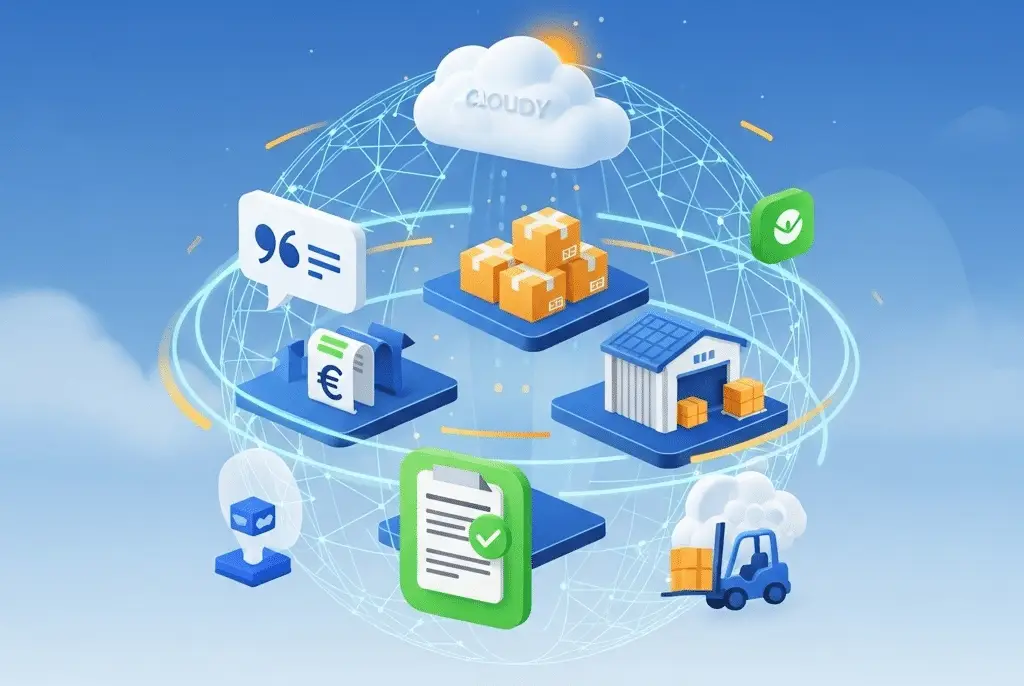
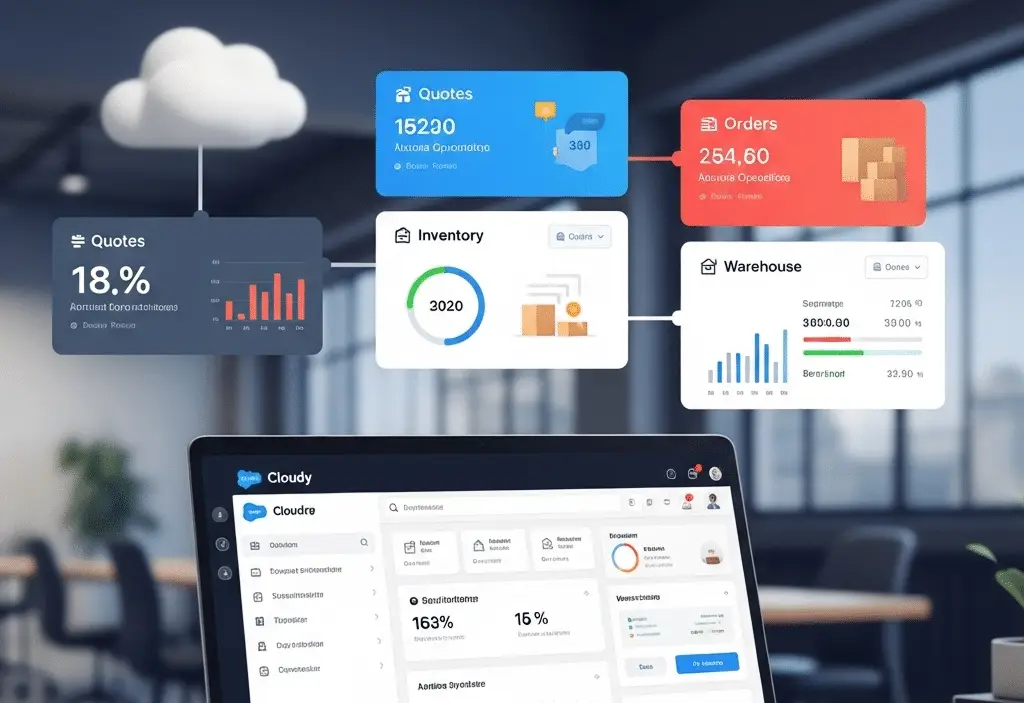
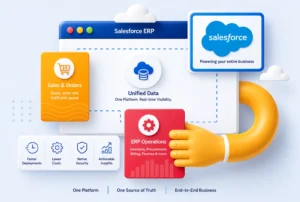
Cloudy Business Ops 360 by Cloudy Wave is a Salesforce-native AppExchange ERP platform purpose-built for product-driven industries including manufacturing, wholesale distribution, retail, logistics, and supply chain. Unlike third-party integrations that create data silos between your CRM and operations, Cloudy Business Ops 360 runs entirely within Salesforce — giving sales, operations, warehouse, and finance teams a single source of truth with no duplicate data entry and no clunky middleware.
For Australian manufacturers and distributors already invested in Salesforce, this eliminates the classic ERP vs. CRM divide that costs businesses thousands in integration overhead and ongoing maintenance.
Key Strengths:
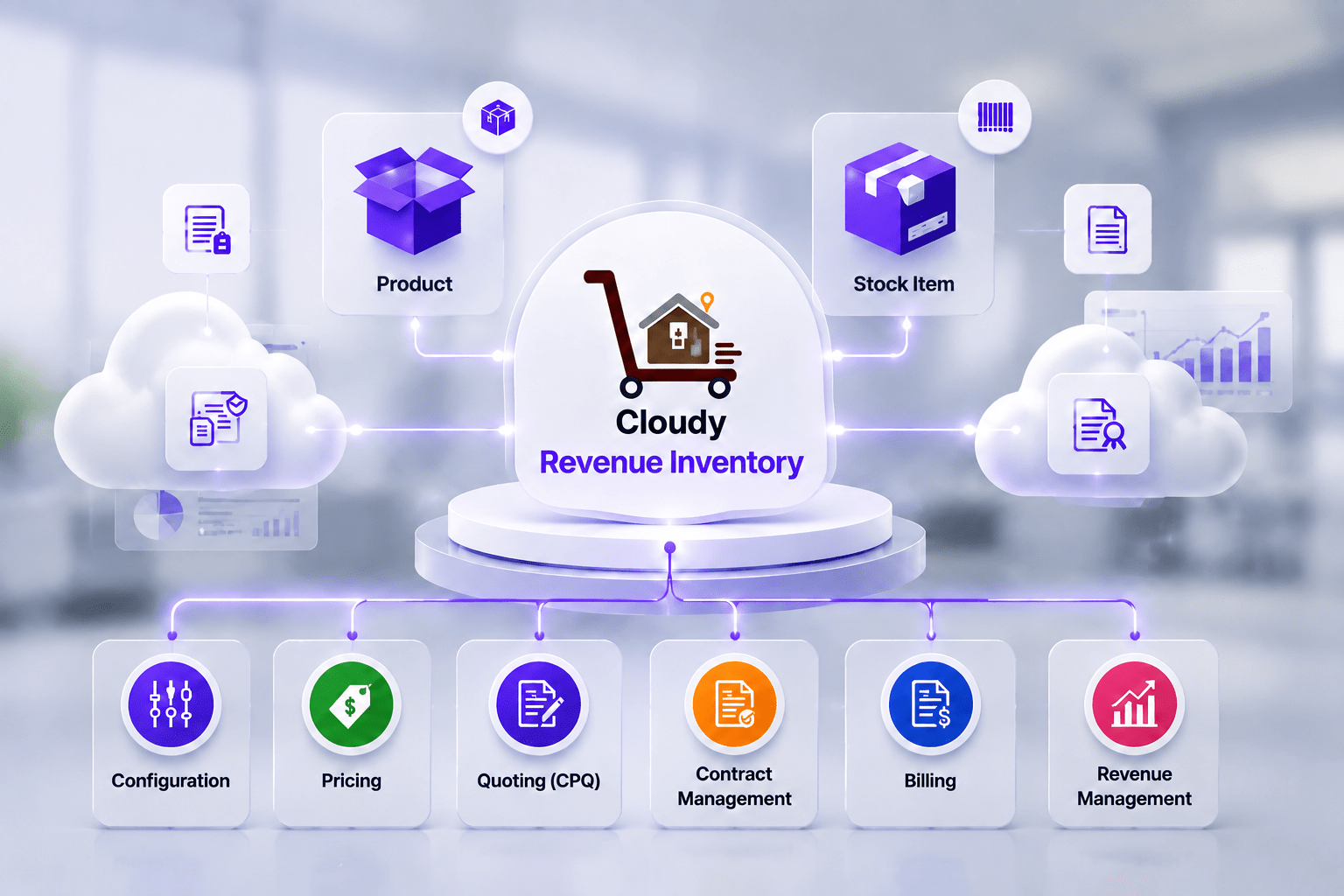
- Fully Salesforce-native — built on the AppExchange, no external integrations required
- Item & Inventory Management with real-time stock visibility across locations
- Warehouse Management including pick, pack, and ship workflows
- Order & Fulfilment Management covering sales orders, purchase orders, and backorders
- Procurement & Vendor Management with supplier tracking and PO automation
- Multi-Currency Support for businesses trading across borders
- Billing & Invoicing integrated directly with Salesforce financials
- Seamless connection to Salesforce Sales Cloud, Service Cloud, and CRM Analytics
- Backed by Cloudy Wave’s 10+ years of Salesforce expertise and 95% implementation success rate
Key Features at a Glance:
| Feature | Capability |
|---|
| Inventory Management | Multi-location, real-time stock tracking |
| Warehouse Operations | Pick/pack/ship, bin management |
| Order Management | Sales orders, POs, backorders, drop-ship |
| Procurement | Vendor management, PO automation |
| Billing | Salesforce-native invoicing and payments |
| Multi-Currency | Global transaction support |
| Platform | 100% Salesforce AppExchange native |
Pricing: Contact Cloudy Wave for a tailored quote based on your Salesforce edition and module requirements.
Ideal Company Size: Startups to mid-market businesses (AUD $500K – $100M revenue) already operating on Salesforce.
Industries Served: Wholesale & Distribution, Manufacturing & Assembly, Retail & eCommerce, Logistics & Warehousing, Supply Chain & Procurement, Trading & Import-Export, Consumer Goods, Industrial & B2B Supply, Healthcare & Medical Supply, and more.
ERP System Comparison Table: Australia Manufacturing & Distribution
| ERP System | Best For | Deployment | Approx. Price (AUD) | Local Compliance |
|---|
| MYOB Acumatica | Mid-market ANZ manufacturers | Cloud | Custom (consumption-based) | ✅ Built-in |
| Microsoft Dynamics 365 BC | Microsoft ecosystem users | Cloud / Hybrid | $100–$200/user/month | ✅ Strong |
| SAP Business One | Complex multi-entity operations | Cloud / On-Prem | $100–$200/user/month | ✅ Strong |
| Oracle NetSuite | Fast-growing multi-location | Cloud | $100–$200/user/month + base fee | ✅ Good |
| Epicor Kinetic | Complex discrete manufacturing | Cloud / On-Prem | Custom | ✅ Good |
| Infor M3 | Large food, beverage, chemical | Cloud | Enterprise pricing | ✅ Strong |
| Odoo | Cost-conscious SMBs | Cloud / On-Prem | $0–$60/user/month | ✅ Available |
| Cloudy Business Ops 360 | Salesforce-native operations | Cloud (Salesforce) | Contact Cloudy Wave | ✅ Built-in |
Key Factors When Evaluating ERP Vendors in Australia
Implementation Risk and Partner Quality
According to NetSuite’s ERP research, businesses that engage a qualified software implementation consultant achieve an ERP project success rate of 85%. Choosing a vendor without a strong local Australian partner network is one of the most common — and costly — mistakes mid-market businesses make.
When assessing vendors, ask:
- How many certified implementation partners do they have in Australia?
- Can they provide Australian customer references in your specific industry?
- What is their average implementation timeline for businesses of your size?
You can explore Cloudy Wave’s case studies to see how real Australian businesses have transformed their operations through expert platform implementation.
Total Cost of Ownership (TCO)
License or subscription costs are only one piece of the puzzle. Factor in:
- Implementation costs (typically 1–2x the first year’s license cost)
- Data migration from legacy systems
- Training costs for all user levels
- Ongoing support and maintenance agreements
- Customisation and integration development
Cloud vs. On-Premise in 2025
The shift toward cloud ERP in Australia is well underway. According to Statista’s Australia ERP market data, cloud-based deployments are accelerating at the expense of on-premise systems, driven by the flexibility, automatic updates, and remote accessibility they provide. For most Australian manufacturers and distributors under AUD $200M in revenue, a true cloud ERP is now the recommended default.
However, businesses with:
- Very high data sensitivity or security requirements
- Highly customised legacy workflows
- Limited or unreliable internet connectivity at production sites
…may still benefit from hybrid or on-premise deployments.
Scalability and Industry Fit
The best ERP systems in Australia for manufacturing and distribution are those that match your current complexity while supporting your growth trajectory. A system that works well for a $5M food manufacturer may not suit a $50M industrial equipment distributor.
Match the system to:
- Your manufacturing type (discrete, process, project-based, mixed-mode)
- Your distribution model (wholesale, direct, omnichannel, B2B portal)
- Your compliance obligations (food safety, pharmaceutical, engineering standards)
- Your international footprint (single country vs. multi-entity)
Cloudy Wave supports businesses across a wide range of product-driven industries — from wholesale distribution and manufacturing to logistics, supply chain, and retail. Explore Cloudy Wave’s industry solutions to find the right fit for your sector
Implementation Best Practices for Australian Businesses
A well-chosen ERP can fail through poor implementation. Research from NetSuite shows that 77% of organisations cite executive leadership support as the most critical success factor in ERP implementations, while 60% identify stakeholder communication as the top skill required.
Follow these proven practices:
- Define clear business objectives before you evaluate any software. Know the specific problems you’re solving.
- Involve end users early — floor managers, warehouse staff, and finance teams all need to be part of the selection process.
- Prioritise data quality before migration. Clean data in, clean data out.
- Choose a phased implementation — more than 50% of successful ERP rollouts use a phased approach rather than a “big bang” go-live.
- Invest in training, not just go-live support. Ongoing user education drives long-term ROI.
- Plan for change management — the technology is often easier than getting people to use it consistently.
Need expert guidance on your implementation journey? Cloudy Wave’s Salesforce and Microsoft consulting services are designed to reduce implementation risk and accelerate time-to-value for Australian businesses.
The Future of ERP for Australian Manufacturing: Key Trends in 2025
AI-Powered ERP
Vendors across the board are embedding AI capabilities — from demand forecasting and predictive maintenance alerts to intelligent exception management and natural language reporting. Australian manufacturers that select AI-ready platforms will gain compounding operational advantages. Cloudy Wave’s Data Cloud services help businesses unlock AI-driven analytics within their existing Salesforce environment.
IoT and Smart Factory Integration
Modern ERP systems increasingly connect directly to IoT sensors on the factory floor, enabling real-time production monitoring, automated quality checks, and predictive maintenance scheduling without manual data entry.
Sustainability and ESG Reporting
Increasing regulatory pressure and enterprise customer requirements are pushing Australian manufacturers to track and report on carbon emissions, waste, and energy use. Next-generation ERP systems are beginning to build these capabilities natively.
Embedded Analytics and BI
The days of running reports in a separate BI tool are fading. Leading platforms now deliver live, role-based dashboards and analytics within the ERP itself — giving operations managers, CFOs, and production supervisors the insights they need without waiting for IT. Explore how Cloudy Wave’s Tableau services help manufacturers turn operational data into actionable business intelligence.
Conclusion: Choosing the Right ERP for Your Australian Manufacturing or Distribution Business
The best ERP systems in Australia for manufacturing and distribution share several qualities: they offer genuine manufacturing depth (not just accounting with bolt-ons), they handle Australian compliance natively, they scale with your growth, and they’re backed by capable local implementation partners.
Key Takeaways:
- MYOB Acumatica is the top-rated choice for mid-market Australian manufacturers wanting local expertise and true cloud architecture.
- Microsoft Dynamics 365 Business Central is ideal if your business is deeply embedded in the Microsoft ecosystem — Cloudy Wave’s Microsoft practice can support your implementation.
- SAP Business One suits complex, multi-entity, or internationally operating businesses.
- Oracle NetSuite is best for fast-growing companies that need scalable, multi-location capability.
- Epicor Kinetic is the go-to for complex discrete or process manufacturers with job-shop requirements.
- Infor M3 leads for large-scale food, beverage, and chemical manufacturers.
- Odoo offers the best value for cost-conscious SMBs willing to invest in customisation.
- Cloudy Business Ops 360 is the standout choice for businesses already on Salesforce who want a fully native ERP covering inventory, warehouse, procurement, order fulfilment, and billing — all without leaving the Salesforce platform.
- Whichever platform you choose, invest in a qualified Australian implementation partner — the data is clear that this dramatically improves project success rates.
The ERP decision is one of the most consequential technology investments your business will make. Take the time to document your requirements, involve your operational teams, and evaluate at least three shortlisted vendors with a structured assessment framework. The right system, properly implemented, will deliver returns for a decade or more.
Ready to take the next step? Contact the Cloudy Wave team for a free consultation, or explore our blogs and resources for more guides on ERP, Salesforce, and digital transformation for Australian businesses.
External Sources & References
| Source | Topic | Link |
|---|
| IBISWorld | ERP Software Developers in Australia — Market Size 2025 | ibisworld.com |
| Expert Market Research | Australia ERP Market Report & CAGR Projections to 2034 | expertmarketresearch.com.au |
| Cargoson | Global ERP Market Size 2025 — Manufacturing Vertical Share | cargoson.com |
| Oracle NetSuite | ERP Statistics, Implementation Success Rates & Trends | netsuite.com |
| Statista | Australia ERP Software Market Forecast 2024–2029 | statista.com |
| iStart / Kilimanjaro Consulting | iStart Buyer’s Guide 2025–26 — MYOB Acumatica #1 ANZ | kilimanjaro-consulting.com |
| Wistec | ERP System Examples & Comparisons for Australian Businesses | wistec.com.au |






 Salesforce ERP
 ERP + CRM Platform
  Inventory Management
  Warehouse Management
  Order Management
  Vendor Management
  Logistics Management
  BOM Management
  Order Fulfillment
  Business Operations
  SaaS Platform for Operations
  Salesforce Cloud ERP Platform
  Xero
Xero
 Zoho books
 Quickbooks
 Shopify
 Acumatica
 SAP
SAP
 Odoo
Odoo
 NetSuite
 Microsoft Dynamics 365
 Sage
Sage


 Agentforce Revenue Management
 Agentforce Revenue Management + Billing
  Salesforce CPQ
 Salesforce Advanced Billing
  Migrate from CPQ to Agentforce Revenue Management
  Microsoft
 Data Cloud
 Tableau
 ·
May 11, 2026
·
15 min read
·
May 11, 2026
·
15 min read

free fire diamonds, 13 May, 2026
Hi, I got a better understanding from this. I might come back and read more later.
Saurabh Wankhede, 06 August, 2026
Thank you! We’re glad the article helped. We’d love to have you back-there are many more resources on Salesforce, Revenue Cloud, and ERP that you may find useful.
Insulation ABM, 29 June, 2026
Really appreciate you taking time to share this
Saurabh Wankhede, 06 August, 2026
Thank you! We truly appreciate your support. Our goal is to share practical, experience-driven insights that help businesses make better Salesforce and ERP decisions.
Insulation ABM, 29 June, 2026
Thanks for being wonderful
Saurabh Wankhede, 06 August, 2026
Thank you for your kind words! We’re glad you found the article valuable. At Cloudy Wave, we’re committed to sharing practical Salesforce and ERP insights that help businesses succeed.