
Cloudy Business Ops 360 vs Odoo | Cloudy Wave
Comparison · Cloudy Business Ops 360 vs Odoo Salesforce-Native Operations vs. Open-Source ERP

Cloudy Business Ops 360 vs Odoo

Two Affordable Paths to Unified Operations — One Built on Salesforce, One Built Open-Source

Odoo is a flexible, low-cost open-source ERP with a huge app library. Cloudy Business Ops 360 takes a different route — a 100% Salesforce-native operations suite that unifies orders, inventory, procurement, and finance with your CRM, deploys in days, and requires no servers or self-hosting. Here's an honest, side-by-side look at where each one fits.

☁ 100% Salesforce Native ⚡ Go Live in Days 🔒 No Servers, No Self-Hosting 🔗 CRM + Operations Unified
Odoo · Open-Source ERP

Standalone open-source ERP with its own database and its own CRM app. Deploy via Odoo Online (SaaS), Odoo.sh (private cloud), or fully self-hosted. Free Community edition available.

Go-live
Weeks–months
Cloudy Business Ops 360 · Challenger

Built 100% natively inside Salesforce. One data model, one security layer, no servers, no self-hosting. Configure with clicks, not code.

Go-live
Days
The Short Answer

Cloudy Business Ops 360 vs Odoo: The Quick Verdict

Choose Odoo if…

You want the lowest possible license cost, a very broad app library covering everything from HR to e-commerce, open-source flexibility, and you have the technical resources (or a strong implementation partner) to configure, host, and maintain it.

Choose Cloudy Business Ops 360 if…

You run on (or want) Salesforce and you want your operations unified with your CRM on one managed, secure platform — live in days, with no servers to host, no version-upgrade projects, and enterprise-grade Salesforce security built in.

The core difference: Odoo is a standalone, open-source ERP you configure and host (or pay a partner to). Cloudy Business Ops 360 is built inside Salesforce — one data model with your CRM, one security layer, fully managed, zero infrastructure.

Side by Side

Cloudy Business Ops 360 vs Odoo at a Glance

Cloudy Business Ops 360Odoo
Platform100% native to SalesforceStandalone open-source ERP (own database)
CRM + opsUnified on SalesforceOdoo CRM is one of its own apps; separate from Salesforce
DeploymentFully managed on SalesforceOdoo Online (SaaS), Odoo.sh (private cloud), or self-hosted
Time to go liveDays to a weekWeeks to months (phased, partner-led)
License costFrom $40/user/month (all modules)From ~$25–$37/user/month (Enterprise); Community free
Total cost driverPredictable subscriptionLicense is low; implementation/hosting is the majority of TCO
Hosting & maintenanceHandled by SalesforceYou or your partner (except Odoo Online)
UpgradesAutomatic Salesforce releasesPeriodic version-upgrade projects
SupportCloudy Wave + SalesforceOdoo (Enterprise) or partner; none for Community
Best fitSalesforce users; product businessesBudget-conscious SMBs wanting broad, flexible ERP

// Odoo Community is free (license only); Odoo Enterprise is ~$25–$37/user/month. Total cost of ownership for either platform depends heavily on implementation, hosting, and support.

In Depth

The Four Differences That Actually Matter

Architecture

Built Inside Salesforce vs. a Standalone Open-Source ERP

Cloudy Business Ops 360 is built 100% natively on Salesforce. Your operations and your CRM share one data model, one security layer, and one interface. If your sales and service teams already live in Salesforce, your orders, inventory, and finance now live there too — no bridge between systems.

Odoo is a standalone, open-source ERP with its own database and its own CRM app. It's genuinely broad and flexible — 50+ integrated apps on a single Odoo database — but it's a separate system from Salesforce. If you use Salesforce for CRM, connecting it to Odoo means building and maintaining an integration between two platforms.

What it means for you: If Salesforce is your system of record, Cloudy Business Ops 360 keeps everything on one platform. If you don't use Salesforce and want an all-in-one open-source suite, Odoo's breadth is a real strength.

Infrastructure

Fully Managed vs. You Own the Hosting

Cloudy Business Ops 360 runs on Salesforce's fully managed, multitenant cloud. There are no servers to provision, no patches to apply, and no upgrade projects — Salesforce handles infrastructure, security, and three releases a year automatically.

Odoo offers three deployment models: Odoo Online (SaaS, Odoo hosts and upgrades everything), Odoo.sh (managed private cloud that allows custom code), and on-premise/self-hosted (you control everything). The free Community edition, in particular, carries hosting, security patching, backups, and upgrade costs you budget separately. Odoo ships a major version annually, and most businesses run periodic upgrade projects to stay current.

What it means for you: Cloudy Business Ops 360 removes infrastructure and upgrade overhead entirely. Odoo gives you deployment choice — including full control if you self-host — but that control comes with responsibility (or partner cost).

Real Cost

License Price Isn't the Whole Story

On license price alone, Odoo is one of the most affordable ERPs on the market — Enterprise runs roughly $25–$37/user/month, and Community is free. But across the industry, the license is typically only a fraction of the real cost: implementation, data migration, hosting, customization, and support usually make up the majority of Odoo's total cost of ownership, and version upgrades recur every few years.

Cloudy Business Ops 360 uses transparent, tiered per-user pricing — a Starter plan at $40/user/month, plus Growth and Enterprise tiers — with every module included, no servers to host, no upgrade projects, and configurable setup that goes live in under a week.

What it means for you: Compare total cost, not sticker price. Odoo can be very cost-effective if you have partner or in-house resources; Cloudy Business Ops 360 offers predictable all-in pricing with the infrastructure and upgrades handled for you.

Time to Value

Live in Days vs. a Phased Implementation

Cloudy Business Ops 360 is configurable out of the box, with most businesses live in under a week and no custom development required.

Odoo implementations are typically phased — start with one or two core apps, validate, then add modules in waves — and are most successful when led by an experienced Odoo partner. Depending on modules, data migration, and customization, go-live commonly spans weeks to months.

What it means for you: For fast operational visibility without a project, Cloudy Business Ops 360 gets you there quickly. If you want to roll out a very broad ERP footprint gradually, Odoo's phased model suits that approach.

In Detail

Feature-by-Feature: Cloudy Business Ops 360 vs Odoo

CapabilityCloudy Business Ops 360Odoo
Salesforce-native 100% native Separate platform
Unified with Salesforce CRM One data model~ Via integration
Order management Built in Built in
Inventory management Real-time, multi-location Strong
Warehouse management Bins, pick-pack-ship Available
Procurement & vendors PO-to-bill matching Available
Manufacturing / BOM Multi-level BOM, batches Available
Logistics & shipments Carrier tracking, returns Available
Billing & finance Native + QuickBooks/Xero/Zoho Built-in accounting
App breadth (HR, e-commerce, etc.)~ Focused on operations 50+ apps, very broad
Open-source / self-host option Managed only Community edition
Fully managed cloud Salesforce~ Odoo Online only
Automatic upgrades Salesforce releases~ Periodic upgrade projects
Enterprise security inherited Salesforce trust layer~ Depends on hosting
Entry license cost~ From $40/user/mo From ~$25/user/mo (or free)
strength ~ partial / depends not applicable
Honest Guidance

When Odoo Is the Right Choice — and When Cloudy Business Ops 360 Is

Choose Odoo when:

  • You want the lowest license cost and open-source flexibility.
  • You need an extremely broad app footprint (HR, e-commerce, POS, project, marketing) in one suite.
  • You have in-house technical resources or a strong Odoo partner to implement, host, and maintain it.
  • You don't use Salesforce and want a self-contained all-in-one ERP.

Choose Cloudy Business Ops 360 when:

  • You already run on Salesforce (or want to) and want operations unified with your CRM.
  • You want a fully managed platform — no hosting, patching, or upgrade projects.
  • You want to go live in days with predictable per-user pricing and enterprise-grade security built in.
  • You're a product business focused on orders, inventory, procurement, manufacturing, logistics, and billing.

Not always either/or: Cloudy Business Ops 360 connects to external systems via open REST APIs, so businesses can integrate best-of-breed tools where it makes sense.

One Suite, Nine Modules

Everything Cloudy Business Ops 360 Runs on Salesforce

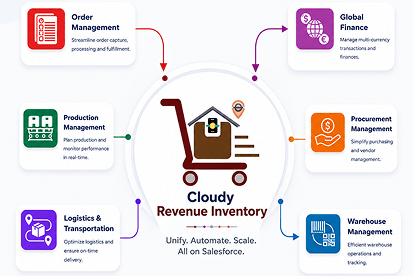
One platform, nine integrated modules, already connected — no integration project required.

Sales & CPQ
Order Management
Subscriptions & Recurring Billing
Procurement + Manufacturing
Inventory Management
Warehouse Management
Logistics & Shipments
Billing & Finance
Analytics & Reporting
100%Salesforce Native
9Integrated Modules
1Source of Truth
Scalability
Open by Design

Connected to the Tools You Already Use

QuickBooksXeroZoho Books StripeAuthorize.NetOpen REST APIs
Trust Layer

Enterprise-Grade Security, Inherited from Salesforce

SOC 2 Type IIISO 27001, 27018, 27017 GDPR & HIPAA ReadyField-Level Encryption Salesforce Shield CompatibleNative Audit Trails

With Cloudy Business Ops 360, security is inherited from Salesforce automatically. With self-hosted Odoo, security posture depends on how you host and maintain it.

Get Started Today

See the Difference for Yourself

Get a personalized walkthrough of Cloudy Business Ops 360 and see how a Salesforce-native operations suite compares to an open-source ERP for your business.

✓ Go live in days✓ From $40/user/month✓ 100% Salesforce Native✓ No servers to host
FAQs

Cloudy Business Ops 360 vs Odoo — Questions, Answered

Yes — for businesses that use Salesforce or want operations unified with their CRM, Cloudy Business Ops 360 is a strong alternative to Odoo. It delivers order management, inventory, warehouse, procurement, manufacturing, logistics, billing, and analytics natively on Salesforce, fully managed, with no servers to host. Odoo remains a great fit for those wanting an open-source, self-hostable ERP with a very broad app library.

Cloudy Business Ops 360 is built 100% natively on Salesforce, so operations and CRM share one data model and one security layer. Odoo is a standalone open-source ERP with its own database and its own CRM app. In short: Cloudy Business Ops 360 lives inside Salesforce; Odoo is a separate platform you configure and host.

On license price, Odoo is among the lowest in the market — Enterprise is roughly $25–$37/user/month and Community is free. Cloudy Business Ops 360 starts at $40/user/month with all modules included. But license price isn't the whole story: for Odoo, implementation, hosting, customization, and support typically make up most of the total cost, while Cloudy Business Ops 360 bundles the managed infrastructure and automatic upgrades into a predictable subscription.

Odoo has its own built-in CRM, so it's usually used as a self-contained suite rather than alongside Salesforce. Connecting Odoo to Salesforce is possible but requires building and maintaining an integration between two separate platforms. Cloudy Business Ops 360 avoids this entirely by running natively inside Salesforce.

No. Cloudy Business Ops 360 runs on Salesforce's fully managed cloud — no servers, patching, or upgrade projects. Odoo offers a managed SaaS option (Odoo Online), but Odoo.sh and self-hosted/Community deployments require you or a partner to handle hosting, maintenance, and version upgrades.

Cloudy Business Ops 360 is configurable out of the box and most businesses go live in under a week. Odoo implementations are typically phased and partner-led, commonly spanning weeks to months depending on modules, data migration, and customization.

It depends on your priorities. Odoo excels at breadth, open-source flexibility, and low license cost — ideal if you have technical resources and want a very wide app footprint. Cloudy Business Ops 360 excels at Salesforce-native unification, fast managed deployment, and predictable pricing — ideal if Salesforce is your system of record.

Cloudy Business Ops 360 has a clear advantage for Salesforce users: it runs natively inside Salesforce, so there's no separate ERP to integrate, no duplicate data, and no second platform to maintain. Your operations and CRM work from the same records in real time.

Odoo offers a broader catalog of apps (50+, including HR, e-commerce, POS, and marketing). Cloudy Business Ops 360 focuses on end-to-end business operations — nine integrated modules covering sales, orders, subscriptions, inventory, warehouse, procurement, manufacturing, logistics, billing, and analytics — all unified with Salesforce CRM. The right choice depends on whether you need maximum app breadth or deep, Salesforce-native operations.

Cloudy Business Ops 360 inherits Salesforce's enterprise trust layer automatically — SOC 2 Type II, ISO 27001/27017/27018, GDPR and HIPAA readiness, encryption, and audit trails. With Odoo, security depends on the deployment: Odoo Online is managed by Odoo, while self-hosted and Community deployments put security responsibility on you or your partner.