
Cloudy Business Ops 360 vs Sage
Unified Operations on Salesforce vs. Best-in-Class Financials You Extend Separately
Sage — especially Sage Intacct — is a highly respected financial management platform. Cloudy Business Ops 360 takes a different approach: a 100% Salesforce-native suite that unifies orders, inventory, procurement, manufacturing, and logistics with your CRM, deploys in days, and uses transparent per-user pricing.
Cloudy Business Ops 360 vs Sage: The Quick Verdict
Choose Sage (Intacct) if…
Your priority is deep, best-in-class financial management — multi-entity consolidation, dimensional accounting, revenue recognition, and (for nonprofits) fund accounting — and you're comfortable running inventory, warehouse, or manufacturing on separate systems that integrate with it.
Choose Cloudy Business Ops 360 if…
You run on (or want) Salesforce and you want unified operations — orders, inventory, procurement, manufacturing, logistics, billing — connected to your CRM in one platform, live in days, with transparent per-user pricing.
The core difference: Sage Intacct is a finance-first platform you extend with other operational systems. Cloudy Business Ops 360 is an operations-first suite built inside Salesforce, with accounting handled through native QuickBooks, Xero, and Zoho Books integration.
Cloudy Business Ops 360 vs Sage at a Glance
| Cloudy Business Ops 360 | Sage (Intacct) | |
|---|---|---|
| Primary strength | Unified operations + CRM | Best-in-class cloud financials |
| Platform | 100% native to Salesforce | Standalone cloud financials |
| CRM + operations | Unified on Salesforce CRM | Not native; integrates via API |
| Native inventory / warehouse / mfg | ✓ Built in | ✗ Not native (integrate separately) |
| Best fit | Product businesses on Salesforce | Finance-led services, SaaS, nonprofits |
| Time to go live | Days to a week | ~2–4 months (Intacct) |
| Pricing model | Transparent per-user | Base platform + per-user + per-module |
| Starting cost | From $40/user/month | Intacct base commonly ~$400+/mo + per-user + modules |
| Deployment options | Salesforce cloud | Intacct (SaaS); X3/100 (cloud or on-prem) |
| Ecosystem | Salesforce AppExchange | Sage Marketplace / API partners |
// "Sage" spans Intacct, Sage 50, Sage 100, Sage X3, and Business Cloud Accounting. This page focuses on Sage Intacct, Sage's flagship cloud financials. Prices are typical 2026 ranges; Sage does not publish a standard list price for Intacct or X3.
The Four Differences That Actually Matter
Full Operations Suite vs. Finance-First Platform
This is the most important distinction. Sage Intacct is a financial management platform — outstanding at general ledger, multi-entity consolidation, dimensional accounting, and revenue recognition. But it does not natively include inventory management, warehouse management, or manufacturing. Organizations that need those typically pair Intacct with a separate operations system or a full ERP.
Cloudy Business Ops 360 is operations-first: order management, real-time multi-location inventory, warehouse and bins, procurement, multi-level BOM manufacturing, and logistics are all built in — and unified with your Salesforce CRM. For accounting, it integrates natively with QuickBooks, Xero, and Zoho Books.
What it means for you: If your need is deep finance and you'll run operations elsewhere, Sage Intacct is excellent. If you need operations and CRM unified in one place — with accounting connected — Cloudy Business Ops 360 covers it without stitching multiple systems together.
Note: Sage X3 is Sage's full operations ERP for manufacturing and distribution — but it's a heavier, longer, higher-cost mid-market ERP, typically a 6–12 month implementation.
Built Inside Salesforce vs. a Standalone Platform
Cloudy Business Ops 360 is built 100% natively on Salesforce. Operations and CRM share one data model, one security layer, and one interface. If your teams already work in Salesforce, your orders, inventory, and procurement now live there too.
Sage products are standalone. Sage Intacct is API-first and integrates well with best-of-breed tools — including Salesforce — but it's a separate platform, so connecting it to your CRM means building and maintaining that integration.
What it means for you: If Salesforce is your system of record, Cloudy Business Ops 360 keeps everything on one platform. Sage's open, API-first design integrates cleanly, but it's still a second system alongside your CRM.
Live in Days vs. a Multi-Month Implementation
Cloudy Business Ops 360 is configurable out of the box, with most businesses live in under a week and no custom development required.
Sage Intacct implementations are typically partner-led and average around 2–4 months (roughly a 90-day project), with implementation cost often running close to 1–1.5× the annual subscription. Sage X3, the operations ERP, runs longer still — commonly 6–12 months.
What it means for you: If you need operational visibility quickly without a project, Cloudy Business Ops 360 is dramatically faster. If you're standing up deep financial consolidation, Sage Intacct's structured implementation is built for that depth.
Transparent Per-User Pricing vs. Base + Users + Modules
Cloudy Business Ops 360 uses transparent, tiered per-user pricing — a Starter plan at $40/user/month, plus Growth and Enterprise tiers — with the operations modules included.
Sage Intacct pricing is quote-based and modular: a base platform fee, per-named-user licenses that vary by role, and add-on modules (project accounting, multi-entity consolidation, revenue recognition, inventory) each priced separately. Sage doesn't publish a standard Intacct price list, so every quote is negotiated, and costs rise as modules are added.
What it means for you: Cloudy Business Ops 360 offers a simpler, more predictable entry point with operations included. Sage Intacct's depth is real, but budgeting requires accounting for base fees, per-role users, and per-module charges.
Feature-by-Feature: Cloudy Business Ops 360 vs Sage
| Capability | Cloudy Business Ops 360 | Sage (Intacct) |
|---|---|---|
| Salesforce-native | ✓ 100% native | ✗ Separate platform |
| Unified with Salesforce CRM | ✓ One data model | ~ Via integration |
| Order management | ✓ Built in | ~ Basic / via add-on |
| Inventory management | ✓ Real-time, multi-location | ~ Add-on module, limited |
| Warehouse management | ✓ Bins, pick-pack-ship | ✗ Not native |
| Procurement & vendors | ✓ PO-to-bill matching | ~ Purchasing available |
| Manufacturing / BOM | ✓ Multi-level BOM, batches | ✗ Not native (see Sage X3) |
| Logistics & shipments | ✓ Carrier tracking, returns | ✗ Not native |
| Accounting / financials | ~ Native + QuickBooks/Xero/Zoho | ✓ Best-in-class, deep |
| Multi-entity consolidation | ~ Multi-entity | ✓ Native, unlimited entities |
| Revenue recognition (ASC 606) | ~ Basic | ✓ Advanced |
| Nonprofit / fund accounting | ✗ Not a focus | ✓ AICPA-endorsed, native |
| Deployment time | ✓ Days | ~ 2–4 months |
| Best for finance-led / nonprofits | ~ Operations focus | ✓ Strong |
When Sage Is the Right Choice — and When Cloudy Business Ops 360 Is
Choose Sage (Intacct) when:
- Deep financial management is your top priority — multi-entity consolidation, dimensional accounting, revenue recognition.
- You're a services, SaaS, or nonprofit organization (Intacct is the AICPA-endorsed, #1 US nonprofit finance system).
- You're comfortable running inventory, warehouse, or manufacturing on separate integrated systems.
- Advanced financial reporting and compliance are central to your ERP decision.
Choose Cloudy Business Ops 360 when:
- You already run on Salesforce (or want to) and want operations unified with your CRM.
- You're a product business that needs inventory, warehouse, procurement, manufacturing, and logistics in one suite.
- You want to go live in days with predictable per-user pricing.
- You'd rather integrate a dedicated accounting tool (QuickBooks, Xero, Zoho Books) than run a separate finance platform.
Not always either/or: some businesses run Cloudy Business Ops 360 for Salesforce-native operations and a dedicated finance system for deep accounting — connected via open REST APIs. And consider Sage X3 if you need a full operations ERP for complex manufacturing or distribution and have the budget and timeline for a larger implementation.
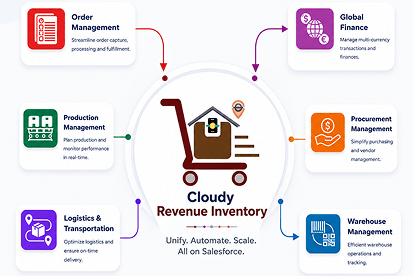
Everything Cloudy Business Ops 360 Runs on Salesforce
One platform, nine integrated modules, already connected — operations and CRM in one place, with accounting integrated.
Connected to the Tools You Already Use
Enterprise-Grade Security, Inherited from Salesforce
With Cloudy Business Ops 360, security is inherited from Salesforce automatically. With Sage, security depends on the product — Intacct is managed by Sage in its own cloud environment.
See the Difference for Yourself
Get a personalized walkthrough of Cloudy Business Ops 360 and see how a Salesforce-native operations suite compares to Sage for your business.
Cloudy Business Ops 360 vs Sage — Questions, Answered
For businesses that need unified operations and CRM, yes. Cloudy Business Ops 360 delivers order management, inventory, warehouse, procurement, manufacturing, logistics, billing, and analytics natively on Salesforce. Sage — especially Sage Intacct — is a finance-first platform, so the two suit different priorities: Cloudy Business Ops 360 for operations on Salesforce, Sage Intacct for deep financial management.
Cloudy Business Ops 360 is an operations-first suite built 100% natively on Salesforce, unifying operations with your CRM. Sage Intacct is a standalone, finance-first platform that excels at accounting and consolidation but doesn't natively include inventory, warehouse, or manufacturing. In short: Cloudy Business Ops 360 leads with operations; Sage Intacct leads with financials.
Most comparisons are with Sage Intacct, Sage's flagship cloud financial management platform. Sage also offers Sage 50 and Sage 100 (accounting/ERP for smaller businesses) and Sage X3 (a full operations ERP for mid-market manufacturing and distribution). Cloudy Business Ops 360 overlaps most with the operations side that Intacct doesn't cover natively, and offers a faster, Salesforce-native alternative to heavier ERPs like Sage X3.
Sage Intacct is primarily a financial management platform and does not natively include full inventory, warehouse, or manufacturing. Organizations needing those typically integrate a separate operations system. Cloudy Business Ops 360 includes real-time inventory, warehouse management, and multi-level BOM manufacturing built in.
Cloudy Business Ops 360 uses transparent per-user pricing starting at $40/user/month with operations modules included. Sage Intacct is quote-based — a base platform fee plus per-role user licenses plus add-on modules — and is negotiated rather than publicly listed, with costs rising as modules are added. Sage X3 is priced higher again as a full operations ERP.
Cloudy Business Ops 360 is configurable out of the box and most businesses go live in under a week. Sage Intacct implementations typically average 2–4 months, while Sage X3 (operations ERP) commonly takes 6–12 months.
Sage Intacct is API-first and integrates with best-of-breed tools including Salesforce, but it remains a separate platform requiring an integration to connect finance with your CRM. Cloudy Business Ops 360 avoids this by running natively inside Salesforce.
It depends on your priority. Sage Intacct is best-in-class for financial management, multi-entity consolidation, and nonprofit fund accounting. Cloudy Business Ops 360 is stronger for unified operations and CRM on Salesforce, and far faster to deploy. Many finance-led organizations choose Intacct; many product businesses on Salesforce choose Cloudy Business Ops 360.
Cloudy Business Ops 360 handles operational billing and finance and integrates natively with QuickBooks, Xero, and Zoho Books for accounting. Sage Intacct offers far deeper native financials — multi-entity consolidation, dimensional GL, and advanced revenue recognition. If deep accounting is your primary need, Sage Intacct is stronger; if operations unified with CRM is the priority, Cloudy Business Ops 360 fits better.
Cloudy Business Ops 360 has a clear advantage for Salesforce users: it runs natively inside Salesforce, so there's no separate platform to integrate for operations, no duplicate data, and one source of truth with your CRM. Sage would run as a separate finance system connected via API.
Explore More Comparisons
Download Company Deck
Thank You!
Your download will begin shortly.
Zoho books
Quickbooks
Shopify
Acumatica
SAP
Odoo
Sage
Agentforce Revenue Management
Agentforce Revenue Management + Billing

Salesforce CPQ
Salesforce Advanced Billing
Migrate from CPQ to Agentforce Revenue Management
Microsoft
Data Cloud
Tableau