
Salesforce Inventory Management | Real-Time Inventory Tracking Native on Salesforce
Business Ops 365 - Salesforce Native ERP

Inventory Management With Cloudy Busness Ops 365

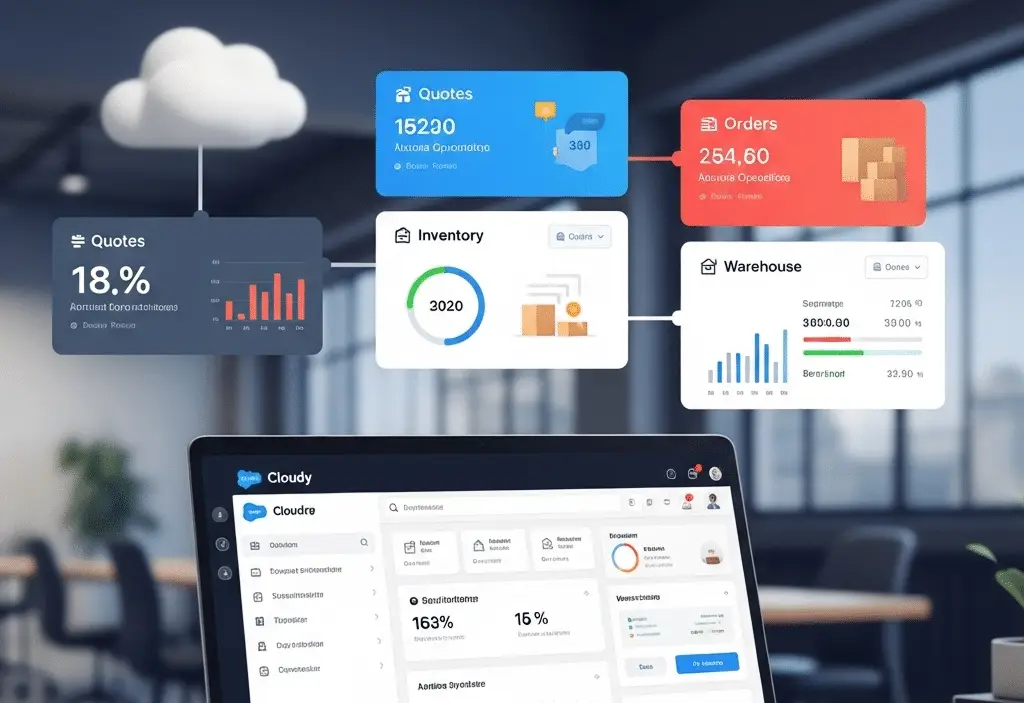
Cloudy Business Ops 365 is a Salesforce-native inventory management platform that helps businesses track inventory across multiple warehouses, automate replenishment, improve inventory accuracy, and optimize order fulfillment in real time. Gain complete inventory visibility from purchase to delivery on a single platform.

99%
Inventory accuracy
40%
Reduction in carrying costs
3×
Faster order fulfillment
500+
Enterprise deployments
Excellence
10+
Years of Salesforce Excellence
Happy Clients
80+
Happy Clients
Success Rate
95%
Implementation Success Rate
Certified
Certified Salesforce
ISV & Consulting
Partner
The Problem

Why Inventory Management Fails in Growing Businesses

Many businesses struggle with inventory management because inventory data is spread across spreadsheets, disconnected systems, and manual processes. Without real-time inventory visibility, businesses experience stockouts, overstocking, fulfillment delays, and inaccurate inventory records that impact revenue and customer satisfaction.

spreadsheet
Spreadsheet Dependency

Manual spreadsheets increase inventory errors and reduce inventory accuracy.

real-time
Zero Real-Time Visibility

Without real-time inventory management, teams make decisions using outdated inventory data.

disconnected
Disconnected ERP & CRM

Disconnected CRM, ERP, and inventory management systems create operational inefficiencies.

out-of-stock
Stockouts & Overstocking

Poor inventory management results in excess inventory or lost sales from stockouts.

reconciliation
Manual Reconciliation

Manual inventory tracking increases errors and slows inventory management processes.

multi-location
Multi-Location Chaos

Managing inventory across locations without visibility causes allocation and fulfillment issues.

delayed
Delayed Fulfillment

Inefficient inventory management slows order processing and delivery timelines.

demand-forecasting
Poor Demand Forecasting

Weak inventory forecasting leads to stockouts and excess inventory costs.

The Solution

One Platform. Complete Inventory Control.

Salesforce Inventory Management brings your CRM data, warehouse operations, and supply chain intelligence into a single, natively connected platform.

real-time-inventory-across-all-locations

Real-Time Inventory Across All Locations

Every stock movement, transfer, and adjustment updates instantly — visible to your entire team, everywhere.

unified-crm-inventory-operations

Unified CRM + Inventory Operations

Sales, service, and warehouse teams work from the same data. Promises made in Salesforce are commitments your warehouse can keep.

ai-driven-replenishment-forecasting

AI-Driven Replenishment & Forecasting

Intelligent demand signals trigger automated reorder workflows before stockouts happen — not after.

mobile-warehouse-access

Mobile Warehouse Access

Receive, pick, count, and transfer inventory from any mobile device — with or without connectivity.

multi-warehouse-lot-tracking

Multi-Warehouse & Lot Tracking

Full lot, batch, and serial number traceability across every warehouse location — from receipt to delivery.

Unified Inventory Flow
🛒
Sales Order Created in Salesforce CRM
Availability checked in real time at quote stage
📋
Inventory Reserved & Fulfillment Triggered
ATP check prevents over-promising
📱
Warehouse Pick-Pack via Mobile App
Barcode scan confirms accuracy
🚚
Shipment Dispatched & Stock Updated
Inventory levels updated across all locations
📊
Analytics & Replenishment AI Fires
Demand signals trigger proactive reorder
Platform Features

Every Feature Your Inventory Operation Needs

Built on Salesforce's enterprise-grade architecture, every capability delivers measurable operational outcomes.

real-time-inventory-visibility

Real-Time Inventory Visibility

See every unit, in every location, at every moment. Live dashboards show on-hand quantities, in-transit stock, reserved inventory, and available-to-promise figures.

✦ Eliminate blind spots that cause stockouts and over-ordering
inventory-tracking-traceability

Inventory Tracking & Traceability

Track every item by lot number, batch, serial number, or expiration date from receipt to customer delivery. Full chain-of-custody visibility for regulated industries.

✦ Meet compliance requirements and quality audit demands
multi-location

Multi-Location Management

Manage stock across unlimited warehouses, distribution centers, and stocking locations. Inter-location transfers, bin-level control, and real-time stock balancing — all unified.

✦ Eliminate multi-warehouse chaos that slows fulfillment
available-to-promise

Available-to-Promise (ATP)

Give your sales team the confidence to commit. ATP calculations factor in current stock, open orders, in-transit inventory, and production schedules.

✦ Reduce order cancellations and customer escalations
automated-replenishment

Automated Replenishment

Replenishment workflows trigger automatically when stock falls below configurable thresholds. POs generated, routed for approval, and sent to suppliers automatically.

✦ Never run out of A-grade inventory again
barcode-serial-tracking

Barcode & Serial Tracking

Mobile barcode scanning for receiving, picking, packing, and cycle counts. Support for 1D, 2D, and QR codes. Serial-level tracking from dock to customer door.

✦ Achieve 99%+ inventory accuracy with scan-to-confirm
demand-forecasting

Demand Forecasting

AI-driven demand signals analyze historical sales, seasonality, lead times, and supplier performance to generate optimized replenishment recommendations.

✦ Reduce excess inventory by up to 35% while improving fill rates
warehouse-optimization

Warehouse Optimization

Slot products intelligently based on velocity and pick frequency. Directed put-away, wave picking, and bin optimization maximize warehouse throughput.

✦ Cut labor costs and improve pick-to-ship cycle times
Salesforce.com_logo

Salesforce Native Architecture

100% native to Salesforce — no middleware, no external databases, no integration overhead. Your inventory data shares security, workflows, and reporting with CRM.

✦ Faster deployment, lower TCO, and better user adoption
Measurable ROI

Outcomes That Show Up on the P&L

These aren't aspirational benchmarks — they're outcomes from real deployments, measured and verified by our customers.

40%
Reduction in Carrying Costs

Smarter replenishment and demand forecasting eliminate excess stock and the capital it ties up.

99%+
Order Accuracy Rate

Scan-to-confirm workflows and serial tracking eliminate pick errors before they reach the customer.

Faster Order Fulfillment

Automated workflows and optimized warehouse processes compress pick-pack-ship timelines dramatically.

35%
Higher Inventory Turns

Right-sized inventory and optimized replenishment cycles mean stock moves faster and costs less to hold.

60%
Fewer Stockout Events

Proactive reorder points and AI-driven demand signals ensure critical SKUs are always available.

25%
Lower Operational Overhead

Automation of manual processes frees your team for higher-value work.

18 Days
Average Go-Live Time

Native Salesforce architecture means faster implementation — no middleware, no complex data migrations.

94%
User Adoption Rate

Teams already in Salesforce adopt naturally — same UI, same workflows, zero learning curve.

Industry Use Cases

Built for Operations That Can't Afford to Get Inventory Wrong

From factory floor to distribution dock, Salesforce Inventory Management adapts to the complexity of your industry.

🏭

Manufacturing

Track raw materials, WIP, and finished goods across production runs. Lot-controlled components, BOM-linked inventory, and production order integration.

BOM IntegrationWIP TrackingLot Control
🩺

Medical Devices

FDA and ISO compliance demands complete traceability. Serial-level tracking, expiration date management, and audit-ready lot history at every shipment.

FDA ComplianceSerial TrackingExpiry Mgmt
⚙️

Industrial Equipment

Manage high-value parts, configure-to-order components, and service inventory for field technicians — linked to Salesforce Service Cloud cases.

Service PartsCTO SupportField Inventory
💡

Electronics & Technology

Short product lifecycles, component shortages, and serialized hardware require precision. Serial tracking and demand forecasting reduce supply chain risk.

Short LifecycleComponent MgmtSupplier Risk
🚛

Wholesale Distribution

High-volume order processing, multi-tier pricing, and complex fulfillment routing across distribution centers. ATP accuracy keeps commitments on track.

High VolumeMulti-DCATP Accuracy
🛒

Consumer Goods

Manage seasonal demand swings, promotional stock builds, and multi-channel fulfillment from a single inventory pool. Demand forecasting prevents the feast-or-famine cycle.

Seasonal DemandOmnichannelForecasting
The Salesforce Advantage

Native on Salesforce. That Changes Everything.

Unlike bolt-on systems that require complex integrations, our solution lives entirely within your Salesforce org — sharing your data model, security, and workflows from day one.

Single Data Model

Inventory, customer, and order data share a unified Salesforce object model. No sync delays, no duplication, no mismatches between systems.

Shared Security & Compliance

Salesforce's enterprise-grade security, role-based permissions, and compliance certifications extend automatically to your inventory data.

No Integration Overhead

Forget middleware, API mapping, and sync jobs. Native architecture means your CRM and inventory share the same database — always in sync.

Unified Reporting Across CRM + Inventory

Build reports spanning sales pipeline, customer orders, and available inventory in a single Salesforce report — something no external system can match.

Faster Deployment & Higher ROI

Native apps deploy in weeks, not months. Lower implementation cost, higher adoption, and no ongoing integration maintenance.

Scales with Your Salesforce Org

As your business grows — new products, warehouses, regions — the platform scales without re-platforming. Add capacity without changing architecture.

🏆

Salesforce AppExchange Certified

Security-reviewed and certified on the Salesforce AppExchange — deployed in regulated industries globally.

Lightning-Ready UI

Built for Salesforce Lightning Experience with a fully responsive, modern interface your team already knows.

🔐

Enterprise Security by Default

SOC 2 Type II, ISO 27001, and GDPR compliance inherited from Salesforce automatically.

🌐

Global Multi-Currency & Multi-Language

Full support for global operations — multiple currencies, languages, and locales out of the box.

🔗

ERP Integration Ready

Pre-built connectors for SAP, Oracle, NetSuite, and Microsoft Dynamics for hybrid architecture.

Comparison

Traditional Inventory vs. Salesforce Native

The architecture decision matters more than the feature list. Here's what native truly means.

Capability Traditional Inventory Systems Salesforce.com_logo Salesforce Native Inventory
Integration ComplexityCustom APIs, middleware, sync jobs requiredZero integration — native to your Salesforce org
Real-Time Visibility~Delayed syncs, batch updates every 15–60 minLive updates across all locations, instantly
CRM AlignmentSales and warehouse operate in silosShared data model — CRM and inventory are one
Scalability~Re-platforming required as business growsScales with Salesforce — no architecture changes
Automation~Limited, often requires custom developmentSalesforce Flow, AI, and Process Builder built in
Reporting & AnalyticsSeparate BI tools, manual data exportsCross-CRM/inventory reports in native Salesforce
Mobile Access~Limited or separate mobile applicationFull functionality via Salesforce mobile app
User ExperienceSeparate login, separate training, separate UISame Salesforce UI your team already uses daily
Security & Compliance~Requires separate security configurationSalesforce enterprise security inherited automatically
Total Cost of OwnershipHigh — integration, maintenance, training compoundLower TCO — no middleware, faster deployment
Clients Feedback

Don't Just Take Our Word for It

logo
Razi Amin
Founder, ASPEN Capital Solutions LLC
Outstanding Support!

Cloudy Wave played a key role in building our complex financial operations with Salesforce ERP software. Their deep technical expertise, combined with a responsive and reliable approach, helped us streamline processes and scale efficiently

logo
Jason Siverman
Founder & Chief Evangelist of BenefitsGuide
Outstanding Support!

Over the past 8 years, Cloudy Wave has consistently delivered exceptional value. Their expertise in Salesforce ERP software, combined with a reliable and forward-thinking approach, has transformed our operations and enhanced our overall business performance.

logo
Robert Smith
Director, Zon Projects Ltd
Outstanding Support!

We’ve partnered with Cloudy Wave for over 8 years, and their expertise in Salesforce ERP software has been exceptional. They consistently deliver high-quality solutions and proactively recommend improvements that have enhanced our operations and customer experience.

GET STARTED TODAY

Your Business Can Run This Well. Let Us Show You How.

See Cloudy Business Ops 360 live with a personalized 30-minute demo built around your operation — no generic slides, no sales theatre.

No commitment required Tailored to your industry Go live in 14 days SOC 2 Type II certified

FAQs

Questions About Salesforce Inventory Management

Inventory Management FAQ – Cloudy Business Ops 360

Inventory management is the process of tracking, controlling, and optimizing inventory across warehouses, distribution centers, and sales channels. Effective inventory management helps businesses maintain accurate stock levels, reduce carrying costs, prevent stockouts, improve order fulfillment, and increase profitability.

Inventory management software helps businesses track inventory levels, monitor inventory movement, automate replenishment, manage warehouses, and improve inventory accuracy. Modern inventory management systems provide real-time inventory visibility, demand forecasting, and reporting from a centralized platform.

Salesforce inventory management refers to inventory management capabilities built natively within the Salesforce platform. Cloudy Business Ops 360 is a Salesforce-native inventory management solution that connects inventory data directly with CRM, sales, warehouse operations, and order management — all within one Salesforce org, with no middleware or external databases required.

Cloudy Business Ops 360 provides end-to-end inventory management built natively on Salesforce. It supports real-time inventory tracking across multiple warehouses, automated replenishment, demand forecasting, barcode and serial number tracking, lot and batch control, available-to-promise calculations, and mobile warehouse access — all connected to CRM, sales orders, and fulfillment workflows on a single platform.

Yes. Cloudy Business Ops 360 automatically updates inventory levels in real time as products are received, transferred, sold, or shipped. Every stock movement — pick, pack, shipment, or adjustment — is reflected instantly across all warehouse locations, giving sales, operations, and fulfillment teams accurate, live inventory data at all times.

Cloudy Business Ops 360 delivers measurable inventory management outcomes verified by customer deployments:

  • 99%+ order accuracy driven by barcode scan-to-confirm workflows
  • 40% reduction in inventory carrying costs through smarter replenishment
  • 3× faster order fulfillment via automated warehouse workflows
  • 35% increase in inventory turns with AI-driven demand forecasting
  • 60% fewer stockout events through proactive reorder points
  • 25% lower operational overhead by eliminating manual inventory processes
  • Average go-live in 18 days due to native Salesforce architecture

Yes. Cloudy Business Ops 360 supports multi-location inventory management across unlimited warehouses, distribution centers, and stocking locations. Businesses can track inventory levels per location in real time, execute inter-location stock transfers, apply bin-level control, and generate location-specific reports — all from a single centralized Salesforce dashboard.

Available-to-promise (ATP) is a real-time inventory calculation that tells sales teams exactly how much stock is available to commit to a customer order, factoring in current on-hand quantities, open sales orders, in-transit inventory, and production schedules.

Cloudy Business Ops 360 provides native ATP calculations that aggregate inventory data across all warehouse locations, enabling sales teams to make accurate delivery commitments, reduce order cancellations, and prevent overselling.

Yes. Cloudy Business Ops 360 includes full barcode and QR code scanning support via the Salesforce mobile app and compatible Bluetooth scanners. Barcode scanning workflows are available for receiving, put-away, picking, packing, inter-location transfers, and cycle counts.

Scan-to-confirm steps eliminate manual data entry errors and are a primary reason Cloudy Business Ops 360 customers achieve 99%+ inventory accuracy rates.

Yes. Cloudy Business Ops 360 provides full lot number, batch, serial number, and expiration date tracking from the point of receipt through to customer delivery. This complete chain-of-custody traceability supports compliance requirements for regulated industries including medical devices, pharmaceuticals, food and beverage, and manufacturing.

Cloudy Business Ops 360 automates inventory replenishment by continuously monitoring stock levels against configurable reorder points and minimum thresholds. When inventory falls below defined levels, the system automatically generates purchase orders, routes them through approval workflows, and sends them to suppliers — without manual intervention.

AI-driven demand forecasting further refines replenishment timing by analyzing historical sales data, seasonality, and supplier lead times, helping businesses reduce excess inventory by up to 35% while maintaining high product availability.

Yes. Cloudy Business Ops 360 includes AI-driven demand forecasting that analyzes historical sales patterns, seasonality, lead times, and supplier performance to generate optimized replenishment recommendations. This helps businesses proactively manage stock levels, reduce costly overstock situations, improve inventory fill rates, and avoid the stockout events that directly impact customer satisfaction and revenue.

Yes. Cloudy Business Ops 360 is purpose-built for manufacturing inventory management. The platform supports raw material tracking, work-in-progress (WIP) inventory, finished goods management, Bill of Materials (BOM) linkage, and lot or batch control across production runs.

Integration with production orders ensures material availability is confirmed before manufacturing begins, preventing production stoppages caused by missing components.

Cloudy Business Ops 360 supports inventory management across a wide range of industries, including:

  • Manufacturing and assembly
  • Wholesale and distribution
  • Retail and eCommerce
  • Consumer goods and CPG
  • Medical devices and healthcare supply
  • Industrial equipment and B2B supply
  • Electronics and technology
  • Logistics and warehousing
  • Trading and import-export
  • Agriculture and agri-supply
  • Automotive and parts

Unlike traditional inventory systems that require custom APIs, middleware, and ongoing integration maintenance, Cloudy Business Ops 360 is built natively on Salesforce — sharing the same data model, security, and workflows as CRM. Key differences include:

  • Zero integration overhead — inventory and CRM share one database
  • Real-time data sync with no batch delays or mismatches
  • Unified CRM and inventory reporting in a single Salesforce report
  • Same Salesforce UI your team already uses — no additional training
  • Faster deployment with lower total cost of ownership
  • Enterprise security inherited automatically from Salesforce

Cloudy Business Ops 360 customers go live with inventory management in an average of 18 days. Because the platform is built natively on Salesforce with no middleware or external databases required, implementation is significantly faster than traditional ERP or standalone inventory systems.

Teams already using Salesforce adopt it naturally — same interface, same login, and a 94% user adoption rate across customer deployments.

Yes. Cloudy Business Ops 360 is entirely cloud-based, built natively on Salesforce with no on-premise infrastructure required. The platform inherits Salesforce's enterprise-grade security including SOC 2 Type II certification, ISO 27001 compliance, GDPR compliance, role-based access controls, and audit trails.

Salesforce's global data center network ensures 99.9% platform uptime, automatic upgrades, and offline mobile capability for warehouse teams operating in areas with intermittent connectivity.