
Cloudy Business Ops 360 vs NetSuite
Two Unified Cloud Platforms — One Built on Salesforce, One a Standalone ERP
NetSuite is a mature, powerful cloud ERP that unifies financials, operations, and CRM in one system. Cloudy Business Ops 360 takes a different route — a 100% Salesforce-native operations suite that unifies orders, inventory, procurement, and finance with your existing Salesforce CRM, deploys in days, and uses transparent per-user pricing.
Cloudy Business Ops 360 vs NetSuite: The Quick Verdict
Choose NetSuite if…
You need a deep, standalone cloud ERP with advanced financials, multi-subsidiary consolidation (OneWorld), and complex global compliance — and you have the budget and timeline for an enterprise-grade implementation and its per-user, per-module pricing.
Choose Cloudy Business Ops 360 if…
You run on (or want) Salesforce and you want unified operations — orders, inventory, procurement, manufacturing, logistics, billing — connected to your CRM, live in days, with predictable per-user pricing and no separate ERP to integrate or maintain.
The core difference: NetSuite is a powerful ERP that replaces or sits beside your CRM. Cloudy Business Ops 360 is built inside Salesforce — one data model with your CRM, one security layer, no middleware, no second platform.
Cloudy Business Ops 360 vs NetSuite at a Glance
| Cloudy Business Ops 360 | NetSuite | |
|---|---|---|
| Platform | 100% native to Salesforce | Standalone Oracle cloud ERP |
| CRM + operations | Unified on Salesforce CRM | Own built-in CRM; separate from Salesforce |
| Best fit | SMB–mid-market on Salesforce | Mid-market to enterprise, finance-led |
| Time to go live | Days to a week | Typically 3–6 months |
| Pricing model | Transparent per-user | Base platform + per-user + per-module (negotiated) |
| Starting cost | From $40/user/month | ~$999+/mo base + ~$99–$199/user/mo + modules |
| Minimum users | No minimum | 10-user minimum (typical) |
| Implementation | Configurable, no coding | Partner-led (SuiteSuccess); 1–3× license fee |
| Multi-subsidiary | Multi-entity supported | OneWorld (add-on, adds cost) |
| Updates | Automatic Salesforce releases | Managed NetSuite upgrades |
| Ecosystem | Salesforce AppExchange | SuiteApps / SuiteCloud |
// Oracle does not publish a public NetSuite price list; figures are typical 2026 negotiated ranges. Total cost of ownership for either platform depends heavily on modules, users, and implementation scope.
Four Ledger Entries Worth Reading Closely
Built Inside Salesforce vs. a Standalone Cloud ERP
Cloudy Business Ops 360 is built 100% natively on Salesforce. Your operations and your CRM share one data model, one security layer, and one interface. If your sales and service teams already work in Salesforce, your orders, inventory, procurement, and finance now live there too — no bridge between systems.
NetSuite is a standalone Oracle cloud ERP with its own database and its own built-in CRM. It's a genuinely unified suite — finance, operations, and CRM in one system — but it's a separate platform from Salesforce. If you use Salesforce for CRM, running NetSuite means either replacing Salesforce or building and maintaining an integration between the two, with the ongoing SuiteTalk/REST connector work that entails.
What it means for you: If Salesforce is your system of record, Cloudy Business Ops 360 keeps everything on one platform. NetSuite's unified suite is powerful, but for Salesforce shops it introduces a second platform to integrate and maintain.
Transparent Per-User Pricing vs. Base + Users + Modules
Cloudy Business Ops 360 uses transparent, tiered per-user pricing: a Starter plan at $40/user/month, plus Growth and Enterprise tiers, with the operations modules included and no minimum user count.
NetSuite pricing has three layered components — a base platform fee (commonly around $999+/month, rising by edition), named-user licenses (typically $99–$199/user/month), and individual add-on modules (WMS, manufacturing, advanced inventory, e-commerce, OneWorld) each priced separately. Oracle does not publish a public price list, so every quote is negotiated, and there's typically a 10-user minimum. Because capabilities are modular, costs can scale quickly as you add modules and users.
What it means for you: Cloudy Business Ops 360 offers a simpler, more predictable entry point. NetSuite offers deep configurability, but budgeting requires accounting for base fees, per-user tiers, per-module charges, and negotiated terms.
Live in Days vs. a Multi-Month Implementation
Cloudy Business Ops 360 is configurable out of the box, with most businesses live in under a week and no custom development required.
NetSuite implementations are partner-led and methodology-driven (Oracle's SuiteSuccess accelerates this), but mid-market rollouts commonly run 3–6 months, and implementation services typically cost 1–3× the annual license fee once data migration, configuration, integrations, and training are included.
What it means for you: If you need operational visibility quickly without a project, Cloudy Business Ops 360 gets you there faster. If you're consolidating complex global financials, NetSuite's structured implementation is built for that depth.
Deep Financial ERP vs. Right-Sized Salesforce-Native Operations
NetSuite shines for finance-led organizations that need advanced accounting, revenue recognition (ASC 606), and multi-subsidiary consolidation across currencies and jurisdictions. That depth is a genuine strength for complex, multi-entity enterprises — and it comes with corresponding cost and complexity.
Cloudy Business Ops 360 is purpose-built for product-driven SMB and mid-market businesses — wholesale and distribution, retail and e-commerce, manufacturing and assembly, trading, and logistics — that want real operational control unified with their CRM, without enterprise-ERP overhead. For accounting, it integrates natively with QuickBooks, Xero, and Zoho Books.
What it means for you: Match the depth to your complexity. NetSuite's advanced financial consolidation is a major advantage if you need it; if you don't, it's cost and complexity you carry without benefit.
Feature-by-Feature: Cloudy Business Ops 360 vs NetSuite
| Capability | Cloudy Business Ops 360 | NetSuite |
|---|---|---|
| Salesforce-native | ✓ 100% native | ✗ Separate platform |
| Unified with Salesforce CRM | ✓ One data model | ~ Via integration |
| Order management | ✓ Built in | ✓ Built in |
| Inventory management | ✓ Real-time, multi-location | ✓ Strong (advanced module) |
| Warehouse management | ✓ Bins, pick-pack-ship | ~ WMS module (add-on) |
| Procurement & vendors | ✓ PO-to-bill matching | ✓ Comprehensive |
| Manufacturing / BOM | ✓ Multi-level BOM, batches | ~ Manufacturing module (add-on) |
| Logistics & shipments | ✓ Carrier tracking, returns | ✓ Available |
| Accounting / financials | ~ Native + QuickBooks/Xero/Zoho | ✓ Deep, enterprise-grade |
| Multi-subsidiary consolidation | ~ Multi-entity | ✓ OneWorld (add-on) |
| Deployment time | ✓ Days | ~ 3–6 months |
| Pricing transparency | ✓ Published per-user | ~ Negotiated, base + modules |
| Minimum users | ✓ None | ~ 10-user minimum |
| No-code configuration | ✓ Clicks-not-code | ~ Partner-led setup |
| Best for finance-led enterprises | ~ Mid-market ceiling | ✓ Strong |
When NetSuite Is the Right Choice — and When Cloudy Business Ops 360 Is
Choose NetSuite when:
- You need a deep, standalone financial ERP with advanced accounting and revenue recognition.
- You operate multiple subsidiaries, currencies, and tax jurisdictions and need consolidation (OneWorld).
- You're finance-led and want ERP, CRM, and e-commerce in one Oracle suite — and don't require Salesforce.
- You have the budget and timeline for an enterprise-grade implementation.
Choose Cloudy Business Ops 360 when:
- You already run on Salesforce (or want to) and want operations unified with your CRM.
- You want predictable per-user pricing with no base-platform or per-module surprises.
- You want to go live in days, not months, with no separate ERP to integrate.
- You're a product business focused on orders, inventory, procurement, manufacturing, and logistics.
Not always either/or: Cloudy Business Ops 360 connects to external systems via open REST APIs, so businesses can integrate specialist tools where it makes sense.
Everything Cloudy Business Ops 360 Runs on Salesforce
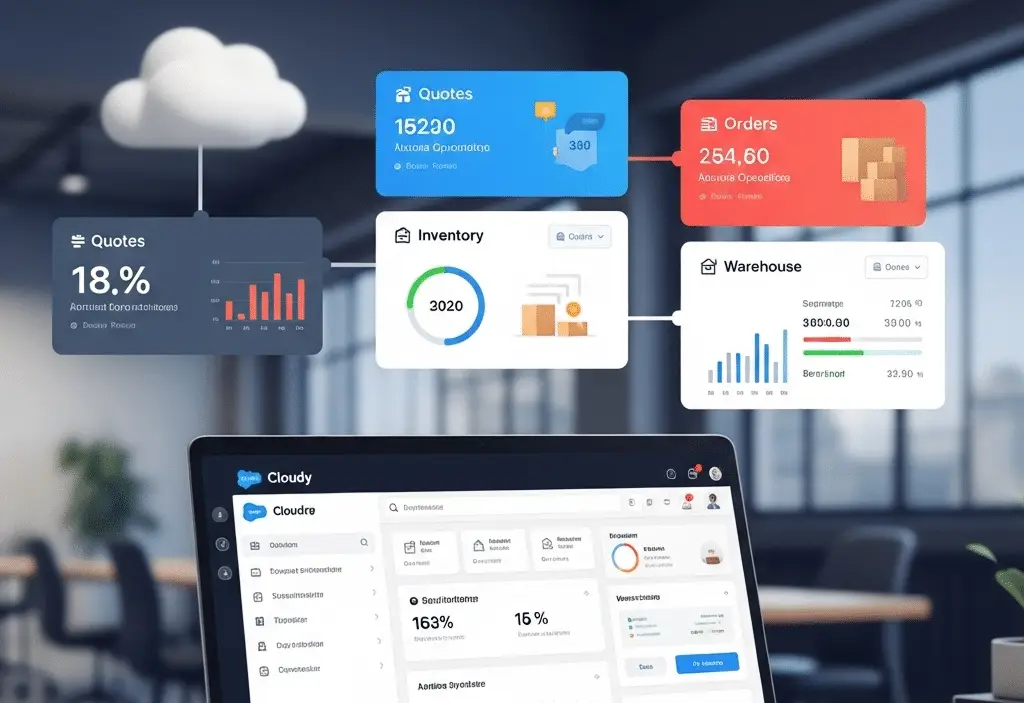
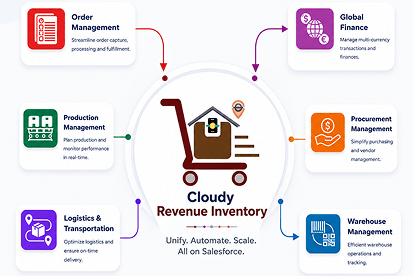
One platform, nine integrated modules, already connected — no integration project required, and all included rather than priced per module.
Connected to the Tools You Already Use
Enterprise-Grade Security, Inherited from Salesforce
With Cloudy Business Ops 360, security is inherited from Salesforce automatically. With NetSuite, security is managed by Oracle within its own standalone environment.
See the Difference for Yourself
Get a personalized walkthrough of Cloudy Business Ops 360 and see how a Salesforce-native operations suite compares to a standalone cloud ERP for your business.
Cloudy Business Ops 360 vs NetSuite — Questions, Answered
Yes — for businesses that use Salesforce or want operations unified with their CRM, Cloudy Business Ops 360 is a strong alternative to NetSuite. It delivers order management, inventory, warehouse, procurement, manufacturing, logistics, billing, and analytics natively on Salesforce, live in days, with predictable per-user pricing. NetSuite remains a strong fit for finance-led organizations wanting a deep, standalone cloud ERP.
Cloudy Business Ops 360 is built 100% natively on Salesforce, so operations and CRM share one data model and one security layer. NetSuite is a standalone Oracle cloud ERP with its own database and its own built-in CRM. In short: Cloudy Business Ops 360 lives inside Salesforce; NetSuite is a separate platform.
Cloudy Business Ops 360 uses transparent per-user pricing starting at $40/user/month with modules included and no minimum users. NetSuite pricing is layered — a base platform fee (commonly around $999+/month), named-user licenses (typically $99–$199/user/month), and individual add-on modules — and is negotiated rather than publicly listed, usually with a 10-user minimum. NetSuite's total cost can scale quickly as modules and users are added.
Cloudy Business Ops 360 is configurable out of the box and most businesses go live in under a week. NetSuite implementations are partner-led and typically take 3–6 months for mid-market rollouts, with implementation services often costing 1–3× the annual license fee.
NetSuite includes its own built-in CRM, so it's usually deployed as a standalone suite rather than alongside Salesforce. Connecting NetSuite to Salesforce is possible but requires building and maintaining an integration between two platforms. Cloudy Business Ops 360 avoids this by running natively inside Salesforce.
It depends on your needs. NetSuite excels at deep financials, revenue recognition, and multi-subsidiary consolidation for finance-led and multi-entity organizations. Cloudy Business Ops 360 excels at Salesforce-native unification, fast managed deployment, and predictable pricing for product businesses on Salesforce. Match the tool to your requirements.
Cloudy Business Ops 360 has a clear advantage for Salesforce users: it runs natively inside Salesforce, so there's no separate ERP to integrate, no duplicate data, and no second platform to maintain. Your operations and CRM work from the same records in real time. With NetSuite, Salesforce shops must either replace Salesforce or integrate the two systems.
NetSuite includes deep, enterprise-grade financials and multi-subsidiary consolidation. Cloudy Business Ops 360 covers operational billing and finance and integrates natively with QuickBooks, Xero, and Zoho Books for accounting. For organizations that need advanced financial consolidation across many entities, NetSuite's financials are deeper; for product businesses that pair operations with a dedicated accounting tool, Cloudy Business Ops 360 fits well.
Cloudy Business Ops 360 has no minimum user count and starts at $40/user/month. NetSuite typically requires a 10-user minimum in addition to its base platform fee, which affects the entry cost for smaller teams.
No. Cloudy Business Ops 360 is a configurable, out-of-the-box solution — no custom development is required to get started, and optional customization is available from Cloudy Wave. NetSuite implementations are generally partner-led and methodology-driven, with configuration, data migration, and integration handled as a project.
Explore More Comparisons
Download Company Deck
Thank You!
Your download will begin shortly.
Zoho books
Quickbooks
Shopify
Acumatica
SAP
Odoo
Sage
Agentforce Revenue Management
Agentforce Revenue Management + Billing


Salesforce CPQ
Salesforce Advanced Billing
Migrate from CPQ to Agentforce Revenue Management
Microsoft
Data Cloud
Tableau