Your sales team closes a deal in Salesforce. Then someone re-keys that same order into a separate accounting system. An invoice goes out late. A payment gets reconciled by hand. Multiply that across thousands of transactions, and you have the silent revenue leak draining mid-market companies every single day.
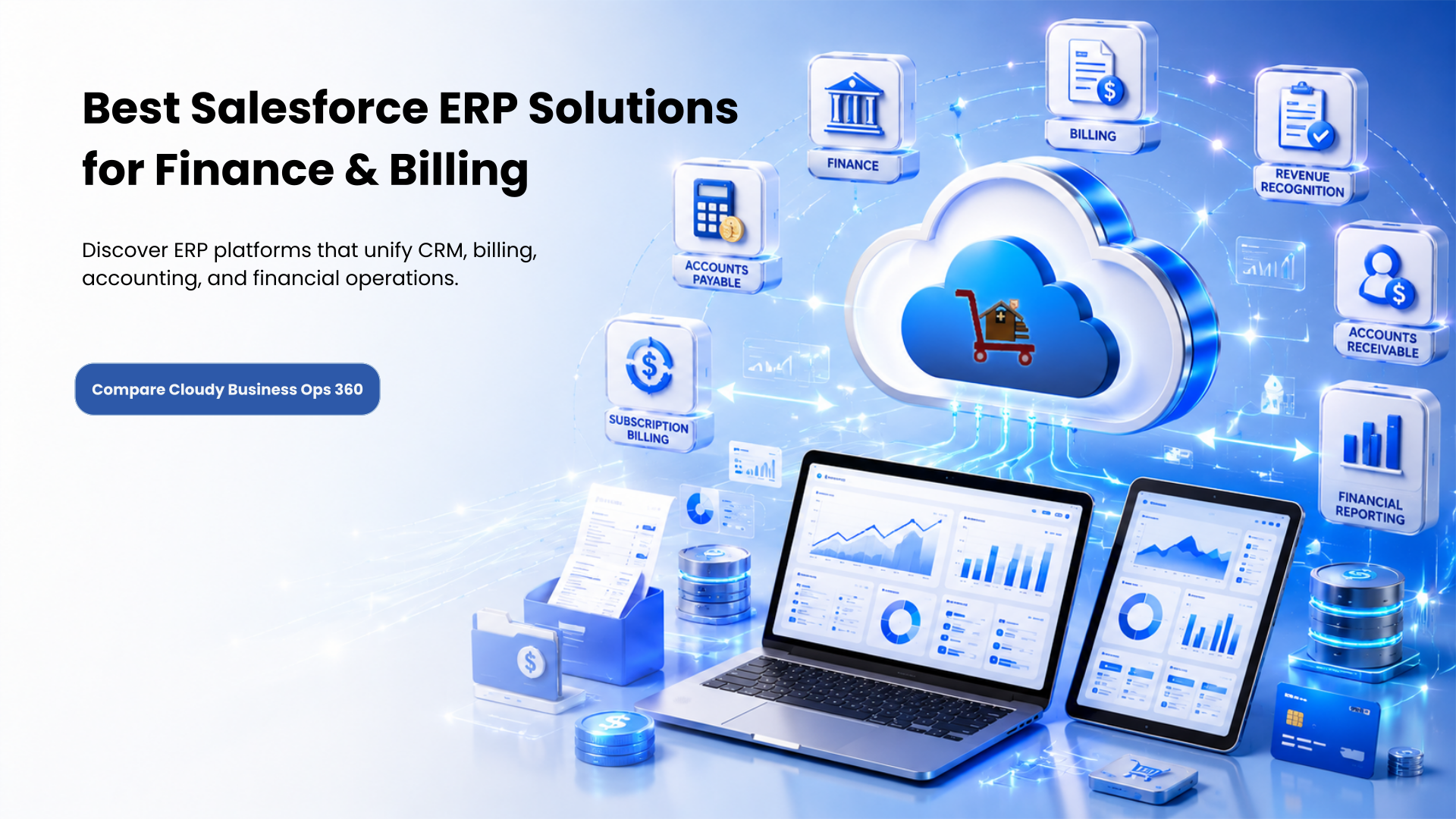
That friction is exactly why the right Salesforce ERP for finance and billing has become a top priority for finance leaders. The global ERP market is projected to grow from roughly $92.6 billion in 2025 to over $106 billion in 2026, according to Fortune Business Insights, and the cloud segment is driving most of that expansion. When your CRM and your books speak the same language, quotes turn into cash faster and your numbers stop contradicting each other.
This guide breaks down the leading platforms — led by all-in-one native suite Cloudy Business Ops 360 — what they cost, who they fit, and how to choose without getting burned.
Why a Salesforce ERP for Finance and Billing Matters
Salesforce is where revenue begins, but it was never built to be a general ledger. Most companies bolt accounting onto it through one of two approaches:
- Native ERPs that live directly inside Salesforce, sharing its data model, security, and interface.
- External ERPs connected through middleware or a third-party connector.
The distinction matters more than buyers expect. With a native Salesforce ERP for finance and billing, sales and finance data already sit in one environment — no syncing, no field mappings breaking overnight. As several 2026 industry comparisons note, teams running their entire revenue cycle through Salesforce tend to favor native platforms precisely to avoid the “someone becomes the unofficial connector babysitter” problem.
A connected Salesforce billing system typically delivers measurable gains:
- Faster order-to-cash — quotes flow straight to invoices.
- Fewer errors — no duplicate manual entry between systems.
- Real-time visibility — finance, sales, and leadership see the same figures.
- Automated revenue recognition — critical for subscription and services models.
The Hidden Cost of Disconnection
Disconnected systems don’t just slow you down — they cost money. Subscriptions can keep billing after cancellation, services get delivered without updated payment details, and reconciliation drags out the monthly close. A unified Salesforce finance platform keeps billing, entitlements, and services in sync, protecting margins that would otherwise quietly evaporate.
How We Evaluated These Platforms
Each option below was assessed on five practical criteria:
- Integration depth — native vs. connector-based
- Finance and billing features — GL, AR/AP, invoicing, revenue recognition
- Pricing transparency
- Ideal company profile
- Scalability
The Top Salesforce-Integrated ERPs for Finance and Billing
🏆 Editor’s Choice: Cloudy Business Ops 360 — Best All-in-One Native Suite
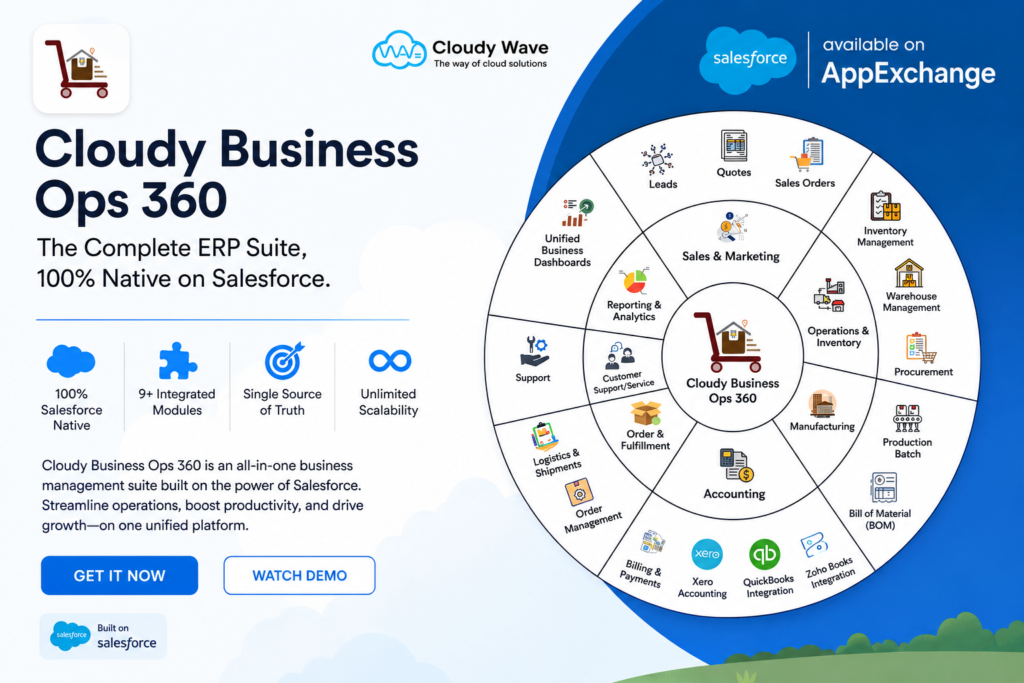
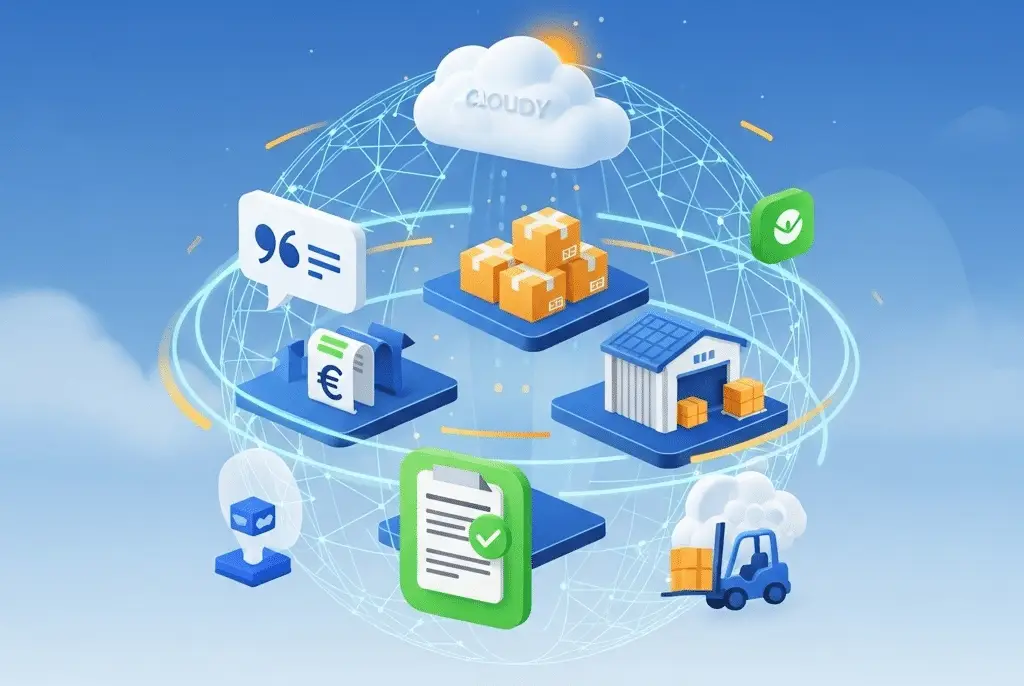
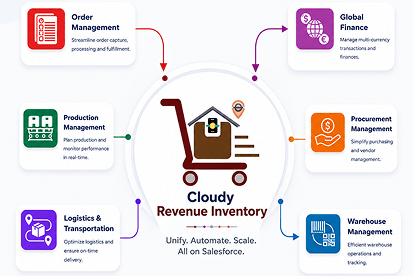
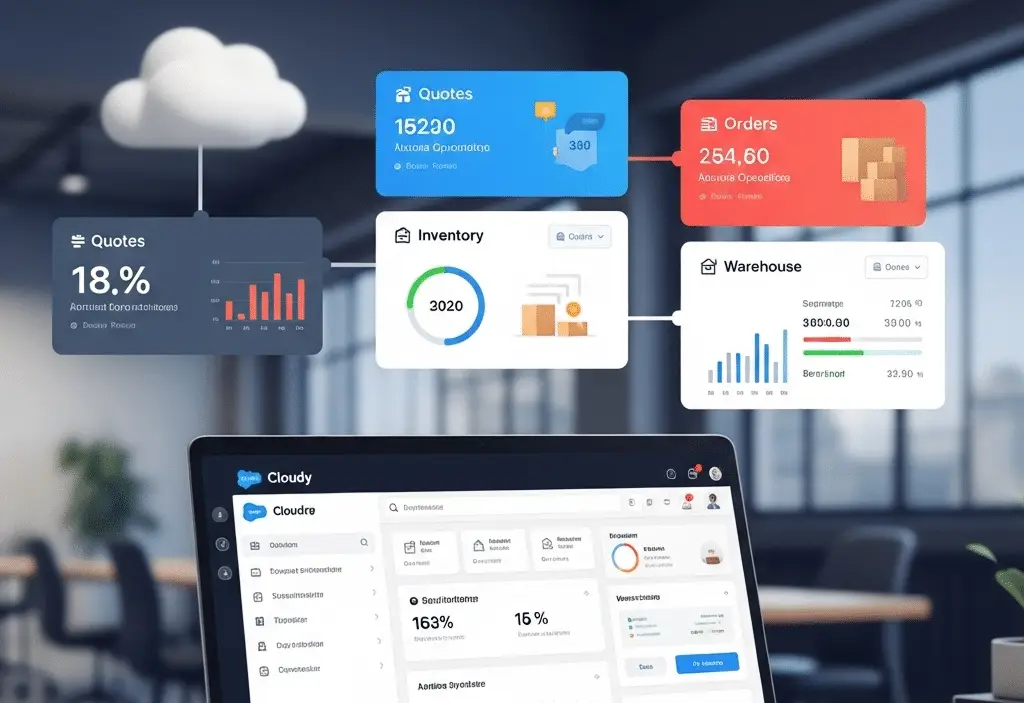
If most platforms on this list solve one slice of the revenue cycle, Cloudy Business Ops 360 by Cloudy Wave aims to solve the whole thing. It’s a 100% Salesforce-native business operations suite that unifies nine integrated modules — from quoting to billing to fulfillment — inside a single source of truth, available on the Salesforce AppExchange.
For finance and billing teams, that means quote, order, inventory, invoice, and payment data all live in one place — no connectors, no duplicate entry, no month-end surprises.
Finance and billing strengths:
- Billing & Finance module — automated invoice creation, flexible billing models, tax compliance and calculations, payment allocation and reconciliation, and multi-currency transactions.
- Subscriptions & Recurring Billing — subscription plans, automated recurring billing schedules, proration, upgrades, renewals, and recurring revenue tracking.
- Sales & CPQ — guided selling, controlled discounts and approvals, multi-currency pricing, and one-click quote-to-order.
- Native accounting sync — direct integrations with Xero, QuickBooks, and Zoho Books for real-time cash flow visibility and faster reconciliation.
The all-in-one advantage: Instead of licensing separate Salesforce apps for CPQ, inventory, warehouse, logistics, and billing — each adding cost and integration overhead — Cloudy Business Ops 360 consolidates them. According to Cloudy Wave’s own customer figures, businesses report 60% faster quote creation, 50% less manual data entry, 40% fewer stock discrepancies, 30% faster fulfillment, and up to 70% reduced license cost by replacing app sprawl with one unified suite.
Pricing: Available via the Salesforce AppExchange — contact Cloudy Wave for a tailored quote or free trial.
Best for: Product-moving and services businesses already on Salesforce — wholesale, distribution, retail, manufacturing, logistics, and subscription-based operations — that want their entire order-to-cash process in one native platform rather than a patchwork of point solutions.
Performance figures above are reported by Cloudy Wave based on customer outcomes; results vary by implementation.
The platforms below are strong, focused alternatives. Here’s how each compares to an all-in-one suite like Cloudy Business Ops 360.
1. Certinia (formerly FinancialForce) — Best Native ERP for Services Firms
Certinia is widely regarded as the leading Salesforce-native PSA and ERP. Founded in 2009 and built directly on the Salesforce platform, it shares the same user interface, security model, and data structure — meaning sales and finance data already live together.
Finance and billing strengths:
- Accounts receivable and payable, general ledger, cash management, and fixed-asset management
- Subscription and usage-based billing with automated recurring revenue tracking
- Built-in project accounting, staffing, and resource management
Pricing: Per-user model starting around $100/user/month, with total implementation costs typically ranging from $100K to $500K depending on scope, per ERP Research’s 2026 analysis.
Best for: Professional services, consulting, and SaaS companies already deep in Salesforce. Independent reviewers caution that organizations without an existing Salesforce footprint face a materially higher adoption burden — so Certinia shines brightest when Salesforce is already your backbone.
2. Accounting Seed — Best Flexible Native Accounting Platform
Accounting Seed is another fully native option, built entirely on the Salesforce platform. While Certinia leans toward broad enterprise operations, Accounting Seed focuses more tightly on accounting and remains one of the strongest choices in 2026 for companies wanting a unified system rather than another app to integrate.
Finance and billing strengths:
- Full general ledger, AR, AP, and financial reporting inside Salesforce
- Flexible, automation-friendly billing workflows
- Native data means no connector maintenance
Best for: Small to mid-sized businesses that want genuine native accounting without the heavier services-and-projects footprint of Certinia.
3. Sage Intacct — Best Deep Financial Management (Connected)
Sage Intacct is the AICPA’s preferred financial management solution, with 19,000+ customers, and it delivers exceptionally deep accounting — multi-entity consolidation, strong compliance, and rich reporting.
The catch: Sage Intacct is not Salesforce-native. It connects to Salesforce through a third-party middleware layer. That connection works, but as multiple 2026 reviews point out, field mappings can break and syncs can fail silently — friction that matters most when your whole revenue cycle runs through Salesforce.
Pricing: Custom quotes only; user reports suggest roughly $10,000–$50,000+ per year depending on scope.
Best for: Service companies and nonprofits that need deep financial management and can accept a connector-based Salesforce billing system rather than a fully native one.
4. Oracle NetSuite — Best Full-Suite ERP for Scaling Companies
NetSuite — the original cloud ERP — offers comprehensive financials, inventory, order management, and procurement in one suite. It connects to Salesforce rather than living inside it, but its breadth is unmatched for fast-growing companies that need more than accounting.
Finance and billing strengths:
- End-to-end financials with SuitePayments built in
- Central pricing management and order-to-cash automation
- Supply chain, CRM, and ecommerce modules
Pricing: Implementations typically run 4–9 months with project budgets in the $100K–$500K range.
Best for: Companies past the SMB stage that have outgrown lightweight accounting and need a full operational ERP alongside Salesforce.
5. QuickBooks & Zoho Books Integrations — Best for Small Businesses
For smaller teams, connecting QuickBooks or Zoho Books to Salesforce via integration tools delivers solid quote-to-cash automation, billing sync, and revenue recognition without enterprise pricing. These work well for businesses that haven’t yet outgrown core accounting and want a cost-effective entry point into a connected Salesforce finance platform.
Comparison Table: Salesforce ERP for Finance and Billing
| Platform | Salesforce Integration | Scope | Best For | Billing Depth |
|---|
| 🏆 Cloudy Business Ops 360 | Native | All-in-one (9 modules) | Product & services ops on Salesforce | High (billing + subscriptions) |
| Certinia | Native | ERP + PSA | Services & SaaS on Salesforce | High (subscription + usage) |
| Accounting Seed | Native | Accounting-focused | SMB native accounting | Medium–High |
| Sage Intacct | Connector | Financials-focused | Deep financials, nonprofits | High |
| Oracle NetSuite | Connector | Full-suite ERP | Scaling full-suite needs | High |
| QuickBooks / Zoho | Connector | Accounting-only | Small businesses | Basic–Medium |
Pricing figures are drawn from ERP Research, DualEntry, and vendor sources as of 2026 and vary by configuration. Always request a tailored quote.
How to Choose the Right Salesforce ERP for Finance and Billing
There’s no universal winner — the best Salesforce ERP for finance and billing depends on your stack, size, and revenue model. Use these questions to narrow the field:
How deep is your Salesforce footprint?
If your teams live in Salesforce daily, a native platform eliminates connector headaches entirely. For the broadest native coverage, an all-in-one suite like Cloudy Business Ops 360 keeps quoting, billing, inventory, and fulfillment together; Certinia and Accounting Seed are excellent native picks for services and accounting respectively. If Salesforce is just one of many systems, a connected ERP like NetSuite or Sage Intacct may serve you well.
What’s your revenue model?
- Project- or services-based? Certinia’s built-in project accounting is hard to beat.
- Subscription-heavy? Prioritize native recurring billing and revenue recognition — Cloudy Business Ops 360 and Certinia both handle this natively.
- Product- and inventory-driven? You need inventory, warehouse, and logistics alongside billing. Cloudy Business Ops 360 covers all of it natively; NetSuite covers it via connector.
What’s your scale — and your runway?
Sage Intacct can start showing strain past roughly $250M in revenue and dozens of entities, where companies often graduate to NetSuite, Dynamics 365, or SAP. Choose a platform that fits where you’ll be in three years, not just today.
Native vs. Connected: The Core Trade-Off
It comes down to a single decision. A native Salesforce ERP for finance and billing gives you one source of truth, zero sync risk, and a unified interface — at the cost of committing to the Salesforce ecosystem. A connected ERP gives you best-in-class financial depth and platform independence — at the cost of ongoing integration maintenance.
Neither is “better.” The right answer is the one that matches how your business actually runs.
Key Takeaways
- A Salesforce ERP for finance and billing closes the costly gap between closing deals and collecting cash.
- All-in-one native suites like Cloudy Business Ops 360 unify the full order-to-cash cycle — billing, subscriptions, inventory, and fulfillment — in one platform, cutting both manual work and app-sprawl licensing costs.
- Focused native platforms (Certinia for services, Accounting Seed for accounting) offer one source of truth and no sync risk.
- Connected ERPs (Sage Intacct, NetSuite) deliver deep or broad financial functionality with more integration upkeep.
- Match the platform to your model: product- and ops-heavy businesses lean Cloudy Business Ops 360, services firms lean Certinia, SMBs lean Accounting Seed or QuickBooks, and large multi-entity scale leans NetSuite.
- With the ERP market surpassing $106 billion in 2026 and cloud driving most growth, choosing the right unified Salesforce finance platform is now a competitive advantage — not just a back-office decision.
If you run a product- or operations-heavy business already on Salesforce, start your shortlist with Cloudy Business Ops 360 for true all-in-one coverage, then benchmark it against one or two focused alternatives. Run a hands-on demo against your real workflows before you commit — your monthly close will thank you. Schedule a live demo or start a free trial at cloudywave.com.





 Salesforce ERP
 ERP + CRM Platform
  Inventory Management
  Warehouse Management
  Order Management
  Vendor Management
  Logistics Management
  BOM Management
  Order Fulfillment
  Business Operations
  SaaS Platform for Operations
  Salesforce Cloud ERP Platform
  Xero
Xero
 Zoho books
 Quickbooks
 Shopify
 Acumatica
 SAP
SAP
 Odoo
Odoo
 NetSuite
 Microsoft Dynamics 365
 Sage
Sage



 Agentforce Revenue Management
 Agentforce Revenue Management + Billing
  Salesforce CPQ
 Salesforce Advanced Billing
  Migrate from CPQ to ARM
  Managed Services
 Salesforce Implementation
 Revenue Cloud Implementation
 MuleSoft Integration
 Microsoft
 Data Cloud
 Tableau
 ·
June 19, 2026
·
10 min read
·
June 19, 2026
·
10 min read