What Is Agentforce Revenue Management? A Complete Guide for Salesforce CPQ Customers
By Saurabh Wankhede·July 24, 2026·18 min read
Not Sure Whether to Migrate, Wait, or Pilot?
Get a clear, unbiased read on where your Salesforce CPQ implementation stands against the Agentforce Revenue Management architecture — before you commit budget or timeline
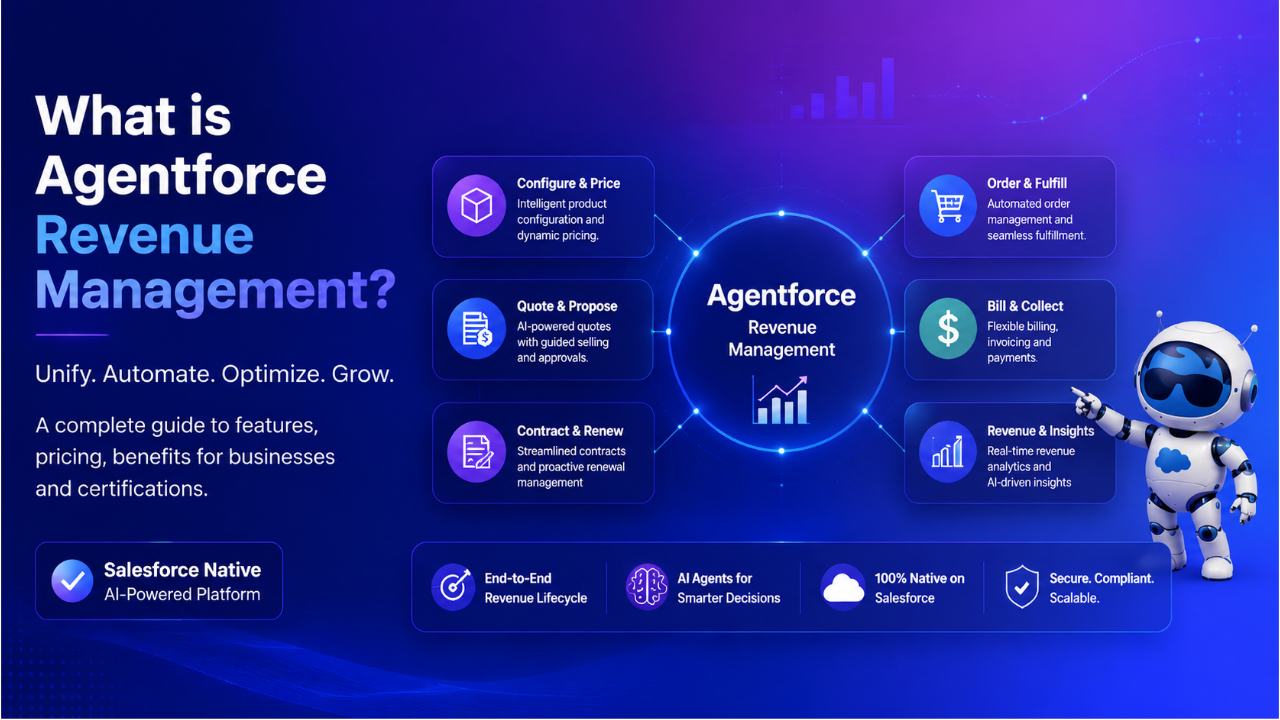
Agentforce Revenue Management is Salesforce’s AI-agent-enabled revenue lifecycle platform, built natively on core Salesforce objects, that unifies product configuration, pricing, quoting, contracts, orders, billing, and renewals into a single data model. It is the current name for the product line that started as Revenue Cloud, was renamed Revenue Lifecycle Management (RLM) in Spring ’24, evolved into Revenue Cloud Advanced (RCA), and was rebranded again at Dreamforce 2025 as Agentforce Revenue Management (ARM). Salesforce CPQ entered End of Sale in March 2025 — it is not discontinued, but it is no longer sold to new customers and receives no new feature investment. Existing CPQ customers can continue renewing and receiving support; migration is a strategic decision, not an emergency.
Key takeaways:
Agentforce Revenue Management (ARM) = the evolution of Salesforce Revenue Cloud, now built natively on core Salesforce Platform objects rather than as a bolt-on managed package.
Salesforce CPQ is End of Sale (March 2025), not End of Life. No official EOL date has been published.
ARM adds Agentforce AI agents, Data Cloud integration, and a constraint-based Advanced Configurator on top of what Revenue Cloud already delivered.
Migration is a multi-quarter architectural project, not a license upgrade — plan deliberately rather than reactively.
Why Everyone Is Talking About Agentforce Revenue Management
Agentforce Revenue Management is generating attention because it represents Salesforce’s fourth naming iteration of the same underlying strategy: move revenue operations off a legacy managed package and onto a native, AI-agent-ready platform. The renaming pattern — Revenue Cloud, then Revenue Lifecycle Management, then Revenue Cloud Advanced, then Agentforce Revenue Management — signals both product maturity and a deliberate repositioning inside Salesforce’s broader Agentforce and AI narrative introduced at Dreamforce 2025.
For CPQ customers, the noise matters because it coincides with a real inflection point: Salesforce CPQ’s March 2025 End of Sale announcement. That timing is not coincidental. Salesforce is simultaneously retiring new sales of the legacy managed package and pushing its go-forward architecture into the market as an AI-native platform, not just a quoting tool. The broader market shift toward AI-powered revenue operations — where agents assist with pricing decisions, approval reasoning, contract review, and renewal forecasting — is the backdrop against which this renaming makes sense. Analyst firms such as Gartner and Forrester have both written about the shift from static CPQ toward agent-assisted Revenue Lifecycle Management (RLM) as a category, and Salesforce’s rebrand is its answer to that category shift.
For architects and RevOps leaders, the practical question isn’t “why did they rename it again,” but “does the underlying architecture change enough to justify a migration project.” It does — and the rest of this guide unpacks exactly what changed, what stayed the same, and how to sequence a decision.
What Is Agentforce Revenue Management?
Agentforce Revenue Management (ARM) is Salesforce’s unified revenue lifecycle platform that combines product configuration, pricing, quoting, contracting, order management, billing, and renewals on native Salesforce Platform objects, with Agentforce AI agents and Data Cloud embedded throughout. Unlike legacy Salesforce CPQ, which ran as an external managed package with its own object model, ARM is built directly on core CRM objects, giving AI agents a single, unfragmented view of pricing, contract, asset, and usage data.
Definition and Architecture
ARM’s architecture is the single biggest technical distinction from Salesforce CPQ. Legacy CPQ (originally SteelBrick, acquired by Salesforce in 2015) stored its quoting, pricing, and configuration data in a separate managed-package object model layered on top of core Salesforce objects like Opportunity and Account. That separation created integration friction, governor-limit tension, and — critically for the AI era — data fragmentation that made it difficult for an AI agent to reason across pricing, contracts, and assets simultaneously.
ARM eliminates that separation. It runs on native Salesforce objects and “pricing procedures,” directly connected to Data Cloud for unified customer data and to Agentforce for autonomous and assisted actions. The result is a platform where an AI agent can see product, price, contract, asset, and usage information in one data model rather than stitching it together across systems.
Purpose and Core Capabilities
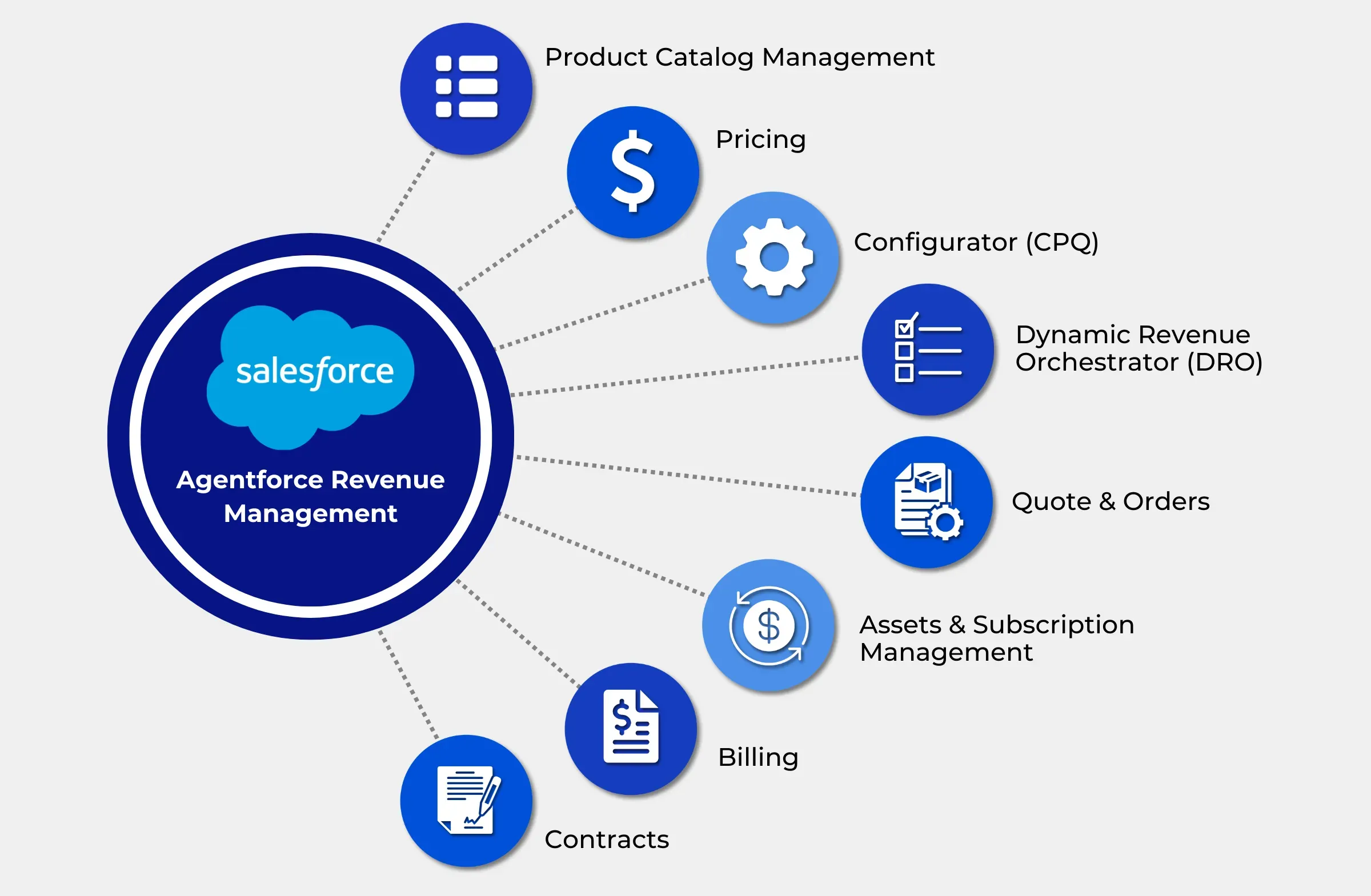
ARM’s stated purpose is to manage the complete revenue lifecycle — not just the sales-side quoting motion that CPQ historically owned. Core capabilities include:
Product Catalog Management — a centralized, API-first catalog spanning goods, services, subscriptions, and usage-based offers.
Advanced Configuration — a constraint-based configurator (rather than CPQ’s rule-based configuration engine) for complex bundles and dependencies.
Dynamic Pricing — pricing procedures that support hybrid pricing models (one-time, subscription, and consumption pricing) in a single quote.
AI Quoting and Guided Selling — Agentforce-assisted quote generation, summarization, and next-best-action recommendations.
Order Management and Orchestration — converting quotes to orders with downstream fulfillment and billing handoffs.
Subscription and Usage-Based Billing — native billing capabilities for recurring and consumption-based revenue models.
Revenue Recognition and Analytics — structured revenue data that supports forecasting and recognition without manual reconciliation.
Business Value and How It Differs from Traditional CPQ
The business value proposition centers on three things Salesforce CPQ customers consistently cite as pain points: fragmented data across CPQ, billing, and contract systems; configuration rule sets that become unmanageable at scale; and an inability to apply AI meaningfully because the underlying data model wasn’t built for it. ARM’s native architecture, unified catalog, and embedded Agentforce agents are Salesforce’s direct response to those three pain points. The difference from traditional CPQ, in short, is architectural (native vs. managed package), scope (full revenue lifecycle vs. quote-to-order), and intelligence (embedded AI agents vs. rules engines).
Is Salesforce CPQ Going Away?
No — not immediately, and Salesforce has not published an End of Life date. Salesforce CPQ entered End of Sale (EOS) on March 27, 2025 (Salesforce first signaled this in communications dating to late 2023). End of Sale means Salesforce stopped selling new CPQ licenses. It does not mean the product stopped working, stopped being supported, or that existing customers must migrate on any forced timeline.
What End of Sale Actually Means
Status
What It Means for You
New licenses
No longer available for purchase by new customers
Existing licenses
Can be renewed under current contract terms
Support
Continues; Salesforce provides ongoing support for existing implementations
New features
None — CPQ is in maintenance mode with no further feature investment
Bug fixes
Continue, though the pace of non-critical fixes has slowed industry-wide
End of Life date
Not yet announced publicly by Salesforce
Clarifying the Misconceptions
The most persistent misconception is that “End of Sale” equals “End of Life.” Salesforce’s own guidance distinguishes the two explicitly: existing CPQ customers keep support and renewal rights, and there is no forced migration to Agentforce Revenue Management. What has changed is where Salesforce is putting its engineering investment — that investment is now directed at Agentforce Revenue Management (formerly Revenue Cloud Advanced), not legacy CPQ.
Industry analysts, extrapolating from typical enterprise software retirement patterns and historical CPQ managed-package precedent (Salesforce required upgrades to more recent CPQ package versions starting November 2020), generally expect a multi-year runway — commonly cited estimates put a plausible End of Life window in the 2029–2030 range — but this is analyst projection, not an official Salesforce commitment. Treat any specific EOL date you see as an estimate, and verify current status directly against Salesforce’s official CPQ End-of-Sale communications before making budget decisions.
Bottom line: current CPQ customers have room to plan deliberately. The urgency isn’t “migrate before it breaks” — it’s “don’t let three or four more years pass without a plan,” because the talent pool and partner ecosystem supporting legacy CPQ will continue to shrink as investment shifts toward ARM.
Why Salesforce Built Agentforce Revenue Management
Salesforce built Agentforce Revenue Management to solve structural problems that CPQ’s managed-package architecture could not fix: fragmented data across quoting, billing, and contracts; configuration rule sets that don’t scale; and an inability to embed AI agents meaningfully into a system where pricing, contract, and asset data live in separate silos.
Specific business drivers include:
Complex, hybrid pricing. Modern B2B revenue models blend one-time, subscription, and usage-based (consumption) pricing in the same deal — something CPQ’s rule engine was never architected to handle cleanly.
Manual approval bottlenecks. Discount and pricing approvals in legacy CPQ are largely rule-based and manual; AI-assisted risk detection can flag anomalies before a human approver even opens the quote.
Long sales cycles. Configuration complexity and back-and-forth approvals slow deal velocity, especially for enterprise deals with multi-tier bundles.
Subscription business model growth. More CPQ customers now run recurring-revenue businesses than when CPQ was originally built for one-time transactional selling.
Usage-based and consumption pricing. Metering, rating, and billing for consumption models sit outside CPQ’s native capability and historically required third-party billing tools.
Global, multi-catalog complexity. Enterprises selling across regions, currencies, and channels need a single governed catalog, not multiple disconnected price books.
Revenue leakage. Disconnected quoting, contracting, and billing systems create reconciliation gaps where revenue is under-recognized or mis-recognized.
The AI transformation mandate. Salesforce’s broader corporate strategy is organized around Agentforce; revenue operations is one of the highest-value surfaces for agentic AI because pricing, approvals, and renewals are decision-heavy, data-rich workflows.
Salesforce CPQ vs. Agentforce Revenue Management
Salesforce CPQ and Agentforce Revenue Management differ primarily in architecture (managed package vs. native platform), scope (quote-to-order vs. full quote-to-cash), and intelligence (rules engine vs. embedded AI agents). The table below compares both across the dimensions that matter most to architects planning a transition.
Dimension
Salesforce CPQ
Agentforce Revenue Management
Architecture
Managed package, separate object model
Native Salesforce Platform objects
Configuration
Rule-based configuration engine
Constraint-based Advanced Configurator
Pricing
Static price rules, price books
Dynamic pricing procedures, hybrid pricing support
Quote generation
Manual/template-based quote documents
AI-assisted and natural-language quote generation
Guided selling
Configurable guided selling flows
AI-recommended guided selling paths
AI assistance
Limited (Einstein add-ons, bolt-on)
Native Agentforce agents throughout the lifecycle
Contracts
Contract objects tied to Opportunity/Quote
Native Contract Lifecycle Management with AI summaries
Orders
Order object, manual orchestration
Real-time order orchestration
Billing
Requires Salesforce Billing or third-party add-on
Native subscription and usage billing
Renewals
Manual renewal opportunity creation
Predictive renewal intelligence and AI recommendations
Asset management
Asset object tracking, largely manual
Unified asset lifecycle tied to subscriptions and usage
Usage-based pricing
Not natively supported
Native consumption/usage pricing support
Revenue recognition
External/manual reconciliation
Structured, native revenue recognition data
Automation
Flow/Apex-based automation
Native automation plus agentic workflows
Data model
Fragmented from core CRM objects
Unified with core CRM objects
User experience
Classic CPQ quote line editor
Modernized, AI-assisted UI
Data Cloud integration
Limited/indirect
Native, direct integration
Agentforce integration
Not native
Core design principle
Analytics
Reports/Dashboards on CPQ objects
Embedded revenue and margin analytics
Scalability
Governor-limit constraints at high volume/complexity
Designed for native-platform scale
Future roadmap
End of Sale; maintenance mode only
Active investment and feature development
How Agentforce Improves Every CPQ Process
Agentforce Revenue Management applies AI assistance at each stage of the traditional CPQ workflow — from product discovery through revenue forecasting — rather than only at the point of quote generation. Here’s what changes stage by stage.
Product Discovery
AI recommends products and bundles based on account history, industry, and Data Cloud signals, reducing the manual product-selection work sales reps previously did inside the CPQ line editor.
Product Configuration
The Advanced Configurator replaces CPQ’s rule-based validation with constraint-based logic, enabling faster, more accurate validation of complex bundles and reducing the rule-maintenance burden on administrators.
Pricing
Dynamic pricing procedures support intelligent discount guardrails and AI-generated pricing recommendations, replacing static price rules with context-aware pricing logic that can account for deal size, competitive pressure, and margin targets.
Quote Creation
Reps can generate quotes using natural-language prompts, with Agentforce producing AI-generated summaries and automatically formatted quote documents — reducing manual quote-building time.
Quote Approvals
AI-assisted approval workflows can flag discount risk and unusual pricing patterns before routing to human approvers, shortening approval cycles for low-risk quotes while surfacing genuinely risky ones faster.
Contracts
AI-generated contract summaries and clause recommendations speed up legal and sales review, while renewal triggers are surfaced automatically rather than requiring manual tracking.
Orders
Real-time order orchestration replaces the more manual, batch-style order processing common in legacy CPQ implementations.
Billing
Native subscription and usage-based billing removes the need for a separate Salesforce Billing package or third-party billing tool for many use cases, simplifying the quote-to-invoice handoff.
Renewals
Predictive renewal intelligence flags at-risk accounts and surfaces upsell/cross-sell recommendations ahead of the renewal date, rather than relying on a rep to remember to create a renewal opportunity.
Revenue Forecasting
Because pricing, contract, and usage data live in one model, AI-driven forecasting can pull structured revenue data directly rather than relying on manual roll-ups from disconnected systems.
AI Features CPQ Customers Will Notice First
CPQ customers evaluating ARM typically care most about a specific set of AI capabilities:
Agentforce agents embedded directly in the quoting and approval workflow, not bolted on as a separate Einstein feature.
Generative AI quote summarization — plain-language summaries of complex, multi-line quotes for both reps and buyers.
Autonomous and semi-autonomous workflows — agents that can take approved actions (e.g., routing an approval, generating a renewal quote) rather than only recommending them.
Predictive recommendations for cross-sell, upsell, and next-best-action at the quote and renewal stages.
Natural language interactions — configuring or updating a quote through conversational prompts rather than manual line-item editing.
AI-generated customer-facing emails tied to quotes, renewals, and contract milestones.
Pricing recommendations that account for deal context rather than static price books alone.
How Quote-to-Cash Changes
The Quote-to-Cash (Q2C) lifecycle stages themselves don’t change under Agentforce Revenue Management — Lead, Opportunity, Configuration, Pricing, Quote, Approval, Contract, Order, Billing, Revenue, and Renewal remain the same conceptual flow — but AI assistance and native data unification touch nearly every stage.
Approval: AI risk detection accelerates low-risk approvals.
Contract: AI summarization and clause recommendations.
Order: Real-time orchestration instead of batch processing.
Billing: Native subscription and usage billing.
Revenue: Structured recognition data feeds forecasting directly.
Renewal: Predictive intelligence surfaces risk and expansion opportunity automatically.
The net effect for RevOps leaders: the stages of Q2C are unchanged, but the effort required at each stage — and the data trust available to finance and forecasting teams — improves materially when the underlying platform is unified.
Top Benefits for Existing CPQ Customers
#
Benefit
1
Single data model across quoting, contracts, billing, and revenue
2
Native AI agents instead of bolt-on Einstein features
Centralized, API-first product catalog across channels
15
Better support for global, multi-currency, multi-catalog selling
16
Embedded margin and revenue analytics
17
Ongoing Salesforce investment and roadmap (vs. CPQ’s frozen state)
18
Tighter alignment between sales, finance, and RevOps data
19
Foundation for future agentic automation across the full lifecycle
20
Long-term reduction in technical debt vs. staying on a frozen managed package
Should You Migrate Now?
Whether to migrate now depends on your subscription-revenue complexity, current CPQ customization depth, and AI readiness — not on urgency created by the End of Sale announcement alone. There is no forced migration deadline today.
Decision Matrix
Your Situation
Recommendation
Heavy usage-based or hybrid pricing needs, growing subscription book
Migrate now — ARM’s native billing and pricing capabilities directly address current pain
Wait and evaluate — migration complexity is high; benefit may be lower near-term
Enterprise scale with multi-catalog, multi-region complexity
Evaluate now, plan a phased migration — architecture benefits are significant but implementation is non-trivial
Small/simple CPQ footprint, low customization
Evaluate, but no urgency — a lighter-weight migration is realistic when ready
Strategic AI investment already underway elsewhere in the org
Migrate now — ARM is the platform where that AI investment compounds inside revenue operations
Recently completed or mid-way through a CPQ implementation
Wait — let the current investment mature before re-platforming
Factors to Weigh
Implementation complexity of your current CPQ instance (custom rules, integrations, Apex triggers).
Degree of customization — heavily customized orgs face longer migration timelines.
Subscription/usage-based revenue exposure — organizations with meaningful recurring or consumption revenue benefit most from ARM’s native billing.
Enterprise scale — larger, multi-catalog organizations see bigger architectural payoff but larger project scope.
AI readiness — whether the organization has the data governance and change-management maturity to adopt agentic workflows.
Business priorities — whether revenue operations modernization is a current strategic priority or a lower-order concern this fiscal year.
Migration Best Practices
A CPQ-to-ARM migration should be treated as a revenue architecture project, not a license upgrade — the object model, configuration logic, and pricing structure all change.
Migration Checklist
Discovery — Inventory current CPQ objects, custom fields, rules, and integrations.
Data cleanup — Audit product, pricing, and account data quality before migrating.
Product catalog review — Rationalize and restructure the catalog for the new constraint-based configurator.
Pricing rule audit — Map existing price rules to new dynamic pricing procedures.
Integration inventory — Identify every system integrated with CPQ (billing, CLM, ERP touchpoints) and plan re-integration.
Sandbox testing — Validate configuration, pricing, and approval logic in a full sandbox before cutover.
User acceptance testing — Involve sales, RevOps, and finance stakeholders directly.
Training — Budget real time for rep and admin training; the UI and configuration paradigm both change.
Change management — Communicate the “why” to sales teams early; configuration paradigm shifts affect daily workflow.
Phased rollout — Consider a phased cutover (by business unit or product line) rather than a single big-bang migration.
Post-migration monitoring — Track quote cycle time, approval time, and data integrity metrics after go-live.
Common Myths, Corrected
“Salesforce CPQ is dead.” False. CPQ is End of Sale, not End of Life. Existing customers retain support and renewal rights, and no official EOL date has been published.
“I have to migrate immediately.” False. There is no forced migration timeline. Migration should be driven by business need and AI readiness, not by the EOS announcement alone.
“Agentforce only adds AI on top of CPQ.” False. Agentforce Revenue Management is a different underlying architecture — native Salesforce Platform objects, a new configurator, native billing, and native Data Cloud/Agentforce integration — not just an AI layer bolted onto existing CPQ.
“My implementation will automatically upgrade.” False. There is no automatic, in-place upgrade path from legacy CPQ to Agentforce Revenue Management. It requires a planned implementation project, similar in scope to a net-new revenue platform rollout.
The Future of Quote-to-Cash
Looking ahead, expect AI agents to take on progressively more autonomous roles across pricing (recommending and eventually setting bounded discount ranges), approvals (auto-approving low-risk quotes within policy), contracts (drafting and redlining routine clauses), and revenue forecasting (continuously updated forecasts drawn from live pricing and usage data rather than periodic manual roll-ups). Sales productivity gains will likely come less from faster manual quoting and more from reduced administrative overhead — reps spending less time navigating configuration rules and more time on customer conversations. On the customer experience side, expect more self-service and partner-facing quoting experiences powered by the same underlying catalog and pricing engine used internally, reducing the quote-to-cash friction that has historically slowed down B2B buying.
Conclusion
Agentforce Revenue Management represents a genuine architectural evolution — not just a marketing rebrand — of Salesforce’s revenue platform strategy. For existing Salesforce CPQ customers, the practical reality is straightforward: CPQ is supported and renewable today, with no published End of Life date, so there is no need to panic-migrate. At the same time, all of Salesforce’s forward investment — native architecture, embedded Agentforce agents, Data Cloud integration, and unified billing — is going into ARM, not CPQ.
The right next step is an honest internal evaluation: assess your subscription and usage-revenue complexity, the depth of your current CPQ customization, and how central AI-driven revenue operations are to your broader business strategy. Organizations with significant hybrid pricing needs or a strong AI mandate should start evaluating and piloting now. Organizations with simpler, stable CPQ implementations can plan on a longer runway — but should not ignore the shift entirely, given the ecosystem’s gradual move away from legacy CPQ expertise and investment. Either way, treat this as a deliberate architecture decision, grounded in your own business goals rather than the pace of Salesforce’s rebranding cycle.
Your CPQ Is Frozen. Your Competitors Aren't Waiting.
While legacy CPQ sits in maintenance mode, teams on Agentforce Revenue Management are already quoting faster, closing hybrid pricing deals, and putting AI agents to work across the revenue lifecycle. See what you're leaving on the table.
Agentforce Revenue Management is Salesforce's native, AI-agent-enabled platform for managing the full revenue lifecycle - product configuration, pricing, quoting, contracts, orders, billing, and renewals — built on core Salesforce Platform objects.
No. Salesforce CPQ is in End of Sale status (since March 2025), meaning it's no longer sold to new customers, but existing customers retain support and can renew licenses. No End of Life date has been announced.
It depends on your subscription/usage revenue complexity, current CPQ customization, and AI strategy. There's no forced deadline — treat it as a strategic evaluation, not an emergency.
It is Salesforce's designated successor platform, but it does not automatically replace an existing CPQ implementation. Migration requires a deliberate project.
Native architecture (vs. managed package), a constraint-based configurator, native subscription/usage billing, embedded Agentforce AI agents, and direct Data Cloud integration.
They continue to function and receive support under existing contract terms; they simply stop receiving new feature investment.
Through natural-language quote generation, AI-generated summaries, dynamic pricing recommendations, and AI-assisted approval risk detection.
It's the current branding for the same underlying platform lineage — Revenue Cloud → Revenue Lifecycle Management → Revenue Cloud Advanced → Agentforce Revenue Management.
RLM was the name Salesforce used briefly starting Spring '24 for what is now branded Agentforce Revenue Management; the term still appears in some documentation and analyst commentary.
In most cases, yes — the catalog and configuration logic need to be restructured for the constraint-based configurator, even if the underlying product data can be reused.
Organizations commonly run a phased migration by business unit or product line, but this requires careful data-model and integration planning rather than a simple parallel run.
It's ARM's constraint-based product configuration engine, replacing CPQ's rule-based configuration approach, designed to handle complex bundles with less manual rule maintenance.
Yes — native subscription and usage-based billing are core capabilities, reducing dependence on a separate billing package for many use cases.
Data Cloud provides the unified customer data layer that Agentforce AI agents draw on for context — account history, engagement signals, and usage data — when making pricing, quoting, and renewal recommendations.
Start with an internal discovery and evaluation: audit your current CPQ customization, subscription/usage revenue exposure, and AI strategy, then benchmark that against the decision matrix in this guide before committing to a timeline.
Saurabh Wankhede
Content Strategist
Share This Post
See How Other CPQ Customers Are Deciding
Join a community of Salesforce Admins, Architects, and RevOps leaders sharing real migration timelines, gotchas, and wins as they evaluate Agentforce Revenue Management.
To provide the best experiences, we use technologies like cookies to store and/or access device information. Consenting to these technologies will allow us to process data such as browsing behavior or unique IDs on this site. Not consenting or withdrawing consent, may adversely affect certain features and functions.
Functional
Always active
The technical storage or access is strictly necessary for the legitimate purpose of enabling the use of a specific service explicitly requested by the subscriber or user, or for the sole purpose of carrying out the transmission of a communication over an electronic communications network.
Preferences
The technical storage or access is necessary for the legitimate purpose of storing preferences that are not requested by the subscriber or user.
Statistics
The technical storage or access that is used exclusively for statistical purposes.The technical storage or access that is used exclusively for anonymous statistical purposes. Without a subpoena, voluntary compliance on the part of your Internet Service Provider, or additional records from a third party, information stored or retrieved for this purpose alone cannot usually be used to identify you.
Marketing
The technical storage or access is required to create user profiles to send advertising, or to track the user on a website or across several websites for similar marketing purposes.





 Salesforce ERP
 ERP + CRM Platform
  Inventory Management
  Warehouse Management
  Order Management
  Vendor Management
  Logistics Management
  BOM Management
  Order Fulfillment
  Business Operations
  SaaS Platform for Operations
  Salesforce Cloud ERP Platform
  Xero
Xero
 Zoho books
 Quickbooks
 Shopify
 Acumatica
 SAP
SAP
 Odoo
Odoo
 NetSuite
 Microsoft Dynamics 365
 Sage
Sage
 Agentforce Revenue Management
 Agentforce Revenue Management + Billing
  Salesforce CPQ
 Salesforce Advanced Billing
  Migrate from CPQ to ARM
  Managed Services
 Salesforce Implementation
 Revenue Cloud Implementation
 MuleSoft Integration
 Microsoft
 Data Cloud
 Tableau
 ·
July 24, 2026
·
18 min read
·
July 24, 2026
·
18 min read