Introduction
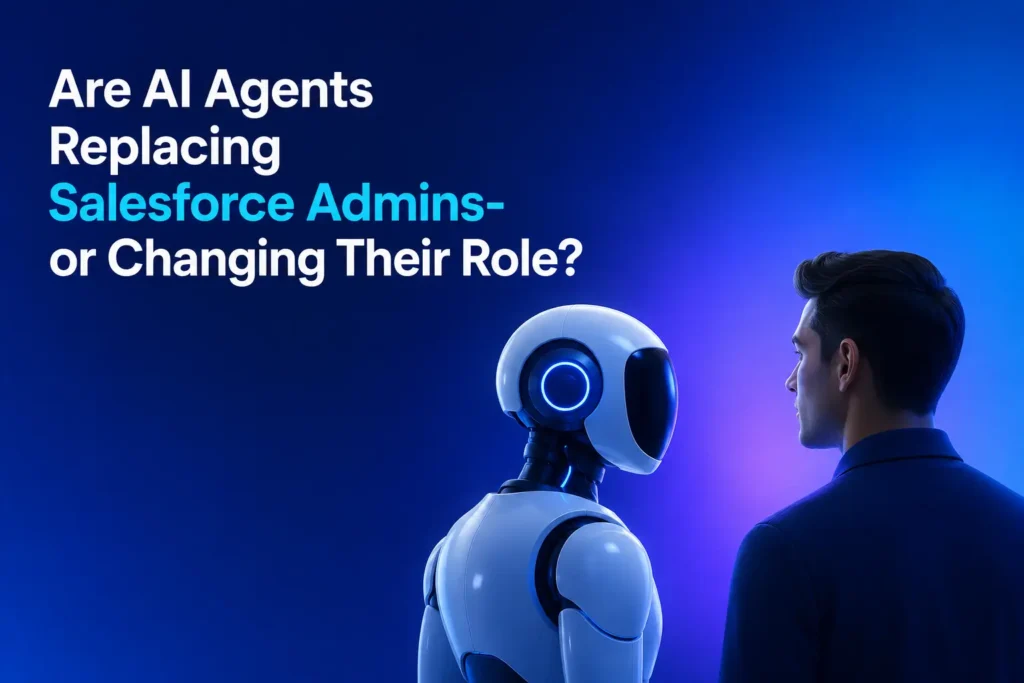
Barely a week goes by in the Salesforce ecosystem without someone raising the question: Will AI replace Salesforce admins? It’s a fair concern. Salesforce AI agents are no longer theoretical. They’re executing actions, reasoning through business processes, generating automation, and handling tasks that once required a human being to log into Setup.
The arrival of Salesforce Agentforce—Salesforce’s agentic AI platform built natively into the Salesforce platform—has pushed this conversation from speculation into practical reality. Agentforce agents can autonomously resolve support cases, update records, draft communications, and assist with complex multi-step processes, all without a human initiating each step.
But there’s a critical distinction that often gets lost in the noise: automating parts of a job is not the same as eliminating the role.
This article gives you a clear, grounded answer. Salesforce AI agents are not simply deleting the Salesforce admin job description. They are fundamentally changing what Salesforce admins are responsible for—moving the role away from repetitive execution toward AI orchestration, business process governance, data stewardship, security architecture, and strategic advisory work.
If you’re a Salesforce admin wondering what’s coming, or a business leader trying to understand how to structure your Salesforce team in the age of AI, this guide is for you.
What Are Salesforce AI Agents?
Salesforce AI agents are autonomous software programs that can perceive context, reason through goals, make decisions, and execute actions—inside and outside of Salesforce—without requiring a human to initiate each step.
Unlike a traditional Salesforce automation such as a Flow or Process Builder rule, AI agents don’t just follow predetermined logic. They interpret a goal, gather relevant information, determine the appropriate sequence of actions, and execute them.
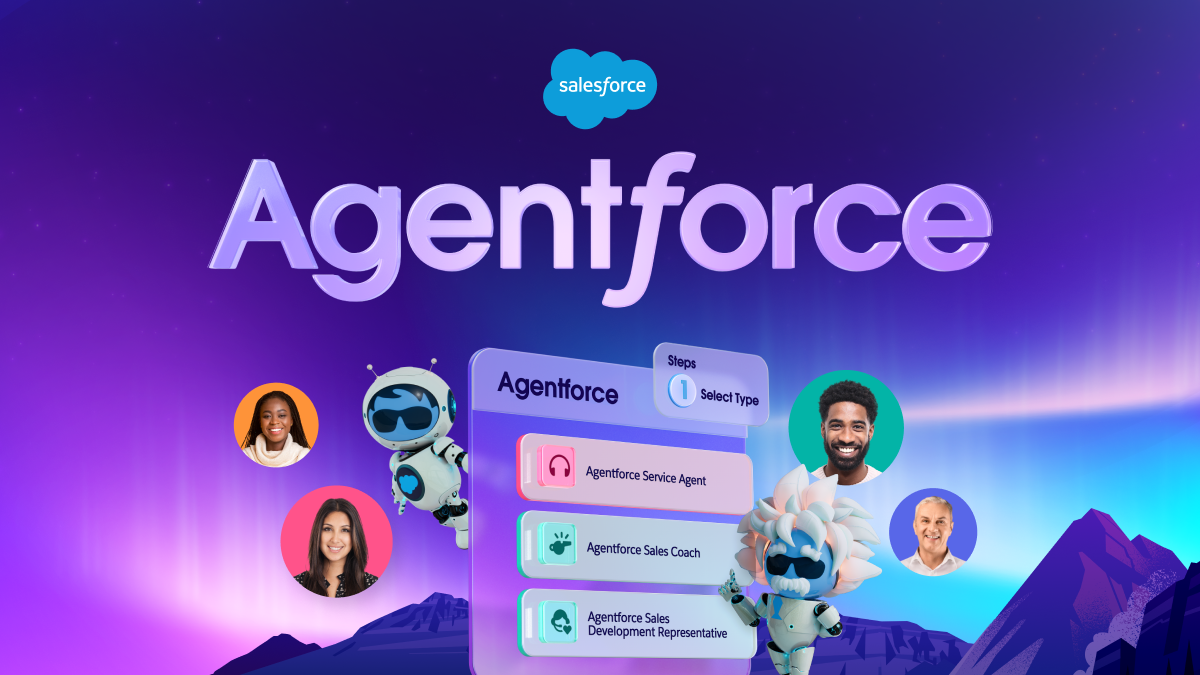
Agentforce is Salesforce’s native platform for building, deploying, and managing these AI agents. Agentforce agents can be assigned roles (Sales Agent, Service Agent, Ops Agent), given instructions, granted specific permissions, and connected to Salesforce data, metadata, and external systems via actions.
Traditional Automation vs. AI Agents
| Traditional Salesforce Automation | Salesforce AI Agents |
|---|
| Rule-based | Context-aware |
| Predetermined logic | Can reason through tasks |
| Trigger/Flow driven | Goal and instruction driven |
| Limited decision paths | Can handle more dynamic situations |
| Requires explicit configuration | Can assist with configuration and execution |
| Consistent but inflexible | Adaptive but requires governance |
The key shift is from if this, then that logic toward given this goal and this context, determine and execute the best action. That’s a meaningful evolution—but it also introduces new complexity that humans need to design, govern, and monitor.
Why Are Salesforce Admins Worried About AI?
The concern is understandable and legitimate. Salesforce admins have long been the people organizations rely on to configure fields, build Flows, troubleshoot errors, manage permissions, and translate business requirements into Salesforce solutions.
Now AI can assist with many of these exact tasks.
Common fears include:
- Will AI configure Salesforce automatically? AI can already generate Field configurations, Page Layouts, and Flow drafts.
- Will AI build Flows and automation? Salesforce Einstein and Agentforce can assist with creating and explaining automation.
- Will AI troubleshoot Salesforce issues? AI can analyze error messages, permission conflicts, and flow failures with increasing accuracy.
- Will companies need fewer Salesforce admins? Productivity improvements may reduce headcount demands in some organizations.
- Will Salesforce certifications lose value? If AI handles configuration, do certifications still matter?
These are reasonable questions. The honest answer is: some traditional admin tasks are already being automated, and more will follow. But the conclusion that “admins are being replaced” misunderstands what experienced Salesforce professionals actually do—and what AI still fundamentally cannot.
What Salesforce AI Agents Can Already Automate
Let’s be direct about what AI is already capable of doing in a Salesforce environment in 2026.
1. Configuration Assistance
Agentforce and Einstein can assist administrators in creating custom objects, fields, validation rules, page layouts, and even basic Flow structures by interpreting natural language requests. An admin can describe a business requirement, and AI will generate a draft configuration.
2. Troubleshooting
AI can analyze error logs, identify permission conflicts, surface redundant automation, and suggest fixes for common Salesforce issues—work that previously required an admin to manually investigate Setup.
3. Data Operations
Repetitive data tasks—record updates at scale, data summaries, deduplication suggestions, report generation, and CRM data retrieval—are increasingly handled by AI agents without manual intervention.
4. Automation Development
AI can help write Flow logic, suggest automation improvements, identify inefficiencies in existing workflows, and assist with testing automation across environments.
5. Documentation and Knowledge
AI can summarize business processes, explain Salesforce configurations in plain language, generate technical documentation, and answer administrator questions against organizational knowledge bases.
6. Testing and Quality Assurance
AI can assist with identifying gaps in test coverage, suggesting test scenarios, and flagging potential issues before deployment.
One important caveat: In every one of these areas, AI assistance still requires human review before production deployment. AI can draft; humans must validate. AI can suggest; humans must decide. That distinction matters enormously.
What AI Agents Still Cannot Replace
This is the most important section of this article—because it explains why experienced Salesforce administrators remain indispensable even in an AI-powered environment.
Business Process Understanding
Salesforce admins know how the organization actually works—not just what the system says. They know why a field exists, which team owns a process, where exceptions happen, and what the business actually needs versus what it originally asked for. AI doesn’t have that organizational memory.
Architecture Decisions
AI may suggest a solution, but evaluating whether it’s scalable, maintainable, aligned with Salesforce best practices, or appropriate for the organization’s technical debt situation requires human expertise and organizational context.
Security and Governance
Permissions, profiles, sharing rules, field-level security, data access policies, and—critically—AI agent guardrails require human ownership. Someone must decide what data AI agents can access, what actions they’re permitted to take, and what triggers a human escalation.
Stakeholder Management
Salesforce admins bridge the gap between business teams (sales, service, finance, marketing, operations) and the technical platform. Building relationships, managing expectations, gathering requirements, and earning trust are deeply human skills.
Change Management
Rolling out a new Salesforce capability—AI-powered or not—requires training, adoption planning, communication, and organizational alignment. AI cannot manage the human side of technology implementation.
Strategic Prioritization
Someone must decide which problems are worth solving. AI can execute; it cannot set organizational strategy or evaluate business priorities.
Data Quality
AI agents are only as useful as the data they have access to. Poor data quality—duplicate records, outdated information, missing fields—makes AI outputs unreliable. Humans must govern data standards and quality over time.
Accountability
Organizations need a human who is accountable for business outcomes, AI behavior, compliance, and system integrity. AI cannot be held accountable. Admins can.
The Salesforce Admin Role Is Evolving
The clearest way to understand what’s happening is this: the Salesforce admin role is evolving from Salesforce Configurator to Business Technology and AI Orchestrator.
Before and After: The Salesforce Admin Role
| Traditional Admin Role | AI-Era Salesforce Admin |
|---|
| Configure Salesforce | Orchestrate AI + Salesforce |
| Build repetitive automation | Design intelligent processes |
| Manage permissions | Govern human + AI access |
| Maintain data | Govern data context and quality |
| Build Flows | Combine Flow + AI agents |
| Troubleshoot manually | Use AI-assisted troubleshooting |
| Manage users | Design human-agent experiences |
| Execute requests | Advise on business outcomes |
This doesn’t mean every Salesforce admin must become a developer or AI engineer. But the admins who thrive will invest in understanding:
- How AI agents work and what they can do
- How to define agent instructions, actions, and guardrails
- How to govern AI access and behavior
- How to design business processes that intelligently combine human and AI execution
- How to measure whether AI is actually delivering business value
How Agentforce Is Changing What Salesforce Admins Do
Salesforce Agentforce gives Salesforce-native teams the tools to build AI agents directly within their existing Salesforce environment—no external AI platforms required. For Salesforce admins, this introduces an entirely new category of work.
An Agentforce-era admin may find themselves:
- Building agents with defined roles, instructions, and scope
- Designing instructions that guide agent reasoning and output quality
- Defining actions that agents are permitted to execute
- Establishing guardrails that prevent agents from taking inappropriate actions
- Testing agent behavior across different scenarios and edge cases
- Monitoring outcomes to identify when AI produces incorrect or suboptimal results
- Managing agent permissions and data access controls
- Connecting agents to business processes so they function within real operational workflows
- Evaluating AI use cases to determine where agents genuinely add value
- Optimizing agent performance as business processes evolve
Increasingly, the Salesforce admin becomes the person answering questions that no algorithm can answer on its own:
Where should AI be used in our Salesforce environment? What should the AI be allowed to do? What data should the AI be able to access? When should AI escalate to a human? How do we know if AI is performing correctly?
These are strategic, governance-heavy, judgment-driven responsibilities. They are the opposite of being automated away.
The New Skills Salesforce Admins Need in 2026
Here are the practical skills that matter most for Salesforce admins navigating the AI era:
- Agentforce Fundamentals — Understand how agents, topics, actions, and instructions work within the Agentforce framework.
- AI Prompt and Instruction Design — Learn how to write clear, precise agent instructions that produce consistent, appropriate AI behavior.
- Salesforce Flow — Flow remains essential. Admins increasingly combine Flow logic with Agentforce actions for complex business processes.
- Data Cloud / Data 360 Concepts — AI agents need unified, contextual data. Understanding how Salesforce Data Cloud structures and surfaces data is increasingly important.
- Data Quality and Governance — The ability to evaluate, clean, and maintain CRM data is more critical than ever when AI is acting on that data.
- Salesforce Security — Profiles, permission sets, sharing rules, and now AI agent permissions require solid security expertise.
- AI Governance — Understanding responsible AI, human-in-the-loop design, escalation paths, and audit trails is a growing requirement.
- Business Process Analysis — Admins who deeply understand business processes can design better AI-powered solutions.
- Automation Architecture — The ability to decide how to structure automation—when to use Flow, when to use Agentforce, when to use both—requires architectural thinking.
- Testing and Monitoring — AI outputs must be tested and monitored. Admins need structured approaches to quality assurance.
- API and Integration Fundamentals — AI agents increasingly interact with external systems. Understanding how integrations work adds significant value.
- Stakeholder Communication — Explaining AI capabilities, limitations, and governance requirements to non-technical business leaders is an increasingly valuable skill.
Will Companies Need Fewer Salesforce Admins?
This is the question most people are really asking—and the honest answer is nuanced.
Scenario 1: Fewer Repetitive Admin Tasks
AI will absorb a meaningful portion of routine, repetitive configuration and support work. Some organizations may reduce their dependency on entry-level administrative support as a result.
Scenario 2: More Productive Admins
A skilled Salesforce admin supported by AI tools may be able to manage a significantly larger and more complex Salesforce environment than before. One admin may do the work that previously required two or three—not because one was fired, but because AI expanded individual capacity.
Scenario 3: New Responsibilities Emerge
Organizations that seriously adopt AI agents will need someone to build, govern, test, monitor, and continuously optimize those agents. That work didn’t exist before. It is admin work. It requires Salesforce expertise.
Job titles, scopes, and seniority levels will shift. Demand for junior admins performing purely manual tasks may soften. Demand for experienced Salesforce professionals who can connect business strategy, data architecture, AI governance, and Agentforce implementation may grow.
The underlying need—someone who understands Salesforce deeply and connects it to business outcomes—is not going away.
AI Agents + Human Salesforce Admins = The New Operating Model
The future isn’t AI instead of admins. It’s AI working with admins within a structured operating model:
Business Goal → Process Design → Data Governance → AI Agent → Guardrails → Human Oversight → Monitoring → Optimization
In this model:
- Business leaders define outcomes
- Salesforce admins design processes and govern the system
- AI agents execute approved, scoped actions at speed and scale
- Admins monitor AI behavior and optimize performance over time
- Humans escalate when AI encounters scenarios outside its guardrails
AI handles execution. Admins provide context, governance, and judgment. This isn’t a threat to Salesforce administration—it’s an expansion of what skilled administrators can accomplish.
How Salesforce Admins Can Prepare for the AI Era
Step 1: Learn Agentforce
Start with Salesforce Trailhead’s Agentforce modules. Understand how agents, topics, actions, and instructions work before you try to build anything.
Step 2: Identify Repetitive Tasks in Your Org
Audit your Salesforce environment for processes that are high-volume, low-judgment, and currently manual. These are prime AI candidates.
Step 3: Improve Your Salesforce Data Quality
Before giving AI access to your CRM data, ensure it’s clean, complete, and consistent. AI amplifies whatever is in your data—good or bad.
Step 4: Strengthen Security Knowledge
Review existing permission sets, profiles, and sharing rules. Understand how agent permissions differ from user permissions and where risks exist.
Step 5: Learn AI Governance Principles
Study how responsible AI frameworks apply to Salesforce environments. Understand escalation design, human oversight, and audit requirements.
Step 6: Build Your First AI-Assisted Solution
Start with a low-risk, high-value use case. A support summarization agent, a data enrichment agent, or an internal knowledge assistant are good starting points.
Step 7: Measure Outcomes, Not Activity
Don’t just track whether the agent runs. Track whether it reduces resolution time, improves data accuracy, or saves measurable admin hours.
Step 8: Become a Business Partner
Stop thinking about your role as “configuring Salesforce” and start thinking about it as “improving business outcomes through intelligent use of the Salesforce platform.” That shift in mindset changes everything.
Common Mistakes Companies Make When Adopting Salesforce AI Agents
- Implementing AI before fixing data quality. AI agents built on dirty data produce unreliable outputs. Fix data quality first—always.
- Automating a broken process. AI makes fast what was already happening. If the process itself is flawed, AI makes the flaw faster. Redesign before automating.
- Giving agents excessive permissions. Over-permissioned agents represent a governance and security risk. Grant agents the minimum permissions they need—nothing more.
- Skipping testing. AI behavior is not guaranteed to be consistent. Testing across edge cases, unusual inputs, and real business scenarios is essential before production deployment.
- Ignoring governance. Deploying AI agents without documented guardrails, escalation paths, and monitoring processes creates significant organizational risk.
- Treating AI as a replacement for employees. Organizations that implement AI with the primary goal of headcount reduction often underinvest in the governance, data, and process design work that makes AI effective. The result is poor AI performance and low adoption.
- Measuring activity instead of business outcomes. The number of agent runs is not a meaningful metric. Time saved, accuracy improved, and business outcomes achieved are the measures that matter.
Salesforce Admin vs. AI Agent—Who Does What?
| Responsibility | AI Agent | Salesforce Admin |
|---|
| Repetitive data tasks | Strong | Oversight |
| Configuration assistance | Strong | Review & validate |
| Business strategy | Limited | Strong |
| Governance | Assist | Own |
| Security architecture | Assist | Own |
| Business process design | Assist | Own |
| Stakeholder management | Limited | Strong |
| Agent configuration | Assist | Own/Manage |
| Testing | Assist | Validate |
| Accountability | No | Yes |
These boundaries are not absolute, and they will continue to evolve as AI capabilities develop. But today, the practical reality is that human expertise, judgment, and accountability remain essential across the most consequential areas of Salesforce administration.
The Future of the Salesforce Admin
Over the next three to five years, the Salesforce admin career path is likely to evolve in a direction that looks something like this:
Salesforce Admin → AI-Enabled Admin → AI Orchestrator → Business Technology Strategist
The most valuable Salesforce professionals will increasingly be those who can:
- Design AI agents that serve real business goals
- Govern AI behavior within compliant, auditable frameworks
- Architect automation strategies that combine Flow, Agentforce, and integration logic
- Build and maintain high-quality data foundations that make AI effective
- Advise business leaders on where AI delivers genuine value versus where human judgment is irreplaceable
- Monitor and continuously optimize AI-human collaborative systems
This isn’t a replacement of Salesforce administration. It’s the next chapter.
Conclusion
Salesforce AI agents are not coming for Salesforce admins’ jobs. They’re coming for the parts of the job that shouldn’t require a skilled human in the first place—the repetitive, the mechanical, the predictable.
What AI cannot do is understand your business, earn trust from your stakeholders, make strategic architecture decisions, govern data responsibly, manage change effectively, or be held accountable when something goes wrong.
The Salesforce admins who will struggle in the AI era are those who define their value entirely by their ability to click through Setup. The Salesforce admins who will thrive are those who define their value by their ability to design intelligent systems, govern complex platforms, and connect technology to real business outcomes.
The future Salesforce admin may spend less time configuring Salesforce and more time deciding what Salesforce—and its AI agents—should accomplish.
That isn’t a diminished role. It’s a more impactful one
Recommended External Sources




 Salesforce ERP
 ERP + CRM Platform
  Inventory Management
  Warehouse Management
  Order Management
  Vendor Management
  Logistics Management
  BOM Management
  Order Fulfillment
  Business Operations
  SaaS Platform for Operations
  Salesforce Cloud ERP Platform
  Xero
Xero
 Zoho books
 Quickbooks
 Shopify
 Acumatica
 SAP
SAP
 Odoo
Odoo
 NetSuite
 Microsoft Dynamics 365
 Sage
Sage

 Agentforce Revenue Management
 Agentforce Revenue Management + Billing
  Salesforce CPQ
 Salesforce Advanced Billing
  Migrate from CPQ to ARM
  Managed Services
 Salesforce Implementation
 Revenue Cloud Implementation
 ServiceNow Consulting Services
 Zoho CRM implementation
 MuleSoft Integration
 Workato Integration
 Microsoft
 Data Cloud
 Tableau
 ·
August 24, 2026
·
14 min read
·
August 24, 2026
·
14 min read