Introduction
Manufacturers today face a brutal reality: disconnected systems are silently draining profits. Sales teams enter customer orders into Salesforce, finance teams re-enter the same data into the ERP, and somewhere along the way, a typo causes a backorder, a delayed shipment, or an unhappy buyer. According to Salesforce’s 2024 Trends in Manufacturing report, 78% of manufacturers spend significant time hunting for information across disconnected systems, and 85% believe they must transform operations to stay competitive.
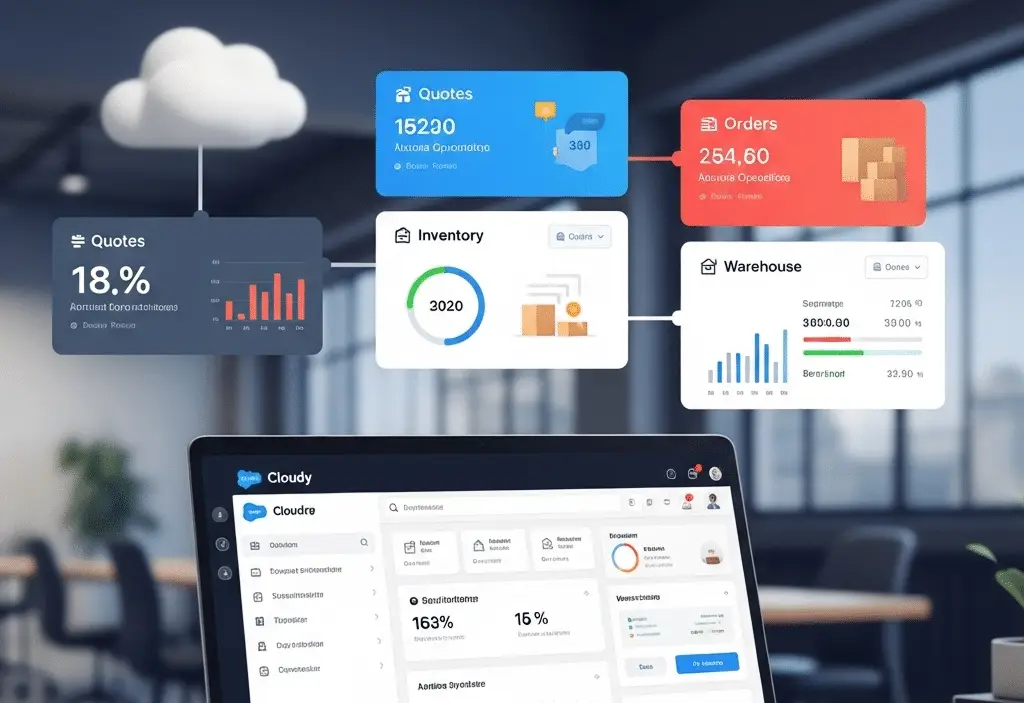
That’s exactly why Salesforce ERP integration has moved from a “nice-to-have” to a strategic priority. By connecting Salesforce CRM with your Enterprise Resource Planning system, manufacturers can finally see customer data, inventory, production schedules, and finances on a single, unified screen. This guide breaks down everything you need to know about Salesforce ERP integration — the benefits, costs, tools, ROI, and pitfalls — so you can make a confident, informed decision.
What Is Salesforce ERP Integration?
Salesforce ERP integration is the process of connecting your Salesforce CRM platform with an Enterprise Resource Planning system (such as SAP, Oracle NetSuite, Microsoft Dynamics 365, Infor, Epicor, or Business Ops 360) so that customer-facing data and back-office operational data flow seamlessly between the two.
Think of it this way:
- Salesforce manages the front office — leads, opportunities, quotes, customer service, and forecasts.
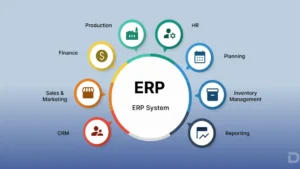
- ERP manages the back office — production, inventory, supply chain, finance, and HR.
Without integration, these two halves of your business operate in silos. With a properly architected Salesforce ERP integration, a closed-won opportunity automatically becomes a sales order, triggers an inventory check, schedules production, and generates an invoice — without a single human re-keying anything.
Why Manufacturers Specifically Need It
Manufacturing represents roughly 32% of the global ERP market, the largest industry vertical, according to Cargoson’s 2025 ERP market analysis. The Gartner-tracked global ERP market itself reached $66 billion in 2024 and is projected to keep growing at over 11% annually. Yet despite that investment, Gartner research indicates that around 70% of ERP implementations fail to meet their objectives — with manufacturing-specific cost overruns averaging a staggering 215%. Most failures trace back to one root cause: poor integration between CRM and ERP.
Key Benefits of Salesforce ERP Integration for Manufacturers
A well-executed Salesforce ERP integration delivers measurable returns across nearly every department. Here are the benefits that matter most:
1. A Single Source of Truth
When customer, order, and inventory data lives in one connected ecosystem, every department works from the same numbers. No more sales reps quoting stock that doesn’t exist, and no more finance teams reconciling phantom orders.
2. Faster Quote-to-Cash Cycles
Industry research shows that Salesforce ERP integration can reduce processing time by 30–50%. A closed deal in Salesforce instantly becomes an ERP order, triggers fulfillment, and generates an invoice — collapsing what used to take days into minutes.
3. Real-Time Inventory Visibility
Sales reps see live stock levels and production schedules inside Salesforce. According to APPSeCONNECT’s manufacturing data, ERP systems drive a 23% improvement in order-to-shipment times and 97% inventory accuracy when properly integrated.
4. Higher ROI
A Nucleus Research study found that every $1 invested in Salesforce Manufacturing Cloud generates roughly $5.58 in benefits. Forrester’s Total Economic Impact study of Microsoft Dynamics 365 Business Central reported a 265% three-year ROI, and Salesforce’s own data suggests Manufacturing Cloud users see ROI gains of around 30%.
5. Better Customer Experience
Service reps can instantly pull a machine’s serial number, full manufacturing batch history, and warranty status — without switching screens. Salesforce reports that integrated Manufacturing Cloud users automate up to 60% of warranty claims and resolve service cases over 20% faster.
6. Smarter Forecasting
Combining Salesforce opportunity data with ERP production data allows manufacturers to forecast demand accurately, align supply chain decisions, and reduce both stockouts and excess inventory.
Common Methods of Salesforce ERP Integration
There’s no one-size-fits-all approach. The right method depends on data volume, complexity, budget, and IT resources.
iPaaS (Integration Platform as a Service)
Cloud-based platforms like MuleSoft (Salesforce-owned), Boomi, Workato, Celigo, Jitterbit, and Rapidi offer pre-built connectors for popular ERPs. The iPaaS market grew from $12.87 billion in 2024 and is projected to reach $78.28 billion by 2032 — a clear sign of where the industry is headed. iPaaS is typically low-code and ideal for mid-sized manufacturers.
Native Integration
Some ERP platforms — most notably Business Ops 360, which is built natively on the Salesforce platform — offer out-of-the-box, real-time integration without middleware. NetSuite also provides native connectors.
Custom API Integration
For enterprises with highly specialized workflows, custom APIs offer maximum flexibility but require significant developer expertise and ongoing maintenance.
ETL / Data Warehouse Approach
Useful when historical reporting matters more than real-time sync. Data is extracted, transformed, and loaded into a central warehouse for analytics.
Salesforce ERP Integration Methods Compared
| Integration Method | Best For | Pros | Cons |
|---|
| iPaaS (e.g., MuleSoft, Boomi) | Mid-market & enterprise | Fast deployment, scalable, low-code | Subscription costs, vendor lock-in |
| Native (Business Ops 360) | Companies wanting unified platform | Real-time sync, single vendor support | Limited to specific ERP choices |
| Custom API | Large enterprises with unique needs | Full flexibility, tailored logic | Costly, slow to build, hard to maintain |
| ETL / Data Warehouse | Analytics-heavy organizations | Excellent reporting | Not real-time |
Top ERP Systems That Integrate with Salesforce
Manufacturers typically pair Salesforce with one of these leading ERPs:
- SAP S/4HANA — preferred by global enterprises; usually integrated via MuleSoft.
- Oracle NetSuite — popular with growing mid-market manufacturers.
- Microsoft Dynamics 365 — strong financial and supply chain capabilities.
- Infor CloudSuite — named a Leader in the 2025 Gartner Magic Quadrant for Cloud ERP for Product-Centric Enterprises for the fifth consecutive year.
- Epicor Kinetic — strong in discrete manufacturing.
- Business Ops 360 — built natively on Salesforce, offering the tightest integration available.
The Role of Salesforce Manufacturing Cloud
Salesforce Manufacturing Cloud is an industry-specific layer that extends Sales Cloud with features built for manufacturers — sales agreements, account-based forecasting, rebate management, and deeper ERP connectors. Combined with Agentforce, Salesforce’s AI-agent platform launched in 2025 (which already has over 4,000 paying customers), Manufacturing Cloud can autonomously update customer records, reroute supply when inventory dips, and trigger procurement workflows.
When paired with a strong Salesforce ERP integration, Manufacturing Cloud becomes the digital nervous system of the modern factory.
Real-World Example: The Furniture Perfect Case Study
Luxury textile manufacturer TFP integrated Salesforce CRM with Business Ops 360 and, according to a Nucleus Research case study, achieved a 223% annual ROI with a 6-month payback period. The rapid payback enabled the company to expand into additional product lines almost immediately — a textbook example of how Salesforce ERP integration directly drives revenue growth.
Common Challenges (and How to Solve Them)
Even well-funded Salesforce ERP projects can stumble. Here are the most common issues and their fixes:
1. Data Quality Issues
Problem: Existing duplicate accounts, outdated SKUs, and inconsistent naming conventions get amplified after integration.
Solution: Conduct a full data audit and cleansing exercise before integration begins. Non-negotiable.
2. Trying to Integrate Everything at Once
Problem: Big-bang projects are the leading cause of failure.
Solution: Start with a single high-ROI process (typically quote-to-cash or order automation) and expand iteratively.
3. API Governor Limits
Problem: Poorly designed Salesforce ERP integrations can hit Salesforce API limits, especially with high data volumes.
Solution: Use bulk APIs, middleware queuing, and event-driven architecture rather than constant polling.
4. Change Management
Problem: Salesforce’s 2024 Trends in Manufacturing report found 32% of manufacturers lack internal AI/digital expertise.
Solution: Invest in training, hire a certified Salesforce consulting partner, and assign an executive sponsor.
5. Security and Compliance
Problem: Connecting two systems exposes sensitive customer and financial data.
Solution: Use encrypted connections, OAuth, role-based access controls, and ensure GDPR/SOC 2 compliance.
Best Practices for a Successful Salesforce ERP Integration
- Define a clear business outcome first. Don’t start with “we need integration.” Start with “we need to cut quote-to-cash time by 40%.”
- Pick one source of truth per data type. Decide whether Salesforce or ERP owns pricing, customer master, and product data.
- Choose real-time vs. batch sync deliberately. Customer-facing data should be real-time; financial reconciliations can be batched.
- Assemble a cross-functional team. Executive sponsor, Salesforce admin, ERP analyst, and integration architect are non-negotiable.
- Test under realistic loads. Especially before peak seasons — performance bottlenecks kill go-lives.
- Plan for ongoing maintenance. Salesforce ERP integration is never “set and forget.” APIs change, data drifts, and business rules evolve.
Cost Considerations
There’s no single price tag for Salesforce ERP integration, but typical investments include:
- iPaaS subscription: $1,000 – $10,000+ per month depending on volume
- Implementation services: $25,000 – $250,000+ depending on scope
- Ongoing maintenance: typically 15–20% of implementation cost annually
- Salesforce Manufacturing Cloud licensing: priced per user, on top of base Salesforce licenses
The good news? Basic order-to-cash setups can finish in four to six weeks with the right partner, and AI-powered platforms now cut implementation timelines by 20–30%.
Key Takeaways
- Manufacturing dominates the $66+ billion global ERP market, and Salesforce ERP integration is now mission-critical, not optional.
- Properly integrated systems can cut processing times by 30–50%, lift ROI by hundreds of percent, and dramatically improve customer experience.
- The biggest pitfalls are dirty data, over-scoped initial projects, and weak change management — all preventable with a partner-led, phased approach.
- AI agents and platforms like Salesforce Manufacturing Cloud + Agentforce are reshaping what “integrated” means in 2026 and beyond.
- Whether you choose iPaaS, native (Business OPS 360), or custom API methods, the fundamental rule holds: integrate around a business outcome, not a technology.
Manufacturers that get Salesforce ERP integration right won’t just save time — they’ll build the operational backbone needed to compete in an AI-driven, customer-centric, real-time economy.




 Salesforce ERP
 ERP + CRM Platform
  Inventory Management
  Warehouse Management
  Order Management
  Vendor Management
  Logistics Management
  BOM Management
  Order Fulfillment
  Business Operations
  SaaS Platform for Operations
  Salesforce Cloud ERP Platform
  Xero
Xero
 Zoho books
 Quickbooks
 Shopify
 Acumatica
 SAP
SAP
 Odoo
Odoo
 NetSuite
 Microsoft Dynamics 365
 Sage
Sage

 Agentforce Revenue Management
 Agentforce Revenue Management + Billing
  Salesforce CPQ
 Salesforce Advanced Billing
  Migrate from CPQ to ARM
  Managed Services
 Salesforce Implementation
 Revenue Cloud Implementation
 ServiceNow Consulting Services
 Zoho CRM implementation
 MuleSoft Integration
 Workato Integration
 Microsoft
 Data Cloud
 Tableau
 ·
April 30, 2026
·
8 min read
·
April 30, 2026
·
8 min read

canadian pharmaceuticals, 15 May, 2026
I was suggested this blog by way of my cousin. I am no longer positive whether this put up is written by means of him as no one else recognize such precise about my trouble. You’re amazing! Thanks!
Saurabh Wankhede, 06 August, 2026
Thank you for your wonderful feedback! We’re delighted the article helped answer your questions. We appreciate your support and look forward to sharing more practical Salesforce and ERP insights.