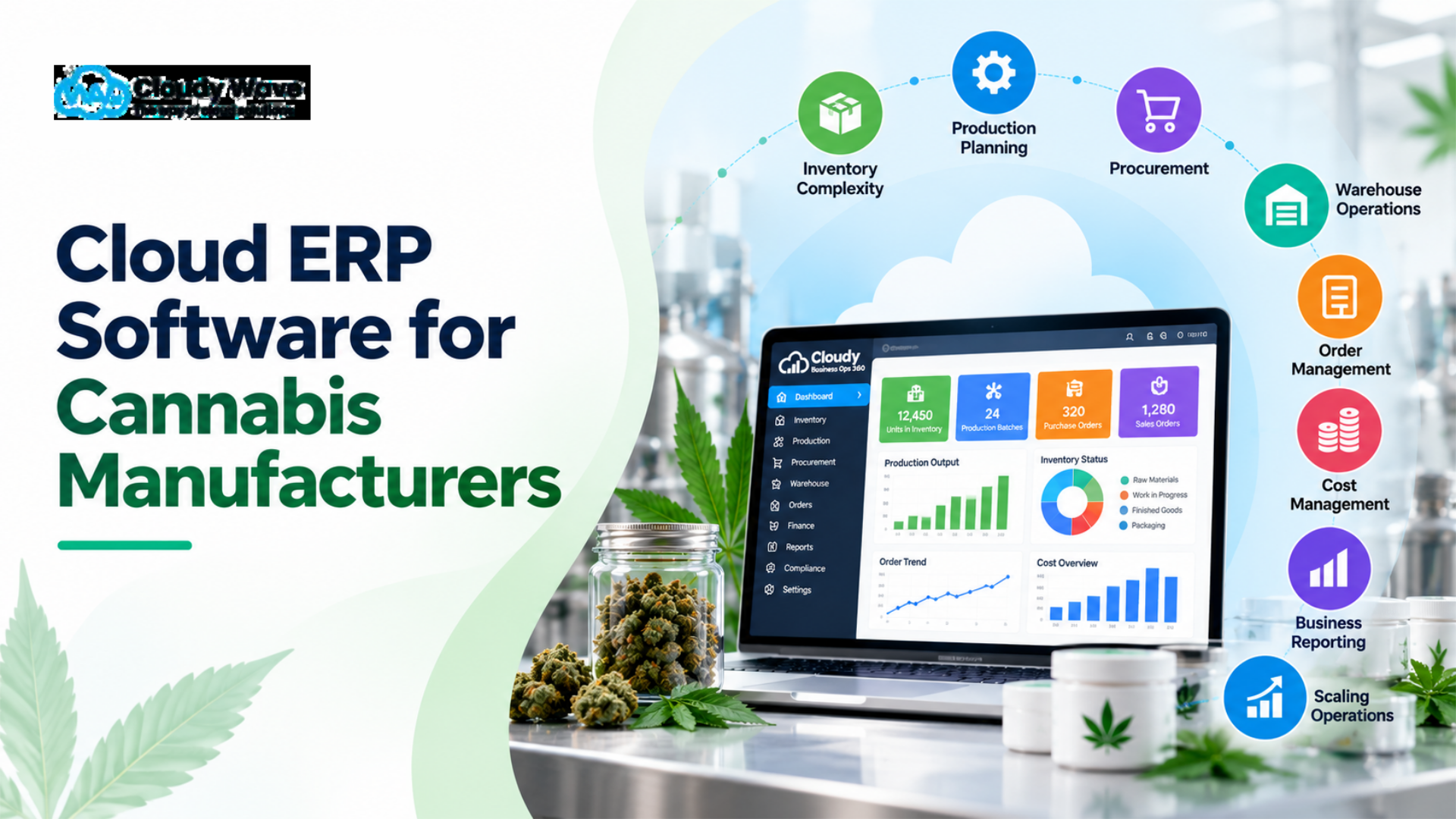
Cannabis manufacturing has grown from a niche operation into a sophisticated industry with the same operational demands as any product-based manufacturer — complex inventory, multi-step production workflows, procurement dependencies, warehouse logistics, and the constant pressure to scale. Yet many cannabis manufacturers still rely on disconnected spreadsheets, siloed systems, and manual data entry to run daily operations.
The result? Inventory inaccuracies, production bottlenecks, fulfillment delays, and reporting that’s always a step behind. As operations grow, the cracks in these manual systems widen — and the cost of inefficiency compounds.
Cloud ERP software for cannabis manufacturers addresses this directly. By connecting orders, inventory, production, warehouse operations, procurement, and financial data into a single platform, a modern ERP transforms fragmented operations into a unified, visible, and scalable business.
This guide walks cannabis manufacturing decision-makers through everything they need to know: what cloud ERP is, why it matters, what features to evaluate, what implementation looks like, and why Cloudy Business Ops 360 — a Salesforce-native cloud ERP platform — is a strong solution for cannabis manufacturing operations of any size.
What Is Cloud ERP Software for Cannabis Manufacturers?
Cloud ERP software for cannabis manufacturers is a centralized, web-based business management platform that connects inventory, production, procurement, warehouse operations, order management, and financial reporting into one system — accessible in real time from any location.
ERP stands for Enterprise Resource Planning. Unlike standalone tools or spreadsheets, a cloud ERP integrates every operational function so that data flows automatically between departments. When a purchase order is received, inventory updates. When production consumes materials, stock levels adjust. When an order ships, fulfillment status is visible to every team.
For cannabis manufacturers specifically, this means fewer manual handoffs, better inventory control, more accurate production planning, and cleaner financial data — without building a patchwork of disconnected applications.
The “cloud” component means the software is hosted on remote servers and accessed via the internet, eliminating the need for on-premises hardware and allowing teams to manage operations from anywhere.
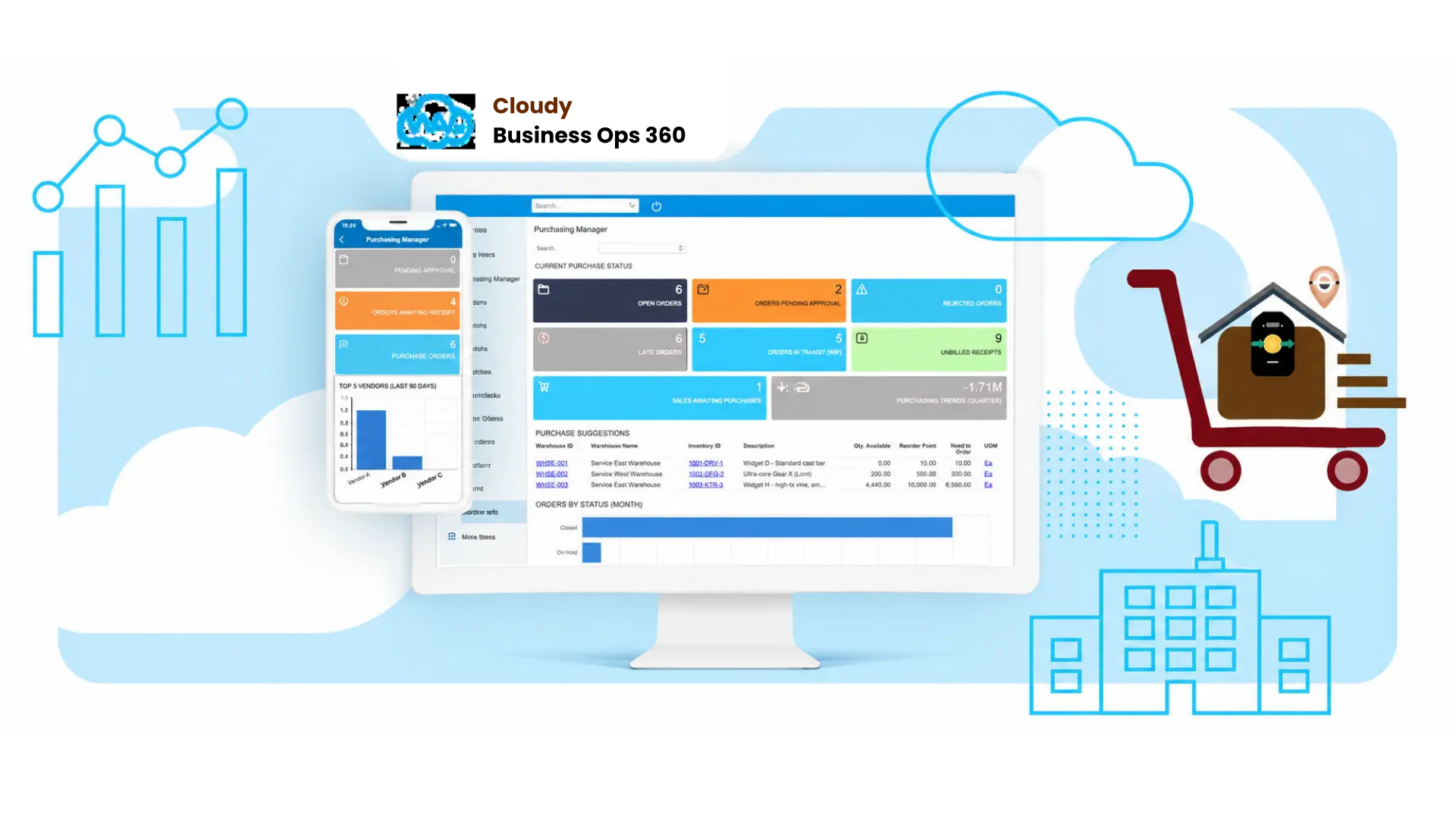
Why Do Cannabis Manufacturers Need Cloud ERP Software?
Cannabis manufacturers need cloud ERP software because manufacturing operations — from procurement through production to customer fulfillment — are too interconnected to manage efficiently through spreadsheets and disconnected tools.
Here’s why the complexity demands a connected system:
1. Inventory Complexity
Cannabis manufacturing involves raw materials, work-in-progress (WIP) inventory, packaging components, and finished goods — often across multiple storage locations. Tracking these manually creates reconciliation gaps and delayed visibility into true stock positions.
2. Production Planning
Production schedules depend on material availability. Without a system that connects inventory with production orders, manufacturers constantly risk material shortages, over-purchasing, or idle production capacity.
3. Procurement
Sourcing raw materials and packaging requires coordinating with multiple suppliers. Without procurement data connected to inventory levels, purchasing decisions are reactive rather than planned.
4. Warehouse Operations
Receiving, storing, picking, and shipping products through a warehouse requires structured workflows. Manual processes create misplacements, slow fulfillment, and poor space utilization.
5. Order Management
Managing orders from multiple channels — and aligning them with inventory availability and production schedules — is impossible to do accurately when each function operates in its own system.
6. Cost Management
Calculating accurate production costs, tracking material spend, and monitoring margins requires connecting procurement, production, and financial data. Spreadsheets rarely achieve this without significant manual effort and frequent error.
7. Business Reporting
Management needs timely, accurate reporting on inventory positions, production output, procurement spend, and order fulfillment. When data lives in separate systems, generating reliable reports becomes a project in itself.
8. Scaling Operations
As volume grows, manual processes break down faster. An ERP provides the operational infrastructure to scale without proportionally increasing administrative overhead.
Common Challenges Faced by Cannabis Manufacturers
Most cannabis manufacturers seeking ERP software are experiencing one or more of these operational pain points:
Spreadsheet Dependency — Inventory, production schedules, and purchase orders managed in spreadsheets create version-control issues, manual error, and no real-time visibility. A cloud ERP replaces these with live, connected data.
Inventory Inaccuracies — Without centralized inventory tracking, stock counts drift from reality. ERP systems automate inventory movements so counts stay current without manual reconciliation.
Manual Data Entry — Re-entering information between systems wastes time and introduces errors. An ERP eliminates duplicate data entry by sharing information across connected modules.
No Real-Time Visibility — When data is spread across tools, no single person has an accurate, current view of operations. Cloud ERP provides dashboards that reflect live operational data.
Production Bottlenecks — Without production planning visibility, capacity constraints and material shortages are discovered late. ERP production modules surface issues early so manufacturers can respond proactively.
Procurement Delays — When purchasing is disconnected from inventory and production, orders are placed too late or for the wrong quantities. ERP connects procurement directly to material requirements.
Warehouse Inefficiencies — Without structured warehouse workflows, picking errors, slow receiving, and poor space utilization increase operating costs. Warehouse management modules impose systematic processes.
Disconnected Financial Data — Billing and procurement data that don’t sync with operational systems produce financial reports that are delayed and incomplete.
Scaling Problems — Businesses that try to grow on manual systems find that every new SKU, location, or customer multiplies their administrative burden. ERP scales with the business.
Key Features to Look for in Cannabis Manufacturing ERP Software
When evaluating cloud ERP software for cannabis manufacturers, these are the functional areas that matter most:
Inventory Management
The foundation of any manufacturing ERP. Look for real-time stock tracking, multi-location visibility, automated replenishment alerts, and demand forecasting. Inventory should update automatically as materials are consumed in production, received from suppliers, or shipped to customers.
Manufacturing Management
Production planning, work orders, bill of materials (BOM) management, and production batch tracking are essential. The system should allow manufacturers to plan production based on demand, available materials, and capacity — and track output through each stage.
Batch and Lot Tracking
For cannabis manufacturers, knowing which batch a product came from and tracing material movements through production is operationally important regardless of regulatory requirements. ERP batch tracking creates an audit-ready chain of custody within your operations.
Note: ERP software provides operational traceability. Regulatory compliance requirements vary by jurisdiction and should be addressed with qualified legal and compliance professionals.
Warehouse Management
Receiving, put-away, picking, packing, shipping, and inventory transfers should follow structured workflows within the ERP. Smart bin and space allocation, pick-pack-ship optimization, and inbound/outbound workflow management reduce errors and speed fulfillment.
Procurement Management
Vendor management, purchase order creation, PO approval workflows, goods receipt, and three-way matching connect purchasing activity directly to inventory and production planning. The system should allow purchasing teams to generate POs based on actual material requirements.
Order Management
Multi-channel order capture, order-to-fulfillment tracking, partial shipment management, and backorder handling keep sales and operations aligned. Orders should flow automatically into inventory and fulfillment workflows.
Cost and Financial Visibility
ERP systems should provide production cost visibility, inventory valuation, payment tracking, and reconciliation. Automated invoice creation, flexible billing models, tax calculations, and multi-currency support are important for manufacturers with complex financial operations.
Analytics and Reporting
Real-time dashboards, operational KPIs, sales and fulfillment metrics, and custom reporting give management the visibility needed to make informed decisions. Reporting should be available without exporting data to spreadsheets.
Cloud Accessibility
A cloud-based platform allows operations managers, warehouse teams, and executives to access live data from any device. This is especially valuable for manufacturers with multiple facilities or distributed teams.
How Cloud ERP Improves Cannabis Inventory Management
Cloud ERP centralizes inventory data across all locations and processes, replacing manual stock counts and spreadsheet updates with real-time, automated inventory visibility.
Specifically, ERP-driven [inventory management](Internal Link: Cloudy Business Ops 360 – Inventory Management) delivers:
- Real-time stock levels updated automatically as materials move through receiving, production, and shipping
- Multi-location visibility showing inventory across warehouses, production floors, and storage areas
- Material availability connected to production schedules so planners know whether sufficient stock exists before starting a production run
- Automated replenishment alerts that trigger purchasing when stock falls below defined thresholds
- Reduced manual reconciliation because inventory movements are system-driven rather than manually logged
- Improved fulfillment accuracy because order management pulls live inventory data rather than estimates
For cannabis manufacturers managing multiple SKUs across multiple locations, centralized inventory visibility is one of the highest-value ERP capabilities — and one of the clearest improvements over spreadsheet-based tracking.
How ERP Supports Cannabis Manufacturing and Production Planning
An ERP system connects demand signals, available inventory, procurement timelines, and production capacity to create a coordinated manufacturing workflow — from raw material to finished product.
The integrated flow looks like this:
Demand → Procurement → Inventory → Production → Warehouse → Orders
Without ERP, each handoff in this chain requires manual communication and data transfer. With ERP, the data flows automatically.
Production planning benefits include:
- Material Requirements Planning (MRP) — determine what materials are needed, in what quantities, and by when
- Bill of Materials (BOM) — define the materials and components required for each finished product
- Work Orders — create and manage production jobs with associated material allocations and output targets
- Production Batch Tracking — monitor production progress, input consumption, and output quantity
- WIP Visibility — see where production jobs stand in real time
- Yield and Scrap Management — track actual versus expected output to improve future planning
- Bottleneck Identification — surface production constraints before they delay fulfillment
The value of integrated production planning is that decisions are based on connected, current data rather than stale reports and manual calculations.
Cannabis Warehouse Management With Cloud ERP
ERP warehouse management connects receiving, storage, picking, and shipping in structured workflows that reduce errors, improve speed, and give managers accurate visibility into warehouse operations.
Key warehouse management capabilities to look for:
- Inbound workflows — structured receiving processes that update inventory immediately upon goods receipt
- Smart bin and space allocation — assign storage locations systematically to improve picking speed and space utilization
- Pick-pack-ship optimization — guide warehouse staff through efficient picking routes and packing processes
- Inventory transfers — track stock movements between locations within the warehouse or across facilities
- Outbound workflows — connect order management to shipping so fulfillment status is visible at every stage
- Multi-location support — manage inventory across multiple warehouses or storage areas from a single system
When warehouse operations are connected to inventory and order management within the same ERP, the data flows in real time. Warehouse managers aren’t waiting for manual updates — they’re working from live information.
Cannabis Procurement and Supply Chain Management
ERP procurement management connects supplier management, purchase orders, material requirements, and goods receipt into a single workflow — replacing reactive, manual purchasing with planned, data-driven procurement.
An integrated procurement module enables:
- Vendor management — maintain supplier records, pricing, and lead times in the same system as purchasing activity
- Purchase order creation and approval — generate POs from inventory requirements and route them through configurable approval workflows
- Material Requirements Planning — let the ERP calculate what needs to be purchased based on production schedules and current inventory levels
- Goods receipt — update inventory automatically when purchased materials are received
- Three-way matching — match purchase orders, delivery receipts, and invoices to reduce payment errors
- Procurement visibility — track outstanding POs, expected delivery dates, and purchasing spend in real time
When procurement is connected to inventory and production within the same platform, purchasing teams respond to actual operational needs rather than gut estimates. The result is more accurate purchasing, fewer emergency orders, and better supplier relationships.
How Cloud ERP Helps Cannabis Manufacturers Scale
Cloud ERP provides the operational infrastructure that allows cannabis manufacturers to grow order volume, expand product lines, and add facilities without proportionally increasing administrative overhead.
Growing manufacturers frequently hit the same wall: their processes worked at small scale but break down as volume increases. The spreadsheets become unmanageable. The manual handoffs multiply. The data gaps widen.
ERP supports scaling through:
- Process standardization — consistent workflows that don’t degrade as team size or volume increases
- Automation — routine tasks like inventory updates, PO creation, and invoice generation happen automatically
- Centralized data — all departments work from the same system, eliminating data silos as teams grow
- Scalable infrastructure — cloud platforms scale to handle increased transaction volume without hardware upgrades
- Multi-location support — manage additional warehouses or production sites within the same system
- Better reporting — management maintains operational visibility even as the business grows more complex
The key insight is that ERP scales with the business rather than against it. The operational model established at current size works at two, three, or five times the volume.
Cloudy Business Ops 360 for Cannabis Manufacturers
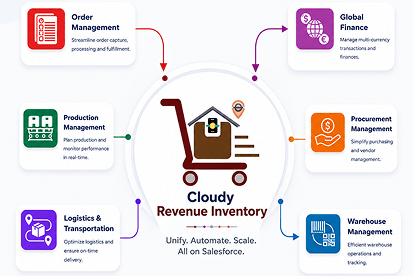
Cloudy Business Ops 360 is a Salesforce-native cloud ERP platform designed to bring all core business operations together in a single, connected system.
Built entirely on the Salesforce platform, Cloudy Business Ops 360 is provides cannabis manufacturers with an integrated suite covering:
- Order Management — multi-channel order capture, partial shipments, backorder management, and order-to-invoice readiness
- Inventory Management — real-time stock tracking, multi-location visibility, automated replenishment alerts, and demand forecasting
- Warehouse Management — smart bin and space allocation, pick-pack-ship workflows, inbound and outbound operations, and inventory transfers
- Procurement + Manufacturing — vendor management, purchase orders, bill of materials, work orders, production batches, WIP tracking, and scrap/yield management
- Billing and Finance — automated invoice creation, flexible billing models, tax compliance, payment allocation, reconciliation, and multi-currency transactions
- Analytics and Reporting — real-time dashboards, sales and fulfillment metrics, revenue and financial insights, and custom drill-down reports
- Accounting Integrations — native integrations with Xero, QuickBooks, and Zoho Books for real-time financial operations
Because it is built natively on Salesforce, Cloudy Business Ops 360 inherits the security, scalability, and ecosystem of the world’s leading CRM platform — while extending it into full manufacturing and operations management.
Cannabis manufacturers benefit from having a single source of truth across the entire operation, without needing to integrate or maintain multiple disconnected applications.
Why Choose Cloudy Business Ops 360 for Cannabis Manufacturing?
Connected Operations
Cloudy Business Ops 360 is connects orders, inventory, procurement, manufacturing, warehouse operations, billing, and analytics in one platform. Data flows between functions automatically — no manual exports, no reconciliation headaches.
Salesforce-Native Architecture
Built natively on Salesforce, Cloudy Business Ops 360 is secure, continuously updated, and integrated with the broader Salesforce ecosystem. No external systems are needed. Cannabis manufacturers already using Salesforce CRM can extend it into full operations management without adding separate platforms.
Real-Time Visibility
Centralized data means management, operations, warehouse, and finance teams all see the same live picture of the business. Dashboards surface inventory positions, production status, open orders, and financial metrics without manual report generation.
Manufacturing Visibility
Production planning, work orders, BOM management, and batch tracking give cannabis manufacturers the operational controls to plan production accurately, track output, and identify bottlenecks before they impact fulfillment.
Inventory Control
Real-time inventory management across multiple locations reduces stock discrepancies and improves fulfillment accuracy. Automated replenishment alerts prevent stockouts. Demand forecasting supports more accurate purchasing decisions.
Scalable Cloud Platform
Cloudy Business Ops 360 scales from SMB to enterprise operations without requiring hardware upgrades or platform migrations. As order volume grows, facilities multiply, or product lines expand, the platform grows with the business.
Pre-Built Intelligence
Ready-to-use dashboards, reports, and analytics provide immediate operational insights from day one — without custom development or external reporting tools.
Easy Customization
Flexible configuration allows cannabis manufacturers to tailor workflows to their specific operational requirements without complex custom development.
Cloud ERP vs. Spreadsheets for Cannabis Manufacturing
| Capability | Spreadsheets | Cloud ERP (Cloudy Business Ops 360) |
|---|
| Inventory visibility | Manual, delayed, error-prone | Real-time, automated, multi-location |
| Manufacturing management | No native capability | Production orders, BOM, batch tracking |
| Procurement | Manual PO tracking | Integrated PO management, material planning |
| Warehouse operations | No structured workflow | Receiving, picking, fulfillment workflows |
| Order management | Manual tracking | Multi-channel, automated fulfillment tracking |
| Reporting | Manual, time-consuming | Real-time dashboards, drill-down reports |
| Automation | Limited or none | Automated inventory updates, invoicing, alerts |
| Scalability | Breaks down at volume | Designed to scale with business growth |
| Centralized data | Siloed, version-controlled | Single source of truth for all teams |
| Real-time visibility | Not available | Live operational and financial data |
| Accounting integration | Manual export/import | Native Xero, QuickBooks, Zoho Books sync |
The table illustrates why manufacturers who have outgrown spreadsheets consistently find that an integrated cloud ERP delivers operational improvements across every function.
How to Choose Cloud ERP Software for a Cannabis Manufacturer
Use this buyer’s checklist when evaluating any cloud ERP for cannabis manufacturing:
- Manufacturing capabilities — Does it support production orders, BOM management, work orders, and batch tracking?
- Inventory management — Can it track inventory in real time across multiple locations?
- Warehouse management — Does it include structured receiving, picking, and shipping workflows?
- Procurement — Does it connect purchase orders to inventory requirements and production schedules?
- Order management — Can it capture orders from multiple channels and connect them to fulfillment?
- Reporting and analytics — Does it provide real-time dashboards without manual data export?
- Cloud architecture — Is it a true cloud platform, accessible from any device?
- Integration capabilities — Can it connect to your accounting software and other business tools?
- Scalability — Can it handle growing order volumes, additional SKUs, or new facilities?
- Implementation support — What onboarding, configuration, and training support is provided?
- Data security — What security certifications and data protection standards does the platform meet?
- Vendor experience — Does the vendor have relevant experience with manufacturing operations?
- Total cost of ownership — What is the full cost including licenses, implementation, and ongoing support?
- Ease of use — Can operations teams use the system without extensive technical training?
- Customization requirements — Can the system be configured to match your specific workflows without heavy development?
Questions to Ask Before Buying Cannabis ERP Software
Before committing to any platform, ask prospective vendors the following:
- Can the ERP manage manufacturing workflows, including production orders and bill of materials?
- Can it track inventory across multiple warehouse locations in real time?
- Does procurement connect directly to inventory requirements and production planning?
- Does it support structured warehouse operations including receiving, picking, and shipping?
- Can order management connect to inventory and fulfillment automatically?
- Does management have access to real-time operational dashboards?
- How does the platform scale as order volume or facility count increases?
- What implementation support, training, and onboarding is included?
- What accounting systems does it integrate with natively?
- How is data secured, and what compliance certifications does the platform hold?
- What is the realistic implementation timeline for a business of our size and complexity?
- What is included in the license cost, and what is billed additionally?
- Can the system be configured to match our specific manufacturing workflows?
- Is there a demo or trial environment available before commitment?
- What ongoing support is available post-implementation?
How Much Does Cloud ERP Software for Cannabis Manufacturers Cost?
Cloud ERP pricing varies based on several factors. Rather than a fixed price, expect costs to depend on:
- Number of users — most platforms price per user per month
- Business size and transaction volume — enterprise-level operations typically require more robust (and more costly) configurations
- Number of locations — multi-warehouse or multi-facility operations may require additional configuration
- Required modules — the more operational areas you activate, the higher the cost
- Manufacturing complexity — businesses with complex BOMs, multiple production stages, or high SKU counts may require more implementation effort
- Integrations — connecting to accounting platforms, e-commerce systems, or logistics providers may have additional costs
- Customization — tailored workflows require configuration effort
- Data migration — moving historical data from spreadsheets or legacy systems takes time and expertise
- Implementation and training — onboarding, configuration, and team training are typically separate from license costs
The right question is not “what is the license price?” but “what is the total cost of ownership, and what business value will ERP deliver?” Manufacturers who quantify the cost of their current inefficiencies — manual hours, inventory write-offs, fulfillment errors, delayed reporting — consistently find that ERP investment pays back across multiple dimensions.
How Long Does Cannabis ERP Implementation Take?
Implementation timelines vary significantly based on:
- Business complexity and number of operational areas being implemented
- Number of users and departments involved
- Volume and quality of existing data to be migrated
- Number of integrations required
- Degree of workflow customization needed
- Number of locations or facilities
- Team availability for training and testing
A smaller manufacturer implementing core modules with clean data can move faster than a multi-location operation with complex manufacturing workflows and legacy system data to migrate.
Implementation typically proceeds through phases: requirements definition, system configuration, data migration, testing, user training, and go-live. Phased implementations — starting with core modules and adding capability over time — often reduce risk and allow teams to build confidence before expanding scope.
Discuss implementation timeline expectations directly with the vendor based on your specific operational profile.
Cannabis ERP Implementation Best Practices
- Define business requirements first — document what each department needs the system to do before selecting or configuring any software
- Map current workflows — understand how orders, inventory, production, procurement, and warehouse operations currently flow through your business
- Identify process gaps — where are the manual handoffs, data silos, and error-prone steps that ERP should address?
- Clean existing data — inventory records, supplier lists, and product data should be audited and corrected before migration
- Define implementation scope — be specific about which modules and workflows are in scope for the initial implementation
- Configure workflows — work with your implementation partner to align the system to your operational model
- Test thoroughly — run end-to-end scenarios before go-live to catch configuration gaps
- Train all users — ensure every team member who will use the system understands their workflows
- Launch in phases where appropriate — starting with highest-priority modules reduces risk and allows teams to adapt
- Monitor KPIs post-implementation — track operational metrics to confirm the system is delivering expected improvements
Benefits of Cloud ERP for Cannabis Manufacturers
A well-implemented cloud ERP delivers measurable operational improvements across the manufacturing business:
- Better inventory visibility — know exactly what stock exists, where it is, and how fast it is moving
- Improved production planning — plan production based on actual material availability and demand
- More efficient procurement — purchase the right materials at the right time, driven by real operational requirements
- Better warehouse control — structured workflows replace chaotic manual processes
- Connected order management — orders, inventory, and fulfillment stay aligned automatically
- Reduced manual processes — automation handles routine tasks that previously required manual effort
- Improved reporting — real-time dashboards replace delayed, manually assembled reports
- Centralized data — one system of record for all operational and financial information
- Greater operational visibility — management sees what is happening across the business in real time
- Better scalability — operations can grow without proportionally increasing administrative burden
- Improved decision-making — decisions are based on current, accurate data rather than estimates
Is Cloud ERP Worth It for Cannabis Manufacturers?
Yes — for cannabis manufacturers who have outgrown manual systems, cloud ERP delivers operational improvements that justify the investment.
ERP investment makes strong business sense when a manufacturer is experiencing:
- Inventory inaccuracies that create fulfillment errors or production delays
- Growing order volumes that manual systems struggle to manage
- Multiple warehouses or storage locations that need coordinated visibility
- Complex manufacturing workflows with multiple production stages
- Procurement challenges — ordering the wrong quantities, too late, or from the wrong suppliers
- Multiple teams that need to share operational information
- Reporting that is consistently late, incomplete, or unreliable
- Scaling plans that current systems cannot support
- Excessive manual data entry consuming team time that could be spent on higher-value activities
The breakeven point varies by business, but manufacturers who quantify the operational cost of their current systems — in labor hours, inventory write-offs, production delays, and fulfillment errors — consistently find that ERP investment returns value.
Why Cloudy Business Ops 360 Is a Strong Choice for Cannabis Manufacturers
Cannabis manufacturers need a platform that can handle the full operational breadth of their business — from purchasing raw materials to delivering finished products — without requiring a portfolio of disconnected tools.
Cloudy Business Ops 360 delivers exactly this. Built natively on Salesforce, it brings together:
Manufacturing + Inventory + Warehouse + Procurement + Orders + Billing + Analytics
…in one unified, cloud-based platform.
For cannabis manufacturers, this means:
- Production visibility from work order to finished goods output
- Inventory accuracy across raw materials, WIP, and finished products
- Procurement control connected directly to material requirements
- Warehouse efficiency through structured inbound, storage, and outbound workflows
- Order management that aligns with real-time inventory and fulfillment status
- Financial clarity through automated billing and accounting integrations with Xero, QuickBooks, and Zoho Books
- Operational dashboards that give management a live view of the entire business
As operations grow, Cloudy Business Ops 360 is scales with them — from single-facility manufacturers to multi-location operations — without requiring platform migrations or additional point solutions.
Key Takeaways
Cloud ERP software for cannabis manufacturers is a centralized, cloud-based platform that connects inventory management, production planning, procurement, warehouse operations, order management, and financial reporting in one system. Cannabis manufacturers need connected ERP because their operations involve complex, interdependent workflows that cannot be managed accurately through spreadsheets or disconnected tools. The most important ERP capabilities for cannabis manufacturing include real-time inventory tracking, production and BOM management, warehouse workflows, procurement integration, and live operational reporting. Cloudy Business Ops 360 — a Salesforce-native cloud ERP platform developed by Cloudy Wave — addresses these requirements by unifying manufacturing, inventory, warehouse, procurement, orders, billing, and analytics in a single, scalable platform accessible from anywhere.
🏭External References
1. Upmetrics — Cannabis Industry Statistics 2026
Covers global market size, North America’s 83.82% share, U.S. revenue projections, and consumer growth data.
🔗 https://upmetrics.co/blog/cannabis-industry-statistics
2. Cannabis Science & Technology — How ERP Solutions Support Accountability in Cannabis Businesses
Peer-reviewed industry journal article on how ERP delivers inventory control, traceability, and operational visibility for cannabis manufacturers.
🔗 https://cannabissciencetech.com/view/how-erp-solutions-support-accountability-cannabis-businesses
3. Cannabis Industry Journal — ERP’s Role in Ensuring Traceability & Compliance in the Cannabis Market
Industry publication covering seed-to-sale traceability, Cole Memorandum context, and how ERP integrates growing, inventory, production, and sales.
🔗 https://cannabisindustryjournal.com/tag/safety/page/60
4. E2B Technology — How ERP Ensures Traceability and Compliance in the Cannabis Industry
Explains how manufacturing ERP systems are uniquely positioned for cannabis operational tracking.
🔗 https://e2btek.com/?p=9963
Capterra India — Cloudy Business Ops 360 Product Listing
Independent software review platform listing for Cloudy Business Ops 360, confirming it as a cloud ERP platform serving manufacturing, warehouse, and distribution use cases.
🔗 https://www.capterra.in/software/1096381/Cloudy-Business-Ops-360





 Salesforce ERP
 ERP + CRM Platform
  Inventory Management
  Warehouse Management
  Order Management
  Vendor Management
  Logistics Management
  BOM Management
  Order Fulfillment
  Business Operations
  SaaS Platform for Operations
  Salesforce Cloud ERP Platform
  Xero
Xero
 Zoho books
 Quickbooks
 Shopify
 Acumatica
 SAP
SAP
 Odoo
Odoo
 NetSuite
 Microsoft Dynamics 365
 Sage
Sage



 Agentforce Revenue Management
 Agentforce Revenue Management + Billing
  Salesforce CPQ
 Salesforce Advanced Billing
  Migrate from CPQ to ARM
  Managed Services
 Salesforce Implementation
 Revenue Cloud Implementation
 MuleSoft Integration
 Microsoft
 Data Cloud
 Tableau
 ·
September 9, 2026
·
21 min read
·
September 9, 2026
·
21 min read