Introduction: Why Revenue Projects Fail Before Configuration Even Starts
After two decades of CPQ, Billing, and Revenue Cloud implementations, I can tell you the pattern almost before the discovery call ends. The project isn’t failing because a pricing rule is wrong or an approval matrix is misconfigured. It’s failing because the data model underneath the configuration was never architected — it was assembled.
I’ve walked into “failed” Revenue Cloud rollouts where:
- The product catalog had three different classification hierarchies built by three different admins, none of which agreed with Finance’s GL mapping.
- Pricing was technically “working,” but nobody could explain why two reps quoting the same bundle got different numbers — because pricing elements were referencing stale context tags.
- Subscription amendments silently broke revenue recognition because Assets and Contracts weren’t properly linked back to the originating Order Item.
- Quotes threw cryptic errors because Qualification Rules referenced attributes that didn’t exist in the active Context Definition.
- Billing schedules didn’t reconcile with invoices because Order Product records were mapped inconsistently across selling models.
None of these are configuration bugs. They’re data modeling failures — the result of treating Revenue Cloud like a form-building exercise instead of an enterprise data architecture project.
This matters more than ever because of Agentforce. AI agents don’t reason over vague business intent — they reason over structured, well-governed data. An agent trying to answer “why did this customer’s invoice change” or “what’s the best upsell for this account” is only as good as the object relationships, context definitions, and metadata it can traverse. If your Agentforce Revenue Management data model is inconsistent, your AI agents will be inconsistent too — just faster and more confidently wrong.
This guide breaks down the actual object model, the relationships between Product Catalog Management, Salesforce Pricing, Transaction Management, Billing, and Agentforce, and the architectural decisions that separate a resilient Revenue Cloud implementation from a fragile one.
What Is Agentforce Revenue Management?
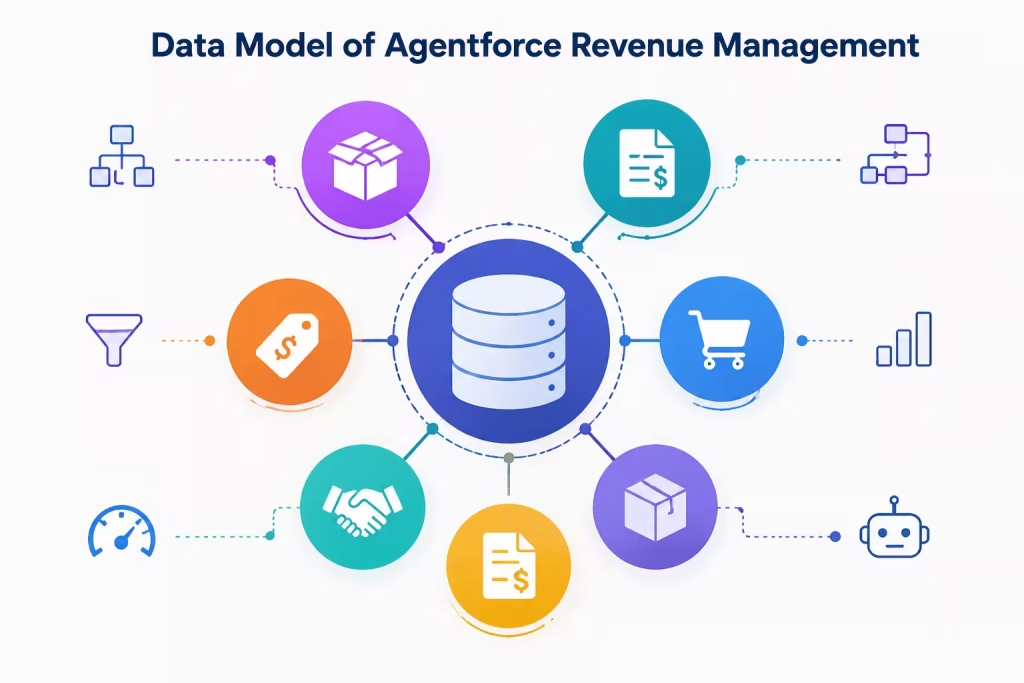
Agentforce Revenue Management is Salesforce’s metadata-driven quote-to-cash platform — the current generation of what was built and marketed as Revenue Cloud Advanced / Revenue Lifecycle Management. It’s built around a genuinely different architecture than legacy Salesforce CPQ, organized into a set of connected data models rather than a single monolithic object graph:
- Product Catalog Management — products, classifications, attributes, catalogs, and qualification rules
- Salesforce Pricing — pricing procedures, pricing elements, price books, cost books, and decision tables
- Rate Management — consumption-based rate cards and rate adjustments for usage products
- Product Configurator — the constraint rules engine and bundle configuration experience
- Transaction Management — Quote, Order, Asset, and Contract data models
- Dynamic Revenue Orchestrator — design-time and fulfillment objects for order decomposition and orchestration
- Usage Management — usage resources, consumption tracking, and billable usage
- Billing — invoicing, credit memos, debit memos, payments, and accounting
- Agentforce for Revenue Management — the agent and subagent layer sitting on top of all of the above
The reason Salesforce redesigned this from CPQ’s object model is largely about metadata vs. hard-coded records. In CPQ, product configuration logic (price rules, product rules, bundle logic) lived almost entirely in custom object records that had to be individually maintained and often duplicated across products. In Agentforce Revenue Management, much of that logic — attributes, qualification rules, pricing procedures — is defined once as reusable metadata and applied across many products, which is a fundamentally more scalable and AI-friendly architecture. It’s also why this platform is described as composable: you can activate Product Catalog Management, Pricing, and Billing independently, in coexistence with CPQ, or as a full quote-to-cash replacement.
Understanding the Revenue Management Data Model — The Layers
Before touching individual objects, architects need a mental model of how the layers stack. I typically explain it to clients in five layers:
| Layer | Purpose | Example Objects |
|---|
| Metadata / Definition Layer | Reusable rules, attributes, and logic that aren’t tied to a single record | Attribute, Attribute Category, Context Definition, Decision Table, Pricing Procedure |
| Catalog / Business Object Layer | The “what we sell” layer | Product, Product Classification, Catalog, Category, Product Selling Model |
| Configuration Layer | How a product gets tailored at the point of sale | Constraint Rules, Product Component Group, Qualification Rule |
| Transaction Layer | The commercial event itself | Quote, Quote Line Item, Order, Order Item |
| Post-Sale / Financial Layer | What the customer owns and owes | Asset, Contract, Billing Schedule, Invoice, Credit Memo, Debit Memo, Payment |
| AI Context Layer | How Agentforce reads across all of the above | Context Service, Context Definition, Context Mapping, Data Cloud |
The critical architectural insight is that Context Service is the connective tissue across every layer. Context Definitions describe “nodes” (containers) and “attributes” (fields) that get mapped to real Salesforce data or external data sources, then tagged so that Pricing Procedures, Qualification Rules, and Agentforce prompts can all query the same structured context without every module needing direct object-level knowledge of every other module. If you get Context Definition design wrong early, you’ll be re-mapping it in every subsequent phase of the project.
Core Data Model Objects
Below is the object-by-object breakdown I use when training a new architect on this platform. I’ve grouped these by the six official Salesforce data model families — Product Catalog Management, Salesforce Pricing, Rate Management, Transaction Management, Billing, and the AI/Context layer — because that’s how Salesforce documents them and how your metadata dependencies will actually behave in an org.
4.1 Product Catalog Management
Product
- Purpose: The core sellable item — goods, services, subscriptions, or usage-based offerings.
- Business Use: Every quote line, order line, and asset ultimately traces back to a Product.
- Key Relationships: Linked to Product Classification, Catalog Category, Attributes, and Product Selling Model.
- Example: A SaaS vendor models “Platform License – Enterprise Tier” as a Product with an associated Product Selling Model of “Subscription.”
- Best Practice: Don’t create near-duplicate Products for pricing variants — use Attributes and Price Adjustment Schedules instead. Duplicate products fragment reporting and confuse Agentforce recommendations.
- Performance Tip: Large catalogs (10,000+ SKUs) should lean on Product Catalog Management’s caching and indexing features rather than deeply nested classification trees, which slow down Product Discovery search.
Product Classification / Subclassification
- Purpose: Defines which Attributes apply to which families of Products, without repeating attribute definitions per product.
- Business Use: A telecom company classifies “Mobile Plans” separately from “Hardware,” each inheriting a different attribute set.
- Best Practice: Model classifications around how Sales and Finance actually segment revenue, not around org chart convenience.
Catalog / Category
- Purpose: The commercial presentation layer — how products are grouped and displayed for discovery, potentially per channel or audience.
- Example: A B2B distributor maintains separate catalogs for direct sales reps versus a self-service partner portal.
- Common Mistake: Treating Catalog structure as identical to Classification structure. They serve different purposes — classification drives attributes and rules; catalog drives navigation and visibility.
Attribute / Attribute Category
- Purpose: Metadata-defined characteristics (size, term, tier, region) that can be reused across many products instead of being modeled as picklists on each object.
- Best Practice: Centralize attribute governance early. Attributes are one of the most reused metadata types in the platform, and uncontrolled proliferation of near-duplicate attributes is one of the most common causes of pricing and configuration bugs I see in audits.
Product Discovery / Guided Product Selection
- Purpose: The search, filtering, and recommendation experience reps and self-service buyers use to find the right product, including semantic and faceted search.
- Business Use: A manufacturer with 40,000 SKUs uses faceted search plus guided assessment forms so a rep can find the correct configuration in seconds rather than scrolling a flat list.
- Performance Tip: Product Discovery depends on a healthy product index. Rebuild and monitor the index as part of your release cadence, not as an afterthought when reps start complaining about stale search results.
Qualification Rule
- Purpose: Determines which products a given customer, channel, or context is even eligible to purchase, evaluated through Decision Tables and Rule Procedures against a Context Definition.
- Example: A healthcare software vendor uses Qualification Rules to hide HIPAA-restricted modules from accounts that haven’t signed a BAA.
- Common Mistake: Building qualification logic in Apex when a Decision Table would be transparent, reusable, and maintainable by RevOps admins without a deployment.
4.2 Salesforce Pricing
Pricing Procedure
- Purpose: The sequenced, configurable engine that replaces CPQ’s Price Rules. A Pricing Procedure orchestrates an ordered set of Pricing Elements to calculate final price.
- Business Use: A single procedure calculates list price, applies volume tiers, layers on contract-based discounts, and rounds the result — all in a defined, inspectable sequence.
- Best Practice: Keep one well-governed default procedure and extend selectively per selling model rather than forking dozens of near-identical procedures.
Pricing Element
- Purpose: An individual calculation step inside a Pricing Procedure — list price lookup, volume/tier discount, attribute-based discount, proration, roll-up, rounding, and more.
- Performance Consideration: Every element you chain adds calculation overhead at scale (especially on large multi-line quotes). Use the Price Waterfall and Decision Explainer tooling to validate that every element is actually earning its place in the sequence.
Price Book / Cost Book
- Purpose: Price Books define list prices per Product per currency; Cost Books capture cost data used for margin analysis.
- Best Practice: Keep Cost Books in sync with Finance’s actual cost accounting cadence — stale cost data quietly corrupts margin dashboards long before anyone notices.
Price Adjustment Schedule
- Purpose: Tiered or scheduled discounting (volume tiers, ramp discounts) applied through Pricing Elements.
Decision Table
- Purpose: A structured, spreadsheet-like way to define business rules (pricing, qualification, discounting) without custom code, evaluated against Context Definitions.
- Best Practice: Decision Tables should be the default tool for RevOps-owned business logic. Reserve Apex hooks for genuinely complex logic that decision tables can’t express.
Charge / Product Selling Model
- Purpose: Product Selling Models define how a product is sold — one-time, subscription (evergreen or termed), or usage-based — and drive which pricing and billing behaviors apply.
- Example: The same “API Platform” Product might have two Selling Models: a termed annual subscription and a pay-as-you-go usage model, each with distinct pricing procedures.
4.3 Rate Management (Usage-Based Pricing)
Rate Card / Rate Card Entry
- Purpose: Defines base rates, tiered rates, and negotiated rate adjustments for usage resources.
- Business Use: A cloud infrastructure company rates API calls per thousand requests, with tiered discounts as monthly volume increases.
- Best Practice: Separate your standard rate cards from negotiated/contract-specific rate adjustments so standard pricing stays clean and auditable.
4.4 Transaction Management
Quote / Quote Line Item
- Purpose: Captures a proposed commercial configuration before commitment — products, quantities, discounts, and calculated pricing.
- Key Relationships: Quote Line Items reference Products (via Price Book Entries), Attributes, and the active Pricing Procedure; Quotes can sync to Opportunities.
- Common Mistake: Letting Quote fields and Opportunity fields drift out of alignment. When these two don’t match, forecast variance shows up almost immediately in RevOps reporting.
Order / Order Item (Order Product)
- Purpose: The committed, converted version of a Quote, used for fulfillment and billing.
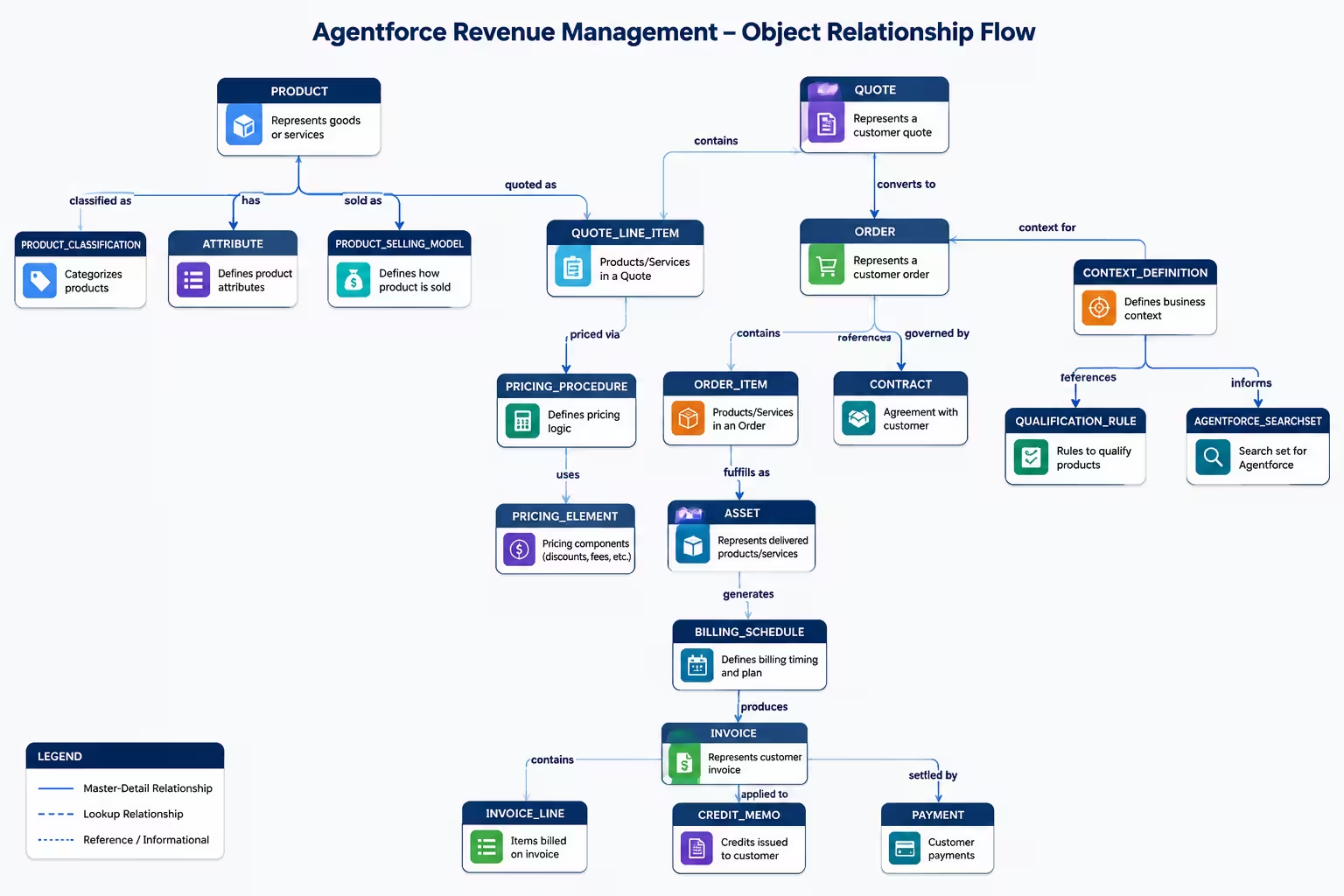
- Best Practice: Preserve a clean line-level link from Order Item back to the originating Quote Line — this traceability is what makes revenue audits and billing reconciliation possible later.
Asset
- Purpose: Represents what the customer actually owns after fulfillment — a subscription seat, license, or entitlement — created from Order Products and tracked through activation, amendment, upgrade, downgrade, and cancellation.
- Business Use: Renewal and upsell processes read directly off Asset state, not off the original Order, because the Asset reflects the customer’s current entitlement after amendments.
- Common Mistake: Treating Assets as static records. In a subscription business, Assets are living objects that change state constantly — architecture that doesn’t plan for amendment history will break renewal automation.
Contract
- Purpose: Captures commercial terms, billing schedule references, and contractual pricing agreements; connects to Salesforce Contracts (authoring/negotiation/obligations) as well as Transaction Management.
- Best Practice: Model contract-level pricing agreements deliberately — tiered contract pricing and cumulative quantity discounts depend on accurate contract-to-asset relationships.
4.5 Billing
Billing Schedule / Billing Schedule Group
- Purpose: Defines billing frequency, billing day-of-month, and proration behavior; generated from Orders or standalone transactions.
- Common Mistake: Underestimating proration edge cases (leap years, mid-cycle amendments, frequency changes). These are exactly the scenarios that generate the most support tickets post-go-live.
Invoice / Invoice Line
- Purpose: The generated bill, mapped back to Order Products or usage records at the line level, produced through Invoice Batch Runs.
- Best Practice: Keep Invoice line-level mapping intact all the way back to the Order Item — this is non-negotiable for accounts-receivable reconciliation.
Credit Memo / Debit Memo
- Purpose: Adjust invoices for returns, overcharges (Credit Memo), or undercharges/additional charges (Debit Memo).
Payment
- Purpose: Tracks processing, application to invoices, and refunds, including saved payment methods and payment schedules.
4.6 AI Context Layer
Context Service / Context Definition
- Purpose: Defines nodes, attributes, context tags, and data mappings that let Pricing Procedures, Qualification Rules, Dynamic Revenue Orchestrator, and Agentforce all query a consistent, governed slice of business data.
- Best Practice: Extend the standard Context Definitions (like the Sales Transaction context) rather than building parallel custom ones. Divergent context models are one of the fastest ways to make Agentforce agents give inconsistent answers.
Agentforce for Revenue Management (Subagents)
- Purpose: Purpose-built subagents — for example, Product Selection, Quote Management, Consumption Management, and Billing Employee Assistance — that read and act on the objects above through the same Context Service layer used by pricing and configuration.
- Architectural Note: Because these subagents rely on Context Definitions and standard object relationships rather than free-text prompts alone, the accuracy of your Revenue Cloud Object Model design has a direct, measurable effect on agent reliability.
Object Relationship Flow
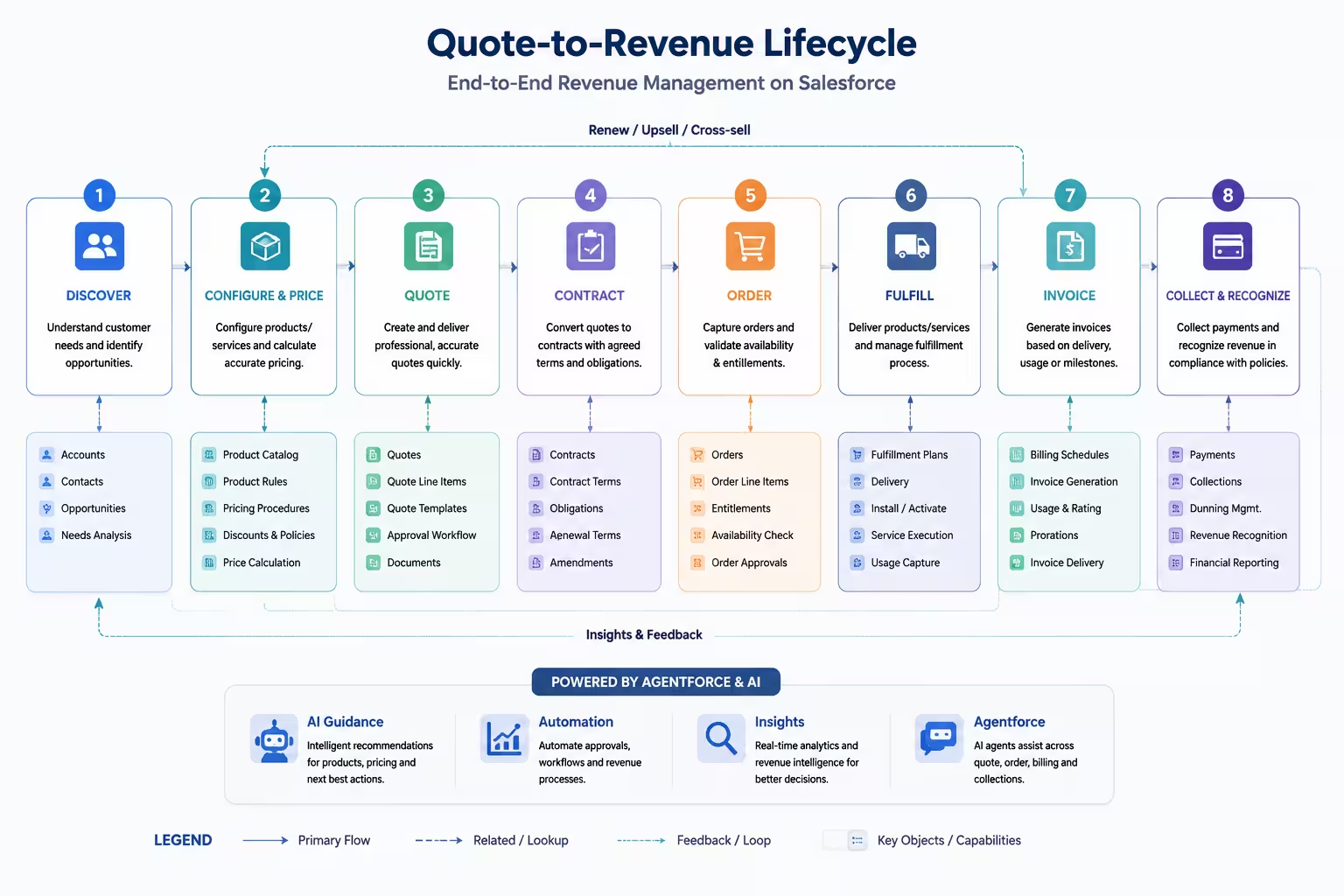
Quote-to-Revenue Lifecycle
How Agentforce Uses the Data Model
Agentforce subagents for Revenue Management don’t operate on vibes — they operate on structured retrieval across the objects above, mediated through Context Service. When a rep asks an agent “what’s this customer already subscribed to and what should I offer them next,” the agent is effectively:
- Resolving the Account/Contact into Context Definition nodes
- Reading Asset state (active entitlements, term end dates, amendment history)
- Cross-referencing Contract pricing agreements
- Checking Billing/Invoice health (payment history, disputes)
- Applying Qualification Rules to filter eligible upsell Products
- Running the relevant Pricing Procedure to project the new price
- Optionally enriching with Data Cloud profile data for behavioral or usage signals
If any one of those object relationships is inconsistent — say, Assets that were manually created outside the standard order-to-asset flow, or Context Definitions that were extended inconsistently across sandboxes — the agent’s answer degrades. This is precisely why structured data isn’t a nice-to-have for AI agents, it’s the entire foundation. Prompt engineering cannot compensate for a broken Revenue Cloud Object Model; it can only make the failure mode less obvious.
Agentforce Revenue Management vs. Salesforce CPQ Data Model
| Dimension | Salesforce CPQ | Agentforce Revenue Management |
|---|
| Architecture | Object-record-driven configuration | Metadata-driven, composable framework |
| Product Model | Product2 + Product Options/Bundles as child records | Product + Classification + reusable Attributes |
| Pricing | Price Rules (sequential, record-based) | Pricing Procedures + Pricing Elements (modular, reusable) |
| Configuration | Product Rules / Option Constraints | Constraint Rules Engine + Qualification Rules |
| Metadata | Largely record-based logic | Attributes, Context Definitions, Decision Tables as reusable metadata |
| Scalability | Degrades with catalog complexity/price rule volume | Designed for large, dynamic catalogs with indexing/caching |
| AI Readiness | Not natively designed for agent consumption | Built with Context Service specifically to support Agentforce |
| Billing | Requires separate Salesforce Billing product | Native Billing data model (Invoice, Credit/Debit Memo, Payments) |
| Subscription Management | Add-on via Salesforce Billing/Subscription Management | Native Asset lifecycle (amend, renew, ramp, cancel) |
| Extensibility | Apex-heavy customization | Apex hooks + Decision Tables + Procedure Plan framework |
| Future Roadmap | Maintenance mode; migration guidance published by Salesforce | Active investment area, including Agentforce and Data Cloud integration |
Note: Salesforce continues to support CPQ, and coexistence between CPQ and Agentforce Revenue Management is an explicitly supported migration path — this is not a forced “rip and replace.” The right approach depends on your catalog complexity, existing customization footprint, and AI roadmap.
Enterprise Implementation Best Practices
Naming Standards. Establish a naming convention for Products, Attributes, Context Definitions, and Pricing Procedures before a single record is created. Inconsistent naming is the single biggest driver of technical debt I see in year-two audits.
Product Catalog Design. Separate your classification hierarchy (drives attributes/rules) from your catalog/category hierarchy (drives navigation). Conflating the two locks you into a rigid structure that fights both Sales and Finance.
Metadata Governance. Attributes, Decision Tables, and Pricing Elements are reusable by design — but reusability without governance becomes duplication. Stand up a lightweight review process (even a simple change-control spreadsheet) before attribute count exceeds a few hundred.
Context Design. Extend standard Context Definitions rather than forking new ones per team. Document every context mapping change — this is the artifact your Agentforce troubleshooting will depend on later.
Pricing Strategy. Keep a single default Pricing Procedure and extend deliberately. Use the Price Waterfall and Decision Explainer tools during UAT, not just when something breaks in production.
Object Relationships. Enforce line-level traceability: Quote Line → Order Item → Asset → Billing Schedule → Invoice Line. This chain is what makes revenue recognition, renewals, and audits possible.
Large Data Volume (LDV) Strategy. For catalogs above roughly 10,000 SKUs or orgs processing high transaction volumes, plan indexing, archiving, and selective sharing rules from day one — retrofitting LDV strategy after go-live is exponentially more expensive.
Performance Optimization. Audit Pricing Procedure element count and Qualification Rule complexity regularly. Every additional element or nested rule adds calculation time on multi-line quotes.
Deployment Strategy. Use the Procedure Plan export/import framework and metadata-aware deployment tooling rather than manual configuration across sandboxes — manual drift between environments is a top source of “it worked in the sandbox” defects.
Security. Model record sharing deliberately across Product, Quote, Order, Asset, and Billing objects — especially in partner/Experience Cloud scenarios where visibility rules differ from internal sales teams.
Data Quality. Build validation into Product Discovery and Qualification Rules rather than relying purely on post-hoc data cleanup. Bad data caught at quote time is dramatically cheaper than bad data caught at renewal time.
Common Implementation Mistakes
- Duplicating Products instead of using Attributes Problem: Teams create near-identical Products for every price variant. Business Impact: Fragmented reporting, confusing catalogs, inconsistent Agentforce recommendations. Technical Impact: Bloated catalog, harder indexing, slower Product Discovery. Solution: Model variation through Attributes and Price Adjustment Schedules.
- Skipping Context Definition governance Problem: Multiple teams extend Context Definitions independently. Business Impact: Inconsistent pricing and agent answers across business units. Technical Impact: Broken mappings, unpredictable Qualification Rule behavior. Solution: Centralize Context Definition ownership under a single architecture team.
- Overloading a single Pricing Procedure Problem: One procedure tries to handle every business unit’s logic via nested conditionals. Business Impact: Pricing becomes a black box to RevOps. Technical Impact: Calculation performance degrades on complex quotes. Solution: Use multiple governed procedures selected by Product Selling Model or context tag, not conditional spaghetti in one.
- Breaking line-level traceability Problem: Custom integrations write Orders or Assets without preserving the Quote Line → Order Item link. Business Impact: Revenue recognition and billing reconciliation become manual, error-prone processes. Technical Impact: Broken reporting joins, audit failures. Solution: Enforce traceability in every integration and migration script.
- Treating Assets as static records Problem: No plan for amendment, upgrade, or ramp history. Business Impact: Renewal quotes reference stale entitlements. Technical Impact: Asset state and Contract terms drift apart. Solution: Design Asset lifecycle flows (amend/renew/cancel) explicitly, including historical state tracking.
- Ignoring Large Data Volume design until go-live Problem: No indexing or archiving strategy for large catalogs/transaction volumes. Business Impact: Slow quoting experience frustrates sales reps and kills adoption. Technical Impact: Search and pricing calculation timeouts. Solution: Plan LDV architecture (indexing, selective sharing, archiving) during design, not after complaints start.
- Custom Apex where a Decision Table would work Problem: Developers default to Apex triggers for business rules RevOps should own. Business Impact: Every pricing/qualification change requires a deployment. Technical Impact: Slower iteration, higher regression risk. Solution: Default to Decision Tables and Rule Procedures; reserve Apex hooks for genuinely complex logic.
- Misaligned Quote and Opportunity fields Problem: Amount, close date, and forecast category drift from Quote totals. Business Impact: Forecast variance and executive distrust of Salesforce numbers. Technical Impact: Broken sync automation. Solution: Define and enforce a single field-mapping standard between Opportunity and Quote.
- Weak Billing-to-Order mapping Problem: Billing Schedules generated without clean references back to Order Products. Business Impact: Accounts receivable reconciliation becomes a spreadsheet exercise. Technical Impact: Invoice line data can’t be traced to its commercial origin. Solution: Validate billing schedule generation logic against Order Item references in every release.
- Underestimating proration and billing-cycle edge cases Problem: Teams test happy-path billing but not mid-cycle amendments, frequency changes, or leap-year proration. Business Impact: Billing disputes and customer trust erosion. Technical Impact: High volume of manual invoice corrections. Solution: Build explicit test scenarios for every proration and billing-cycle edge case before go-live.
Real Enterprise Example: SaaS Subscription + Services + Usage + Renewal
Consider a mid-market SaaS company selling a platform subscription, implementation professional services, a usage-based API add-on, and an annual renewal. Here’s what actually gets created across the Agentforce Revenue Management data model:
At quoting: A Quote is created with four Quote Line Items, each referencing a Product (Platform License, Professional Services, API Usage Add-on, and an implicit renewal-eligible term). The Pricing Procedure runs per line — list price for the subscription and services lines, and a Rate Card lookup through Rate Management for the usage line. Qualification Rules confirm the customer’s region and tier are eligible for each product.
At order conversion: The Quote converts to an Order with four Order Items. The professional services line may route through Dynamic Revenue Orchestrator for fulfillment task creation; the subscription and usage lines generate Assets representing the platform license and the usage entitlement.
At fulfillment: Assets are activated. The Contract captures the term, billing schedule reference, and any negotiated contract pricing (for example, a tiered discount on API usage above a committed volume).
At billing: A Billing Schedule Group generates recurring Invoices for the subscription; a one-time Invoice bills the professional services; usage is metered through Usage Management and rated via Rate Management before being billed on the next cycle’s Invoice. Payments are applied against each Invoice, with Credit/Debit Memos available for any adjustments.
At renewal: Twelve months later, the Asset’s term-end triggers a renewal quote. Agentforce’s Quote Management subagent can read the Asset’s current entitlements and Contract pricing agreement to pre-populate a renewal quote — and, if usage data shows the customer consistently exceeding their committed API volume, a Consumption Management subagent can surface an upsell recommendation for a higher usage tier, grounded in actual Usage Management data rather than a guess.
This single scenario touches nearly every object family covered in Section 4 — which is exactly why data model discipline, not configuration cleverness, determines whether this flow works reliably at enterprise scale.
The Future of Agentforce Revenue Management
Salesforce’s stated direction — consistent with what’s documented for Agentforce for Revenue Management today — points toward deeper integration between transactional revenue data and AI agents:
- Expanded subagent coverage across product selection, quote management, consumption management, and billing service assistance, reducing manual quote-building and billing triage work.
- Deeper Data Cloud integration, letting Agentforce reason over behavioral and usage signals alongside core CRM/revenue data rather than CRM data alone.
- Promotions and dynamic pricing capabilities (currently rolling out as beta functionality in recent releases), suggesting more automated, rules-driven discounting scenarios.
- Predictive risk and revenue intelligence, including features like invoice risk scoring, which point toward AI increasingly informing collections and revenue operations decisions, not just sales quoting.
As with any actively developed product line, exact feature availability depends on your release train and licensing — treat roadmap items as directional rather than committed until you see them in your org’s release notes.
The Future of Agentforce Revenue Management
Salesforce’s stated direction — consistent with what’s documented for Agentforce for Revenue Management today — points toward deeper integration between transactional revenue data and AI agents:
- Expanded subagent coverage across product selection, quote management, consumption management, and billing service assistance, reducing manual quote-building and billing triage work.
- Deeper Data Cloud integration, letting Agentforce reason over behavioral and usage signals alongside core CRM/revenue data rather than CRM data alone.
- Promotions and dynamic pricing capabilities (currently rolling out as beta functionality in recent releases), suggesting more automated, rules-driven discounting scenarios.
- Predictive risk and revenue intelligence, including features like invoice risk scoring, which point toward AI increasingly informing collections and revenue operations decisions, not just sales quoting.
As with any actively developed product line, exact feature availability depends on your release train and licensing — treat roadmap items as directional rather than committed until you see them in your org’s release notes.





 Salesforce ERP
 ERP + CRM Platform
  Inventory Management
  Warehouse Management
  Order Management
  Vendor Management
  Logistics Management
  BOM Management
  Order Fulfillment
  Business Operations
  SaaS Platform for Operations
  Salesforce Cloud ERP Platform
  Xero
Xero
 Zoho books
 Quickbooks
 Shopify
 Acumatica
 SAP
SAP
 Odoo
Odoo
 NetSuite
 Microsoft Dynamics 365
 Sage
Sage


 Agentforce Revenue Management
 Agentforce Revenue Management + Billing
  Salesforce CPQ
 Salesforce Advanced Billing
  Migrate from CPQ to ARM
  Managed Services
 Salesforce Implementation
 Revenue Cloud Implementation
 ServiceNow Consulting Services
 Zoho CRM implementation
 MuleSoft Integration
 Workato Integration
 Microsoft
 Data Cloud
 Tableau
 ·
July 30, 2026
·
21 min read
·
July 30, 2026
·
21 min read
Saurabh Wankhede, 05 August, 2026
test done