If you’re running a product-driven business on Salesforce and still managing inventory through spreadsheets, disconnected ERP systems, or bolt-on tools that barely talk to your CRM — you’re leaving money on the table every single day.
The right Salesforce Inventory Management Solution doesn’t just track stock. It connects your sales pipeline, fulfillment operations, purchasing, and customer data into one unified system. It eliminates the manual handoffs, costly stockouts, and order errors that erode margins and damage customer trust.
But here’s the challenge: the Salesforce AppExchange lists dozens of inventory management apps, and not all of them are built the same way. Choosing the wrong one can cost you more in rework, re-implementation, and lost productivity than staying with your legacy system.
This guide cuts through the noise. You’ll get a clear, expert framework for evaluating, comparing, and selecting the Salesforce Inventory Management Solution that’s the right fit for your specific business — right now and as you scale.
Why Inventory Management on Salesforce Matters More Than Ever
Inventory inefficiency is not a minor operational issue. According to research by the IHL Group, inventory distortion — the combined cost of overstocks and out-of-stocks — costs global retailers approximately $1.77 trillion annually. For product-driven businesses, inventory accuracy is directly tied to revenue, customer experience, and cash flow.
Traditional standalone ERP systems address inventory in isolation. They don’t know what your sales team just promised a customer. They don’t see which deals are in your pipeline. They can’t trigger a reorder when a high-value opportunity moves to Closed Won.
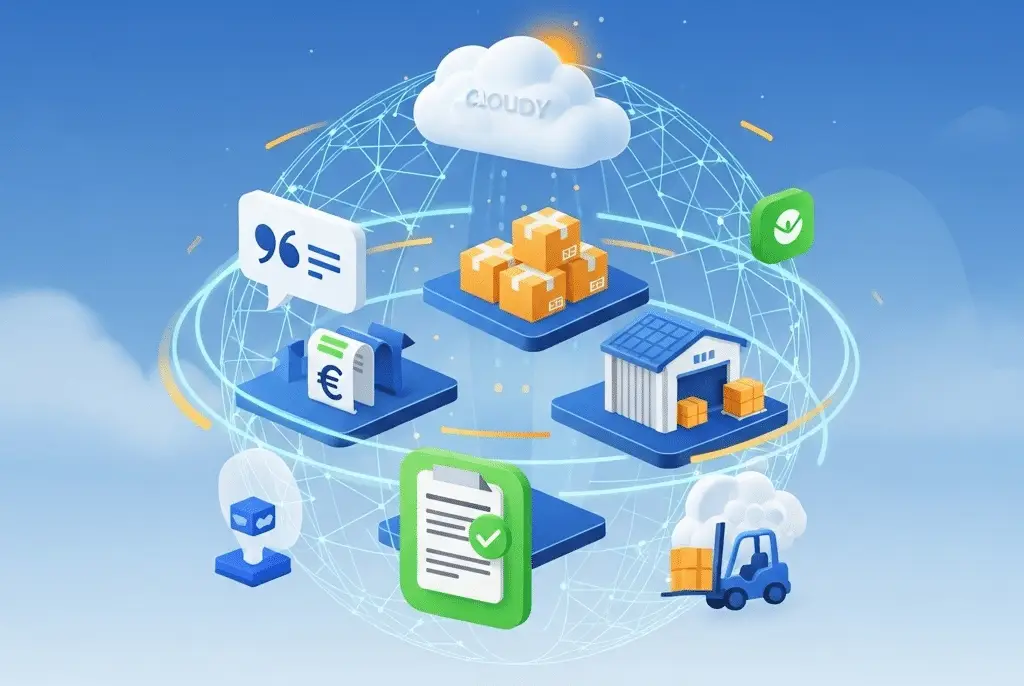
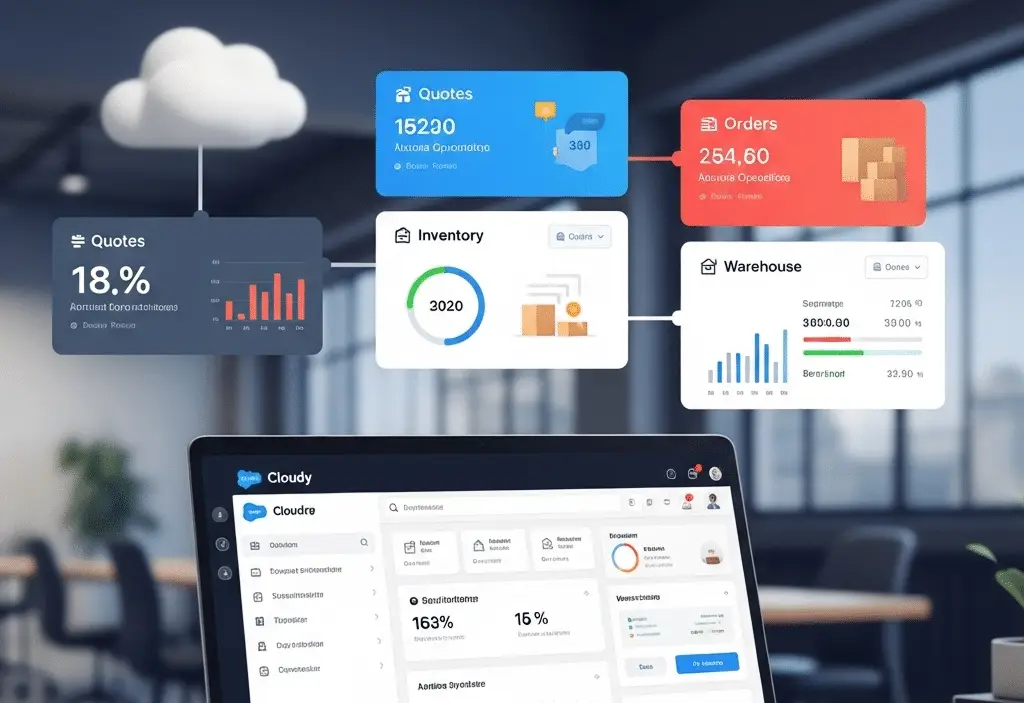
A native or deeply integrated Salesforce Inventory Management Solution changes this entirely. It creates a closed loop between:
- Sales data — opportunities, quotes, and orders
- Inventory data — stock levels, warehouse locations, reorder points
- Fulfillment data — shipments, delivery tracking, returns
- Financial data — COGS, margins, billing
According to Salesforce’s own State of Commerce report, 73% of business buyers say they expect companies to understand their unique needs and expectations. Without real-time inventory visibility tied to your CRM, delivering that experience is nearly impossible.
Key Features to Look for in a Salesforce Inventory Management Solution
Before you evaluate any specific product, get clear on what capabilities your business actually needs. The following features represent the non-negotiables and the differentiators.
Core Inventory Features (Must-Haves)
Every credible Salesforce Inventory Management Solution should include:
- Real-time stock tracking — Live visibility into on-hand quantities, reserved stock, and available-to-promise inventory across all locations
- Multi-warehouse and multi-location support — Manage inventory across multiple warehouses, stores, or distribution centers from a single interface
- Reorder point and purchase order automation — Automatically trigger purchase orders when stock falls below defined thresholds
- Lot and serial number tracking — Essential for regulated industries (healthcare, food, electronics) requiring full traceability
- Product bundling and kitting — Support for assembled or bundled products with component-level inventory tracking
- Return and refund management — Streamlined RMA workflows tied to the original sales order and customer record
Salesforce-Specific Integration Features (Differentiators)
This is where the real competitive advantage lies. Prioritize solutions that offer:
- Native Salesforce objects — Built on Salesforce’s data model (not just integrated via API), meaning inventory data lives inside Salesforce, not in a parallel system
- Opportunity-to-fulfillment workflow — Inventory checks and reservations triggered directly from Salesforce opportunities or quotes
- Salesforce Flow and Process Builder compatibility — Ability to automate inventory workflows using Salesforce’s native automation tools
- Einstein Analytics / Tableau CRM dashboards — Inventory reporting built into Salesforce’s analytics layer
- AppExchange managed package — Fully maintained, upgradeable app that receives regular updates without breaking your customizations
- Salesforce CPQ integration — Syncs product availability with your quoting and configure-price-quote workflows
Advanced Features for Scaling Businesses
As your business grows, these capabilities become increasingly important:
- Demand forecasting — AI-driven prediction of future inventory needs based on historical sales data and pipeline
- Multi-currency support — Essential for businesses operating in multiple countries
- Barcode and QR code scanning — Mobile-friendly scanning for receiving, picking, and stocktaking
- EDI and supplier integration — Electronic data interchange with suppliers for automated purchase order processing
- Consignment inventory tracking — For businesses managing supplier-owned stock
- Landed cost calculation — Full cost visibility including freight, duties, and handling fees
7 Critical Questions to Ask Before Choosing a Salesforce Inventory Management Solution
Don’t start evaluating products until you can answer these questions about your own business.
1. Is the Solution Truly Native to Salesforce — or Just Integrated?
This is the single most important question. There’s a meaningful difference between:
- Native solutions — Built entirely on the Salesforce platform using Salesforce objects, Apex code, Lightning components, and standard Salesforce security. Your data lives in Salesforce. No sync required.
- Integrated solutions — Separate applications that connect to Salesforce via API. Data is replicated between two systems, creating sync delays, duplication risks, and additional failure points.
Native solutions offer better performance, simpler administration, and a more seamless user experience. They also eliminate the hidden costs of maintaining API integrations and managing data conflicts between systems.
Ask any vendor: “Does our inventory data live in Salesforce objects, or in your separate database?”
2. What Is Your Inventory Complexity?
Different businesses have wildly different inventory requirements:
| Business Type | Typical Needs |
|---|
| Wholesale / Distribution | Multi-warehouse, lot tracking, EDI |
| Manufacturing | BOM, work-in-progress, component tracking |
| Retail / eCommerce | SKU management, returns, multi-channel sync |
| Field Services | Parts and equipment tracking per job |
| Subscription Businesses | Usage-based inventory, recurring order management |
Matching the solution’s architecture to your inventory complexity avoids both under-buying (missing critical features) and over-buying (paying for complexity you don’t need).
3. How Does It Handle the Quote-to-Cash Process?
Inventory management doesn’t exist in isolation — it’s part of a broader operational flow. Ask how the solution handles:
- Stock reservation at quote stage — Can it reserve inventory when a quote is sent, not just when the order is confirmed?
- Real-time availability checks during CPQ — Can sales reps see live stock levels while building a quote?
- Automatic fulfillment trigger — Does a Closed Won opportunity automatically initiate a pick/pack/ship workflow?
Solutions that handle this end-to-end within Salesforce eliminate the handoff gaps that cause fulfillment errors and customer disappointment.
4. What Are the Total Cost of Ownership Implications?
The AppExchange listing price is rarely the full story. Calculate total cost across:
- License fees — Per-user or per-org pricing models
- Implementation costs — Configuration, data migration, and integration work
- Training costs — Time investment for your team
- Ongoing admin costs — Who maintains it internally?
- Upgrade costs — Does the vendor charge for major version upgrades?
- Integration costs — Do you need additional connectors for your ERP, 3PL, or eCommerce platform?
According to Panorama Consulting’s annual ERP Report, organizations that underestimate total cost of ownership by more than 25% are significantly more likely to report project failure. Get a fully loaded cost estimate before committing.
5. Does It Scale With Your Business?
The solution that works for 10,000 SKUs may buckle at 100,000. The setup that handles one warehouse may struggle with five. Ask vendors directly:
- What is the maximum number of SKUs, transactions, or warehouses supported?
- How does performance hold up at your expected transaction volume?
- Are there architectural limits that would require re-implementation as you grow?
- What do their largest customers look like, and can they provide references?
6. How Are Users Actually Adopting It?
The best inventory system in the world delivers zero ROI if your warehouse staff, procurement team, or sales reps won’t use it. Evaluate:
- Mobile accessibility — Can warehouse staff use it on a phone or tablet for receiving, picking, and counting?
- User interface quality — Is the Lightning UI clean, fast, and intuitive?
- Training resources — Does the vendor provide documentation, video tutorials, or Trailhead modules?
- Salesforce familiarity — If your team already uses Salesforce, a native solution dramatically reduces the adoption barrier
7. What Does the Vendor’s Support and Roadmap Look Like?
You’re not just buying a product — you’re entering a long-term relationship with a vendor. Research:
- AppExchange reviews and ratings (look for recency and response patterns)
- Support response time commitments (SLA)
- Frequency of updates and releases
- Evidence of active product development (release notes, changelog)
- Community and partner ecosystem around the product
A vendor with 4.5+ stars on AppExchange and consistent release notes is a safer bet than a newer entrant with limited track record.
Top Salesforce Inventory Management Solutions Compared
Here is an objective comparison of the most widely used Salesforce-native and Salesforce-integrated inventory management solutions:
| Solution | Native to Salesforce | Best For | Key Strength | AppExchange Rating |
|---|
| Cloudy Business Ops 360 | ✅ Yes | SMB to Mid-Market, Distribution | All-in-one ERP + inventory, fast implementation | ⭐ 4.8+ |
| Rootstock ERP | ✅ Yes | Manufacturing, Distribution | Deep manufacturing/MRP capabilities | ⭐ 4.7 |
| Skuid / Custom Build | ✅ Yes | Enterprises with unique workflows | Full customization via Salesforce platform | Varies |
| inFlow Inventory | ❌ Integrated | SMBs needing simple tracking | Ease of use, low cost | ⭐ 4.3 |
| Fishbowl | ❌ Integrated | QuickBooks users expanding | QuickBooks + Salesforce bridge | ⭐ 3.9 |
| Cin7 | ❌ Integrated | Multi-channel retail | Omnichannel inventory sync | ⭐ 4.1 |
| Certinia (FinancialForce) | ✅ Yes | Professional Services | PSA + financials integration | ⭐ 4.5 |
Note: AppExchange ratings are indicative and subject to change. Always verify current ratings and read recent reviews before making a decision.
How to Evaluate Salesforce Inventory Management Solutions: A Step-by-Step Process
Follow this structured evaluation process to make a confident, data-driven decision.
Step 1: Document Your Current State
Before looking at any vendor, map out:
- Current inventory workflows (receiving, storage, picking, shipping, returns)
- Pain points and failure modes in the current process
- Systems currently in use (ERP, WMS, accounting, eCommerce)
- Data volumes (SKU count, daily transaction volume, warehouse count)
- Team structure (who manages inventory, who needs visibility)
Step 2: Define Your Requirements
Convert your pain points into functional requirements. Separate them into:
- Must-have — The solution cannot be selected without these
- Should-have — Important but not dealbreakers
- Nice-to-have — Value-adds if available
Weight each requirement by business impact to build a scoring framework.
Step 3: Shortlist 3–5 Vendors
Based on your requirements, identify 3–5 solutions that appear to match. Use:
- Salesforce AppExchange search with your industry and use case
- G2 and Capterra reviews for unfiltered user feedback
- Peer recommendations from your Salesforce User Group or partner network
Step 4: Run Structured Demos
Don’t accept generic product demos. Provide each vendor with your specific scenarios and ask them to demonstrate:
- How your most complex inventory workflow is handled
- How it integrates with your existing Salesforce configuration
- How a new warehouse or product line would be added
- What happens when stock goes negative or a sync fails
Step 5: Conduct a Proof of Concept (POC)
For solutions that pass the demo stage, request a sandbox trial or POC environment with your actual data and workflows. A 2–4 week POC with your real users is the most reliable predictor of long-term success.
Step 6: Evaluate References
Request 2–3 customer references in your industry and company size range. Ask references specifically:
- How long did implementation take versus the original estimate?
- What problems emerged after go-live?
- How has the vendor’s support been?
- Would you choose this solution again?
Step 7: Negotiate the Contract
Don’t accept the first pricing proposal. Key areas to negotiate:
- User licensing model (named vs. concurrent)
- Implementation support inclusion
- Multi-year discount
- Exit clauses and data portability
- SLA commitments and penalty provisions
Common Mistakes to Avoid When Choosing a Salesforce Inventory Management Solution
Learning from others’ mistakes saves you months of frustration and thousands in wasted investment.
Mistake 1: Prioritizing price over fit The cheapest solution rarely delivers the best ROI. A $5,000/year tool that requires $50,000 in custom development to fit your workflows is not a bargain.
Mistake 2: Skipping the data migration plan Data quality problems discovered after go-live are catastrophic. Invest time in data cleansing and migration planning before implementation begins.
Mistake 3: Evaluating without end users Procurement or IT selecting a tool without involving the warehouse managers, purchasing staff, and sales reps who will use it daily is a reliable recipe for poor adoption.
Mistake 4: Underestimating change management Even the best solution requires a structured change management plan. Budget time and resources for training, process documentation, and post-go-live support.
Mistake 5: Choosing a vendor without a Salesforce-first mindset Some inventory solutions were built for other platforms and later added Salesforce integration as an afterthought. These solutions never achieve the depth of native integration — and it shows in the user experience and data reliability.
Industry-Specific Considerations
Manufacturing
Manufacturing businesses need inventory solutions that support Bill of Materials (BOM), work-in-progress (WIP) tracking, and production order management. Solutions like Rootstock ERP are purpose-built for this complexity. Ensure your chosen solution handles both raw material and finished goods inventory simultaneously.
Wholesale and Distribution
Distribution businesses prioritize pick, pack, and ship workflows, multi-warehouse management, lot/batch tracking, and EDI supplier connectivity. Speed and accuracy at the warehouse level are paramount. Mobile scanning capability is often non-negotiable.
Retail and eCommerce
Retailers need real-time multi-channel inventory sync to prevent overselling across Shopify, Amazon, physical stores, and direct sales channels. Returns management and accurate COGS calculation are critical for margin visibility.
Professional Services
Project-based businesses need inventory tied to specific projects, jobs, or work orders — not just general stock levels. Look for solutions that allow inventory consumption to be tracked against Salesforce project records.
The Role of AI in Modern Salesforce Inventory Management
Artificial intelligence is no longer a futuristic add-on in inventory management — it’s rapidly becoming a baseline expectation. Leading Salesforce Inventory Management Solutions are incorporating AI in several key ways:
- Demand forecasting — Machine learning models that analyze historical sales data, seasonal patterns, and pipeline data to predict future inventory needs with significantly higher accuracy than rule-based reorder points
- Anomaly detection — AI-powered alerts when inventory data shows unusual patterns (unexpected drops, potential theft, data entry errors)
- Supplier performance scoring — Automated analysis of supplier lead times, fill rates, and quality metrics to optimize purchasing decisions
- Einstein integration — Native Salesforce Einstein capabilities applied to inventory data for predictive insights and recommendations
Gartner predicts that by 2026, more than 75% of commercial supply chain management application vendors will have embedded advanced AI and data science into their core platforms. Choosing a solution with a credible AI roadmap today protects your investment for the future.
Conclusion: Making the Right Choice
Selecting the right Salesforce Inventory Management Solution is one of the highest-leverage technology decisions a product-driven business can make. Done right, it eliminates data silos, accelerates your order cycle, reduces carrying costs, and gives every team — from sales to finance to the warehouse floor — the real-time visibility they need to do their jobs well.
Done wrong, it creates a new set of problems: expensive customizations, poor user adoption, sync failures, and a system that doesn’t grow with your business.
Key Takeaways:
- Prioritize native Salesforce solutions over integrated third-party apps wherever possible
- Match the solution’s complexity to your actual business needs — don’t over-buy
- Evaluate total cost of ownership, not just license price
- Involve end users in demos, POC, and go-live planning
- Choose a vendor with a strong AppExchange track record and an active AI roadmap
- Plan your data migration with the same rigor as the implementation itself
The best Salesforce Inventory Management Solution for your business is the one that fits your workflows today, scales with your growth tomorrow, and keeps your team in one platform — Salesforce — where every customer, order, and inventory decision is connected.
References and Further Reading






 Salesforce ERP
 ERP + CRM Platform
  Inventory Management
  Warehouse Management
  Order Management
  Vendor Management
  Logistics Management
  BOM Management
  Order Fulfillment
  Business Operations
  SaaS Platform for Operations
  Salesforce Cloud ERP Platform
  Xero
Xero
 Zoho books
 Quickbooks
 Shopify
 Acumatica
 SAP
SAP
 Odoo
Odoo
 NetSuite
 Microsoft Dynamics 365
 Sage
Sage

 Agentforce Revenue Management
 Agentforce Revenue Management + Billing
  Salesforce CPQ
 Salesforce Advanced Billing
  Migrate from CPQ to Agentforce Revenue Management
  Microsoft
 Data Cloud
 Tableau
 ·
May 7, 2026
·
13 min read
·
May 7, 2026
·
13 min read