
Cloudy Business Ops 360 vs Microsoft Dynamics 365
Two Unified Business Platforms — One Built on Salesforce, One on Microsoft
Microsoft Dynamics 365 Business Central is a capable cloud ERP that's a natural fit for Microsoft-centric businesses. Cloudy Business Ops 360 is its mirror image for the Salesforce world — unifying orders, inventory, procurement, and finance with your existing Salesforce CRM, live in days, with transparent per-user pricing.
Cloudy Business Ops 360 vs Microsoft Dynamics 365: The Quick Verdict
Choose Microsoft Dynamics 365 if…
Your business runs on the Microsoft stack — Office 365, Excel, Outlook, Teams, Power BI, and Azure — and you want a cloud ERP that plugs deeply into that ecosystem, with embedded CRM and Copilot.
Choose Cloudy Business Ops 360 if…
You run on (or want) Salesforce and you want unified operations — orders, inventory, procurement, manufacturing, logistics, billing — connected to your CRM, live in days, with transparent per-user pricing and no separate ERP to integrate.
The core difference: Both are strong "unified platform" plays — the deciding factor is which ecosystem you already live in. Dynamics is native to Microsoft; Cloudy Business Ops 360 is native to Salesforce. If Salesforce is your system of record, Cloudy Business Ops 360 keeps everything on one platform.
Cloudy Business Ops 360 vs Microsoft Dynamics 365 at a Glance
| Cloudy Business Ops 360 | Microsoft Dynamics 365 (Business Central) | |
|---|---|---|
| Platform | 100% native to Salesforce | Native to Microsoft (Azure) |
| CRM + operations | Unified on Salesforce CRM | Embedded CRM; separate from Salesforce |
| Best fit | SMB–mid-market on Salesforce | SMB–mid-market on the Microsoft stack |
| Time to go live | Days to a week | Typically 3–6 months |
| Pricing (published) | From $40/user/month | Essentials ~$70–80/user/mo; Premium ~$110/user/mo |
| Team/light user | Included per plan | Team Members ~$8/user/mo (limited) |
| Implementation | Configurable, no coding | Partner-led (no direct Microsoft delivery) |
| Ecosystem strength | Salesforce + AppExchange | Microsoft 365, Power BI, Azure, Copilot |
| Manufacturing | Multi-level BOM, batches | Premium tier (adds manufacturing) |
| Updates | Automatic Salesforce releases | Two major cloud updates/year |
// "Dynamics 365" spans many apps; this compares Business Central, Microsoft's SMB/mid-market ERP. Prices are Microsoft list prices as of 2026; total cost depends on modules, users, and implementation.
The Four Differences That Actually Matter
Native to Salesforce vs. Native to Microsoft
This is the real decision. Business Central's biggest genuine strength is how deeply it integrates with the Microsoft ecosystem — Outlook, Excel, Teams, Power BI, Azure, and Copilot. For an organization already all-in on Microsoft, that coherence has real operational value.
Cloudy Business Ops 360 delivers exactly that same advantage — for the Salesforce world. It's built 100% natively on Salesforce, so your operations and your CRM share one data model, one security layer, and one interface. If your sales and service teams already work in Salesforce, your orders, inventory, procurement, and finance now live there too.
What it means for you: Pick the platform native to the ecosystem you already run. If that's Microsoft, Business Central fits. If that's Salesforce, Cloudy Business Ops 360 keeps everything unified without a second platform to integrate.
Unified with Salesforce CRM vs. Microsoft's Embedded CRM
Business Central includes basic embedded CRM features, and Microsoft offers Dynamics 365 Sales for deeper CRM. That works well if Microsoft is your CRM platform — but if you use Salesforce, Business Central means running CRM and ERP on two different vendors' clouds and connecting them.
Cloudy Business Ops 360 doesn't add a second CRM — it runs on your Salesforce CRM. There's no integration to build, no duplicate customer records, and no sync to maintain between operations and sales.
What it means for you: If Salesforce is your CRM, Cloudy Business Ops 360 avoids the two-platform split entirely. If you'd rather standardize CRM on Microsoft, Dynamics is the coherent choice.
Live in Days vs. a Multi-Month Implementation
Cloudy Business Ops 360 is configurable out of the box, with most businesses live in under a week and no custom development required.
Business Central is sold and implemented exclusively through Microsoft's certified partner network — Microsoft doesn't implement it directly. Standard deployments typically take 3–6 months, and more complex or manufacturing rollouts can run longer, with implementation costs commonly ranging from around $40,000 to $100,000+ depending on scope and partner.
What it means for you: For fast operational visibility without a lengthy project, Cloudy Business Ops 360 gets you there quickly. For a full Microsoft-stack ERP rollout, Business Central's partner-led model is built for that scope.
Transparent Per-User Pricing on Either Side — But Watch the TCO
Credit where due: Business Central pricing is unusually transparent for the ERP market — Microsoft publishes its per-user list prices (Essentials around $70–$80/user/month, Premium around $110/user/month, Team Members around $8/user/month for light access).
Cloudy Business Ops 360 is also transparent, starting at $40/user/month with operations modules included. On both platforms, the license is only part of the story — but Cloudy Business Ops 360's days-not-months, no-code deployment keeps implementation cost and time far lower, while Business Central's partner-led implementation is typically the largest year-one cost.
What it means for you: Compare total cost, not just license price. Cloudy Business Ops 360's lower entry price and fast configuration reduce total cost to value; Business Central's transparent licensing is a plus, but budget for partner implementation.
Feature-by-Feature: Cloudy Business Ops 360 vs Microsoft Dynamics 365
| Capability | Cloudy Business Ops 360 | Dynamics 365 Business Central |
|---|---|---|
| Salesforce-native | ✓ 100% native | ✗ Microsoft-native |
| Unified with Salesforce CRM | ✓ One data model | ~ Via integration |
| Microsoft 365 / Power BI integration | ~ Via API | ✓ Deep, native |
| Order management | ✓ Built in | ✓ Built in |
| Inventory management | ✓ Real-time, multi-location | ✓ Strong |
| Warehouse management | ✓ Bins, pick-pack-ship | ✓ Advanced (Premium) |
| Procurement & vendors | ✓ PO-to-bill matching | ✓ Comprehensive |
| Manufacturing / BOM | ✓ Multi-level BOM, batches | ✓ Premium tier |
| Logistics & shipments | ✓ Carrier tracking, returns | ✓ Available |
| Accounting / financials | ~ Native + QuickBooks/Xero/Zoho | ✓ Full financials |
| Deployment time | ✓ Days | ~ 3–6 months |
| Pricing transparency | ✓ Published per-user | ✓ Published per-user |
| No-code configuration | ✓ Clicks-not-code | ~ Partner-led setup |
| Implementation model | ✓ Direct / Cloudy Wave | ~ Microsoft partner only |
| Best for Microsoft-stack shops | ~ Via integration | ✓ Strong |
When Microsoft Dynamics 365 Is the Right Choice — and When Cloudy Business Ops 360 Is
Choose Microsoft Dynamics 365 Business Central when:
- Your business is all-in on Microsoft — Office 365, Teams, Power BI, Azure, Copilot.
- You want a cloud ERP with embedded CRM native to the Microsoft ecosystem.
- You have a strong Microsoft implementation partner and budget for a 3–6 month rollout.
- Deep Excel, Outlook, and Power BI workflows are central to how your team works.
Choose Cloudy Business Ops 360 when:
- You already run on Salesforce (or want to) and want operations unified with your CRM.
- You want to go live in days, not months, with no separate ERP to integrate.
- You want transparent per-user pricing and configurable, no-code setup.
- You're a product business focused on orders, inventory, procurement, manufacturing, and logistics.
Not always either/or: Cloudy Business Ops 360 connects to external systems — including Microsoft tools — via open REST APIs, so businesses can integrate where it makes sense.
Everything Cloudy Business Ops 360 Runs on Salesforce
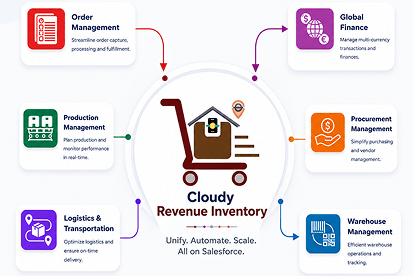
One platform, nine integrated modules, already connected — no integration project required, and all included rather than split across tiers.
Connected to the Tools You Already Use
Enterprise-Grade Security, Inherited from Salesforce
With Cloudy Business Ops 360, security is inherited from Salesforce automatically. With Microsoft Dynamics 365, security is managed by Microsoft within its own Azure environment.
See the Difference for Yourself
Get a personalized walkthrough of Cloudy Business Ops 360 and see how a Salesforce-native operations suite compares to Microsoft Dynamics 365 for your business.
Cloudy Business Ops 360 vs Microsoft Dynamics 365 — Questions, Answered
Yes — for businesses that use Salesforce or want operations unified with their CRM, Cloudy Business Ops 360 is a strong alternative to Microsoft Dynamics 365 Business Central. It delivers order management, inventory, warehouse, procurement, manufacturing, logistics, billing, and analytics natively on Salesforce, live in days, with transparent per-user pricing. Business Central remains a strong fit for organizations built on the Microsoft ecosystem.
Cloudy Business Ops 360 is built 100% natively on Salesforce, so operations and CRM share one data model and one security layer. Microsoft Dynamics 365 Business Central is native to the Microsoft ecosystem, with embedded CRM and deep Microsoft 365 integration. The main deciding factor is which ecosystem you already run — Salesforce or Microsoft.
Business Central is the closest comparison — it's Microsoft's cloud ERP for small and mid-sized businesses, covering finance, inventory, sales, purchasing, and (in the Premium tier) manufacturing. For very large enterprises, Microsoft offers Dynamics 365 Finance & Supply Chain Management, which targets a higher tier than Cloudy Business Ops 360.
Cloudy Business Ops 360 starts at $40/user/month with operations modules included. Business Central publishes per-user list prices — Essentials around $70–$80/user/month and Premium around $110/user/month, plus a light Team Members license around $8/user/month. On both platforms, implementation adds to total cost, but Cloudy Business Ops 360's days-not-months deployment keeps that far lower.
Business Central includes its own embedded CRM and is designed to work within the Microsoft ecosystem, so it's usually deployed alongside Microsoft tools rather than Salesforce. Connecting it to Salesforce is possible but means running CRM and ERP on two vendors' clouds and maintaining an integration. Cloudy Business Ops 360 avoids this by running natively inside Salesforce.
Cloudy Business Ops 360 is configurable out of the box and most businesses go live in under a week. Business Central is implemented through Microsoft's certified partner network and typically takes 3–6 months for standard deployments, longer for complex or manufacturing rollouts.
It depends on your ecosystem. Business Central is an excellent choice for Microsoft-centric businesses that value deep Office 365, Power BI, and Azure integration. Cloudy Business Ops 360 is the better choice for Salesforce-centric businesses that want operations unified with their CRM, fast deployment, and transparent pricing. Match the platform to the ecosystem you already run.
Cloudy Business Ops 360 has a clear advantage for Salesforce users: it runs natively inside Salesforce, so there's no separate ERP to integrate, no duplicate data, and no second vendor's cloud to maintain. Your operations and CRM work from the same records in real time.
Cloudy Business Ops 360 supports multi-level bills of materials, production batches, material issues, and scrap and yield tracking — suitable for many SMB and mid-market manufacturers. Business Central adds manufacturing in its Premium tier. Both cover core manufacturing needs; the right choice again depends on which ecosystem you run.
No. Cloudy Business Ops 360 is a configurable, out-of-the-box solution — no custom development is required, and optional customization is available directly from Cloudy Wave. Business Central, by contrast, is sold and implemented exclusively through Microsoft's certified partner network rather than by Microsoft directly.
Explore More Comparisons
Download Company Deck
Thank You!
Your download will begin shortly.
Zoho books
Quickbooks
Shopify
Acumatica
SAP
Odoo
Sage
Agentforce Revenue Management
Agentforce Revenue Management + Billing


Salesforce CPQ
Salesforce Advanced Billing
Migrate from CPQ to Agentforce Revenue Management
Microsoft
Data Cloud
Tableau