Cloudy Business Ops 360 vs SAP
SAP is the gold standard for large, complex, multinational enterprises. Cloudy Business Ops 360 unifies orders, inventory, procurement, and finance with your CRM, goes live in days, and starts at $40/user/month. Here's an honest, side-by-side look at where each one fits.
Standalone ERP on its own stack (HANA, BTP, Fiori). Deep industry editions, global compliance across 150+ countries, sold and implemented through certified partners.
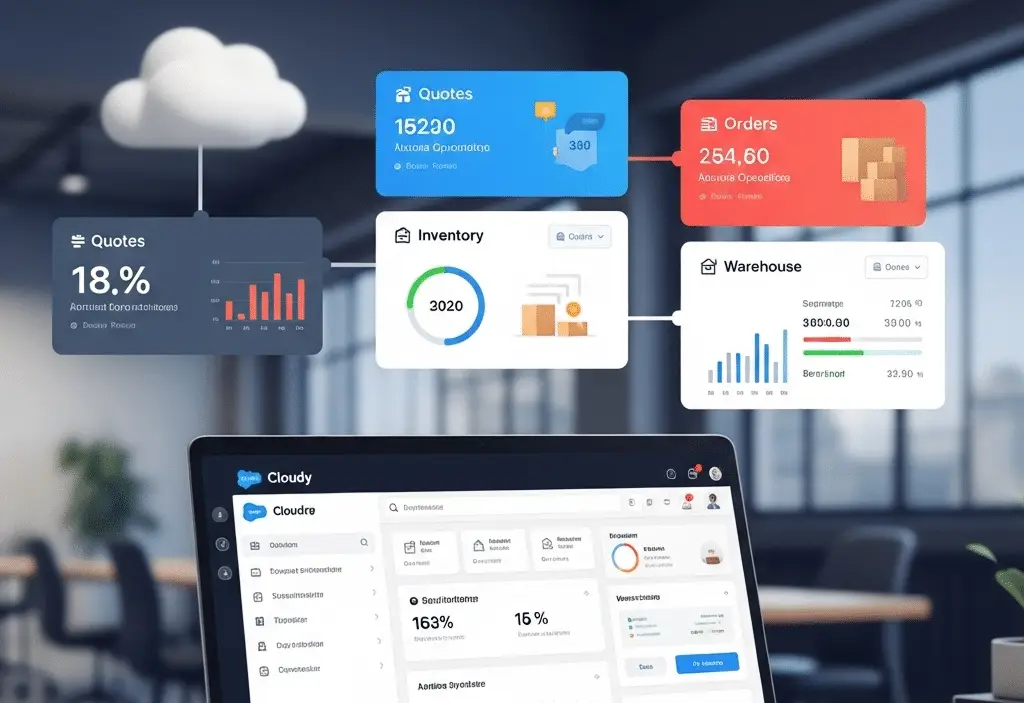
Built 100% natively inside Salesforce. One data model, one security layer, no middleware. Configure with clicks, not code.
Cloudy Business Ops 360 vs SAP: The Quick Verdict
Choose SAP if…
You're a large, multinational enterprise that needs the deepest possible ERP — complex multi-entity manufacturing, global compliance across 150+ countries, and industry depth — and you have the budget and timeline for an enterprise implementation.
Choose Cloudy Business Ops 360 if…
You're a small-to-mid-market product business that runs on (or wants) Salesforce, and you want unified operations — orders, inventory, procurement, manufacturing, logistics, billing — connected to your CRM without the cost, complexity, or long implementation of a traditional ERP.
The core difference: SAP is a standalone enterprise ERP that sits beside your CRM. Cloudy Business Ops 360 is built inside Salesforce — one data model, one security layer, no middleware.
Cloudy Business Ops 360 vs SAP at a Glance
| Cloudy Business Ops 360 | SAP | |
|---|---|---|
| Platform | 100% native to Salesforce | Own stack (HANA, BTP, Fiori); separate from CRM |
| Best fit | SMB to mid-market product businesses | Large, complex, multinational enterprises |
| CRM + ops | Unified on one platform | CRM integrated separately |
| Deploy time | Days to a week | Weeks to months (cloud); longer for enterprise |
| Starting cost | From $40/user/month | Subscription (cloud); enterprise programs can exceed $1M |
| Implementation | Configurable out-of-the-box, no coding | Partner-led, methodology-driven (SAP Activate) |
| Product lineup | One suite, 9 integrated modules | Business One (SMB), S/4HANA / GROW (mid-market–enterprise) |
| Customization | Clicks-not-code on Salesforce | Deep but requires SAP/partner expertise |
| Updates | Automatic (Salesforce releases) | Managed releases; upgrade projects for on-prem/private |
| Ecosystem | Salesforce AppExchange | SAP Ariba, SuccessFactors, Concur, BTP |
// "SAP" refers broadly to its ERP portfolio; specific facts vary by product (Business One vs S/4HANA / GROW with SAP).
The Four Differences That Actually Matter
Built Inside Salesforce vs. a Standalone ERP
This is the single biggest difference. Cloudy Business Ops 360 is built natively on Salesforce — your operations and your CRM share one data model, one security layer, and one user interface. An Account in CRM is the same Account in operations. No middleware, no sync jobs, no duplicate records.
SAP runs on its own technology stack (the HANA database, SAP Business Technology Platform, and Fiori UI). It's a powerful, self-contained ERP — but it sits alongside your CRM rather than inside it. If you use Salesforce for sales and service, connecting it to SAP means building and maintaining an integration between two separate systems.
What it means for you: With Cloudy Business Ops 360, sales, operations, and finance work from the same records in real time. With SAP, you get enterprise depth, but you also own the integration between ERP and CRM.
Live in Days vs. an Implementation Project
Cloudy Business Ops 360 is configurable out of the box. Most organizations are up and running in less than a week, with no custom development required.
SAP's cloud midmarket editions have improved markedly: GROW with SAP (built on S/4HANA Cloud Public Edition) uses pre-configured best practices and the SAP Activate methodology, and SAP has publicized accelerated go-lives in as little as 4 weeks — though 3–6 months is the more typical timeline for a standard mid-market deployment. Enterprise S/4HANA programs run longer still.
What it means for you: If you need operational visibility quickly and don't want a multi-month project, Cloudy Business Ops 360 gets you there faster. If you're re-platforming an entire global enterprise, SAP's structured methodology is built for that scale.
Predictable Per-User Pricing vs. Enterprise ERP Economics
Cloudy Business Ops 360 uses transparent, tiered per-user pricing: a Starter plan at $40/user/month, a Growth plan for mid-sized businesses, and an Enterprise plan for large, multi-entity, multi-warehouse operations. There's no hardware and no minimum user count.
SAP pricing depends heavily on the product and scope. SAP Business One is its affordable SMB option; cloud editions like GROW with SAP are subscription-based, commonly priced per user per month, with the total first-year investment — once implementation, data migration, and training are included — typically running several times the annual license cost. At the enterprise end, full S/4HANA programs commonly exceed $1 million in year one.
What it means for you: For SMB and mid-market budgets, Cloudy Business Ops 360 offers a lower and more predictable entry point. SAP's enterprise editions deliver more depth — at enterprise economics.
Right-Sized Operations vs. Maximum Depth
SAP is unmatched for global enterprises with deeply complex processes — multi-country compliance, sophisticated manufacturing, and industry-specific depth. That power comes with complexity that many smaller businesses never fully use.
Cloudy Business Ops 360 is purpose-built for product-driven SMB and mid-market businesses — wholesale and distribution, retail and e-commerce, manufacturing and assembly, trading, logistics, and more. It covers the operations these businesses actually run, without the overhead of enterprise ERP.
What it means for you: Match the tool to your complexity. Enterprise-grade depth is only an advantage if you need it — otherwise it's cost and complexity you carry without benefit.
Feature-by-Feature: Cloudy Business Ops 360 vs SAP
| Capability | Cloudy Business Ops 360 | SAP |
|---|---|---|
| Salesforce-native | ✓ 100% native | ✗ Separate platform |
| Unified CRM + ops | ✓ One data model | ~ Via integration |
| Order mgmt | ✓ Built in | ✓ Built in |
| Inventory mgmt | ✓ Real-time, multi-location | ✓ Deep, enterprise-grade |
| Warehouse mgmt | ✓ Bins, pick-pack-ship | ✓ Advanced (EWM add-on) |
| Procurement | ✓ PO-to-bill matching | ✓ Comprehensive (Ariba) |
| Manufacturing / BOM | ✓ Multi-level BOM, batches | ✓ Advanced, industry depth |
| Logistics | ✓ Carrier tracking, returns | ✓ Advanced (TM add-on) |
| Billing / finance | ✓ Native + QuickBooks/Xero/Zoho | ✓ Full financials |
| Multi-currency/entity | ✓ Supported | ✓ Extensive, global |
| Deployment time | ✓ Days | ~ Weeks to months |
| No-code config | ✓ Clicks-not-code | ~ Requires expertise |
| Entry cost | ✓ From $40/user/mo | ~ Higher / project-based |
| Global compliance (150+ ctys) | ~ Growing | ✓ Industry-leading |
| Very large enterprises | ~ Mid-market ceiling | ✓ Enterprise standard |
// Reflects general positioning; SAP capabilities vary by product and edition.
When SAP Is the Right Choice — and When Cloudy Business Ops 360 Is
Choose SAP when:
- You're a large or multinational enterprise with complex, multi-country operations.
- You need the deepest manufacturing, supply chain, and compliance capabilities available.
- You have the budget and timeline for an enterprise ERP program and a partner-led implementation.
- Industry-specific SAP depth (and its ecosystem — Ariba, SuccessFactors, Concur) is central to your strategy.
Choose Cloudy Business Ops 360 when:
- You already run on Salesforce (or want to) and want operations unified with your CRM.
- You're an SMB or mid-market product business that needs real operational control without ERP complexity.
- You want to go live in days and keep costs predictable and per-user.
- You'd rather configure with clicks than run a long, code-heavy implementation.
Not always either/or: Cloudy Business Ops 360 also integrates with SAP via API — so businesses running SAP at the core can still use Cloudy Business Ops 360 to extend Salesforce-native operations without ripping anything out.
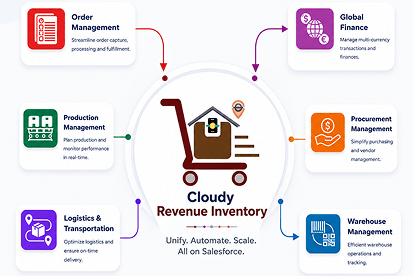
Everything Cloudy Business Ops 360 Runs on Salesforce
One platform, nine integrated modules, already connected — no integration project required.
Connected to the Tools You Already Use
Native, pre-built integrations and open REST APIs — including SAP.
Enterprise-Grade Security, Inherited from Salesforce
See the Difference for Yourself
Get a personalized walkthrough of Cloudy Business Ops 360 and see how a Salesforce-native operations suite compares to a traditional ERP for your business.
Cloudy Business Ops 360 vs SAP — Questions, Answered
For small-to-mid-market product businesses, yes. Cloudy Business Ops 360 provides order management, inventory, warehouse, procurement, manufacturing, logistics, billing, and analytics — natively on Salesforce. It's a strong alternative for companies that want unified operations and CRM without the cost and complexity of a full enterprise ERP. For very large, highly complex multinational enterprises, SAP's enterprise editions remain the deeper solution.
Cloudy Business Ops 360 is built 100% natively on Salesforce, so operations and CRM share one data model, one security layer, and one interface. SAP is a standalone ERP that runs on its own stack and integrates with your CRM separately. In short: Cloudy Business Ops 360 lives inside Salesforce; SAP sits beside it.
Cloudy Business Ops 360 is configurable out of the box and most businesses go live in under a week. SAP's cloud midmarket editions (like GROW with SAP) can go live in as few as several weeks in accelerated deployments, but 3–6 months is the more typical timeline for a standard mid-market rollout, while larger enterprise S/4HANA programs take longer due to their scope and complexity.
Cloudy Business Ops 360 uses transparent per-user pricing starting at $40/user/month, with no hardware or minimum user count. SAP pricing varies by product: Business One is its affordable SMB option and cloud editions are subscription-based per user, while full enterprise S/4HANA programs commonly exceed $1 million in year one once implementation is included.
It depends on your business. SAP is the industry standard for large, complex, multinational enterprises that need maximum ERP depth and global compliance. Cloudy Business Ops 360 is a better fit for SMB and mid-market product businesses that want fast, affordable, Salesforce-native operations connected to their CRM. Match the tool to your size and complexity.
Yes. Cloudy Business Ops 360 can integrate with SAP via API. Businesses running SAP at their core can still use Cloudy Business Ops 360 to run Salesforce-native operations and extend their processes without replacing SAP.
Cloudy Business Ops 360 supports multi-level bills of materials, production batches, material issues, and scrap and yield tracking — suitable for many SMB and mid-market manufacturers. SAP offers deeper, industry-specific manufacturing capabilities suited to large or highly complex production environments.
If you already use Salesforce, Cloudy Business Ops 360 has a clear advantage: it runs natively inside Salesforce, so there's no separate ERP to integrate and no duplicate data. Your operations and CRM work from the same records in real time.
Yes, for many mid-market and larger product businesses. Its Enterprise plan supports multi-entity, multi-warehouse operations with unlimited scalability on Salesforce. For the most complex global enterprises with deep industry and compliance needs, SAP's enterprise editions may still be the better fit.
No. Cloudy Business Ops 360 is a configurable, out-of-the-box solution — no custom development is required to get started. If your business has unique workflows, Cloudy Wave offers optional customization and add-on services. SAP implementations typically involve partner-led configuration and methodology-driven projects.
Download Company Deck
Thank You!
Your download will begin shortly.
Zoho books
Quickbooks
Shopify
Acumatica
SAP
Odoo
Sage
Agentforce Revenue Management
Agentforce Revenue Management + Billing


Salesforce CPQ
Salesforce Advanced Billing
Migrate from CPQ to Agentforce Revenue Management
Microsoft
Data Cloud
Tableau