Picture this: your company signs off on a shiny new custom ERP. The budget is set. The timeline is agreed. Eighteen months later, you’re three times over budget, the go-live keeps slipping, and half the promised features still don’t work. If that sounds dramatic, the data says it’s closer to the norm than the exception.
This is exactly why a quiet revolution is underway. Businesses are walking away from expensive, from-scratch builds and embracing Low-Code Salesforce ERP instead. The shift isn’t about chasing trends — it’s about survival, speed, and sanity. In this guide, we’ll unpack the hard numbers behind ERP failure, explain what makes the low-code approach different, and show you why so many companies now see it as the smarter path forward.
The Custom ERP Problem: A Crisis in Numbers
Let’s start with an uncomfortable truth. Building or heavily customizing a traditional ERP is one of the riskiest technology bets a company can make.
According to Gartner’s analysis, more than 70% of ERP implementations fail to meet their original business goals. Panorama Consulting’s 2025 ERP Report is even starker for some sectors: 73% of discrete manufacturing ERP projects fail to meet objectives, with average cost overruns reaching a staggering 215%.
The financial damage is real and repeatable:
- Average implementation costs run 189% over budget across all industries.
- Only about 30% of ERP projects finish on time and on budget, per Gartner and CIO.com data.
- 51% of companies experience operational disruptions when going live.
- 41% of enterprises fail to achieve even half of the expected benefits.
These aren’t fringe statistics from obscure blogs. They come from Gartner, Panorama Consulting, and Deloitte — the heavyweights of enterprise research.
Real-World Wreckage
History offers expensive lessons. Revlon reported a $70.3 million net loss in Q4 2018 after a new ERP paralyzed a North Carolina manufacturing plant. More recently, Quebec’s SAAQ digital platform ran roughly $500 million over budget. Zimmer Biomet’s SAP S/4HANA rollout led to shipment delays the company linked to a 1–1.5% revenue decline — around $75 million annually.
The pattern is clear. Custom ERP development promises a perfect fit but too often delivers cost, chaos, and delay.
Why Custom Builds Collapse
Why do so many projects fail? The research points to a handful of recurring culprits:
- Inadequate change management — the single biggest cause, behind over 42% of failures.
- Unrealistic timelines — projects with squeezed schedules are about 70% more likely to overrun.
- Heavy customization — over-modified systems become hard to maintain and upgrade.
- Inexperienced teams — 35% of failures involve project teams lacking relevant expertise.
Notably, Panorama found that 93% of organizations require customization, yet that very customization is what drives budgets and timelines out of control.
What Is Low-Code Salesforce ERP?
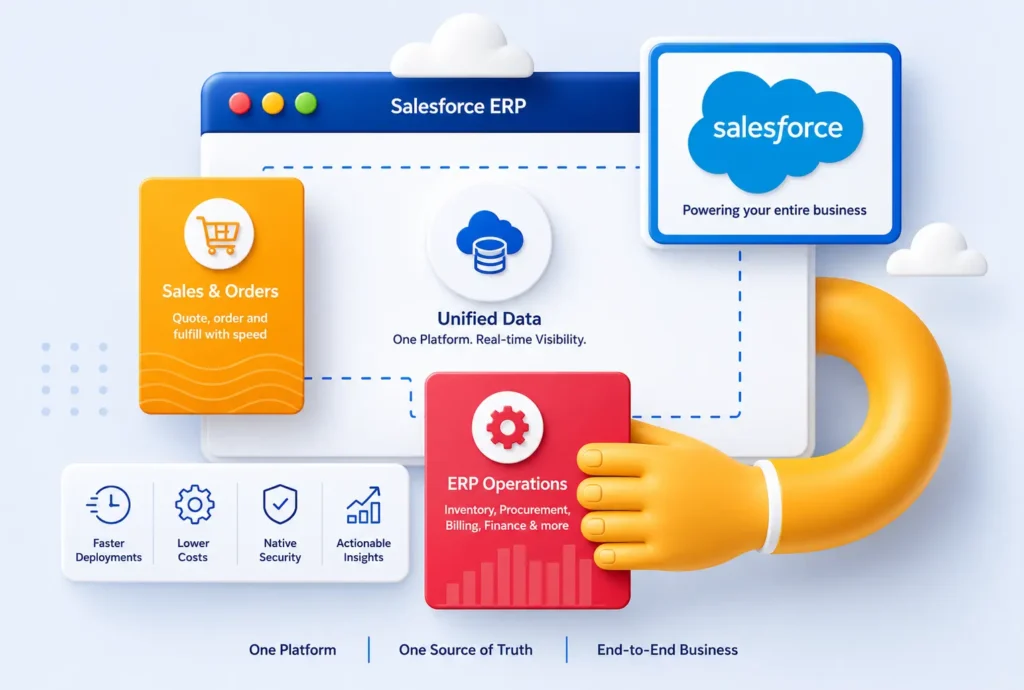
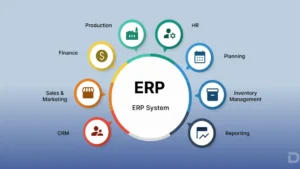
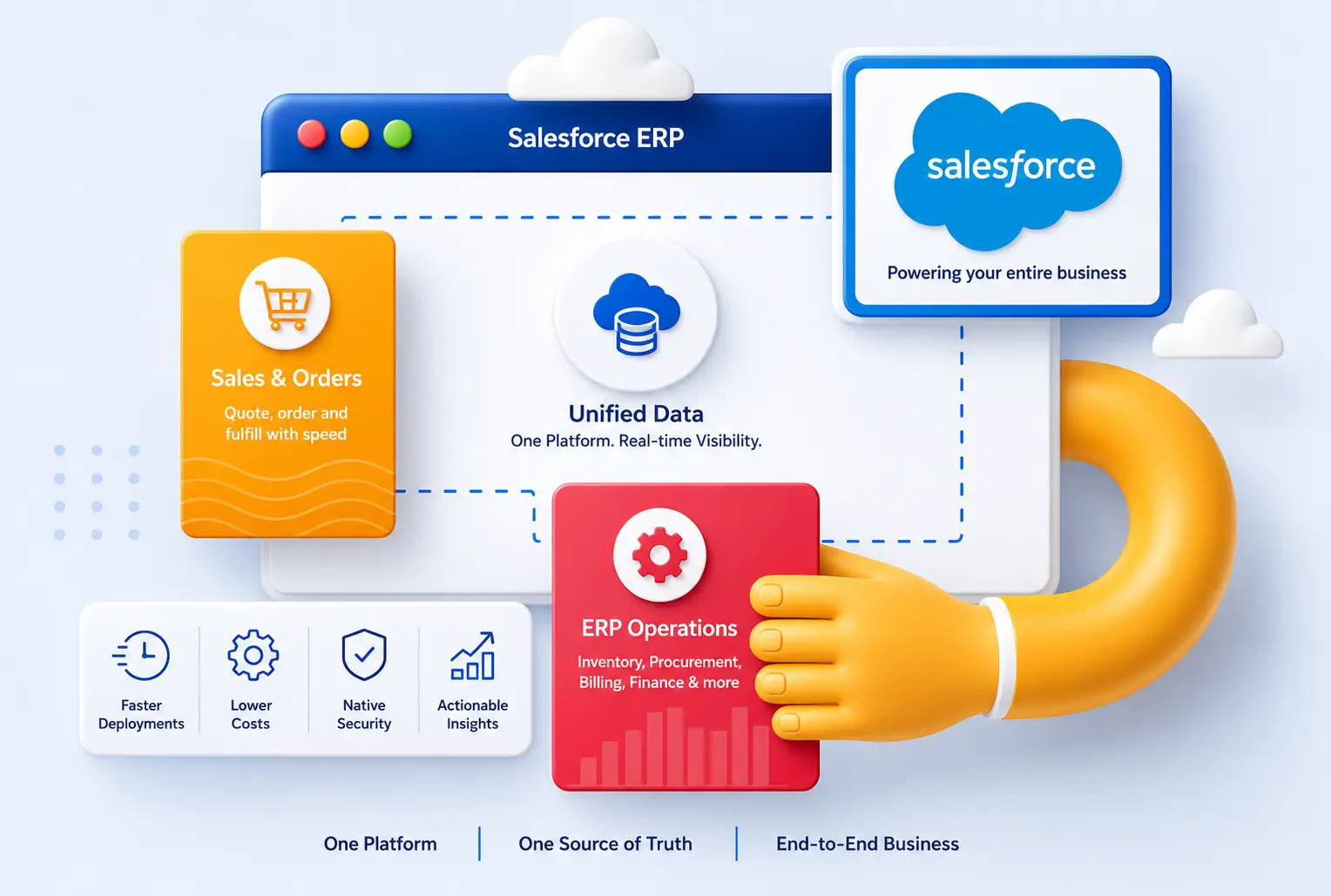
A Low-Code Salesforce ERP is a business management system built on the Salesforce platform using visual, drag-and-drop tools instead of thousands of lines of hand-written code. It combines the operational muscle of an ERP — inventory, orders, procurement, billing — with the flexibility of low-code configuration and the CRM data you already trust.
Instead of building every workflow from zero, teams assemble and configure pre-built components. This is the “assembly over construction” model that’s reshaping enterprise software.
The Low-Code Wave Is Already Here
The move toward a Low-Code Salesforce ERP reflects a much broader industry shift. Gartner forecasts that by 2025, 70% of new applications will use low-code or no-code technologies — up from less than 25% in 2020. The low-code market is projected to reach $44.5 billion by 2026, climbing toward $58.2 billion by 2029.
The reason is simple economics. Low-code platforms can cut development time by up to 50%, and composite studies cited by Gartner show returns as high as 363% ROI over three years, with payback periods under six months. When Forrester surveyed enterprises, 100% reported positive ROI from low-code adoption.
Custom ERP vs. Low-Code Salesforce ERP: A Side-by-Side Look
The contrast becomes obvious when you put the two approaches next to each other.
| Factor |
Custom ERP Development |
Low-Code Salesforce ERP |
| Timeline |
12–24+ months |
Weeks to a few months |
| Cost |
High; 189% average overrun |
Lower, predictable |
| Failure risk |
70%+ miss objectives |
Reduced via proven components |
| Maintenance |
Ongoing developer dependency |
Configurable by admins |
| Upgrades |
Manual, risky, costly |
Automatic platform updates |
| Integration |
Custom API work |
Native to Salesforce CRM |
| Scalability |
Requires re-platforming |
Scales on the platform |
The low-code column isn’t just cheaper — it’s structurally less risky. That’s the heart of why the migration is happening.
Why Businesses Are Making the Switch
Beyond the headline stats, five practical drivers explain the move to a Low-Code Salesforce ERP.
1. Speed to Value
Traditional ERP projects measure timelines in years. Native low-code apps deploy in weeks. Organizations report delivering applications 3–8 times faster than with traditional development. For a growing business, that difference is the gap between capturing an opportunity and missing it.
2. Dramatically Lower Cost and Risk
By assembling proven, security-reviewed components instead of coding from scratch, companies sidestep the biggest sources of overrun. There’s no massive custom codebase to debug, and no army of specialist developers to keep on retainer.
3. One Source of Truth
Because a Low-Code Salesforce ERP lives on the same platform as your CRM, sales, service, inventory, and finance data all share one database. No middleware. No sync jobs. No conflicting versions of the truth. A promise made in Salesforce is a commitment your warehouse can actually keep.
4. Empowered Business Teams
Low-code closes the developer gap. Gartner predicts that by 2026, 80% of low-code users will come from outside traditional IT. That means your operations manager can adjust an approval workflow without filing a six-week IT ticket. This “citizen developer” model has become a strategic necessity as the global developer shortage deepens.
5. Enterprise-Grade Security, Automatically
Building on Salesforce means inheriting its security model, role-based permissions, and compliance certifications. You don’t rebuild governance from scratch — it comes with the platform, and it updates continuously.
Where Custom Development Still Makes Sense
Honesty matters here. Low-code isn’t a cure-all. Complex, one-of-a-kind systems — proprietary algorithms, unique competitive logic, extreme-scale performance tuning — may still need traditional development. As industry analysts put it, low-code handles the plumbing so developers can focus on genuine innovation.
The smart move isn’t ideological. It’s matching the tool to the job. For the vast majority of standard business operations — quoting, ordering, inventory, fulfillment, billing — a Low-Code Salesforce ERP delivers what most companies actually need, faster and cheaper.
A Practical Migration Path
For businesses considering the switch, experts recommend starting small:
- Identify a high-pain, high-visibility process (like order-to-cash).
- Prove value with a departmental pilot before scaling.
- Establish light governance so configuration stays clean.
- Expand module by module — inventory, then procurement, then finance.
This staged approach avoids the “big bang” go-live that sinks so many traditional ERP projects.
Real Results with a Low-Code Approach
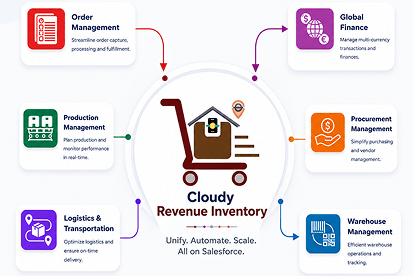
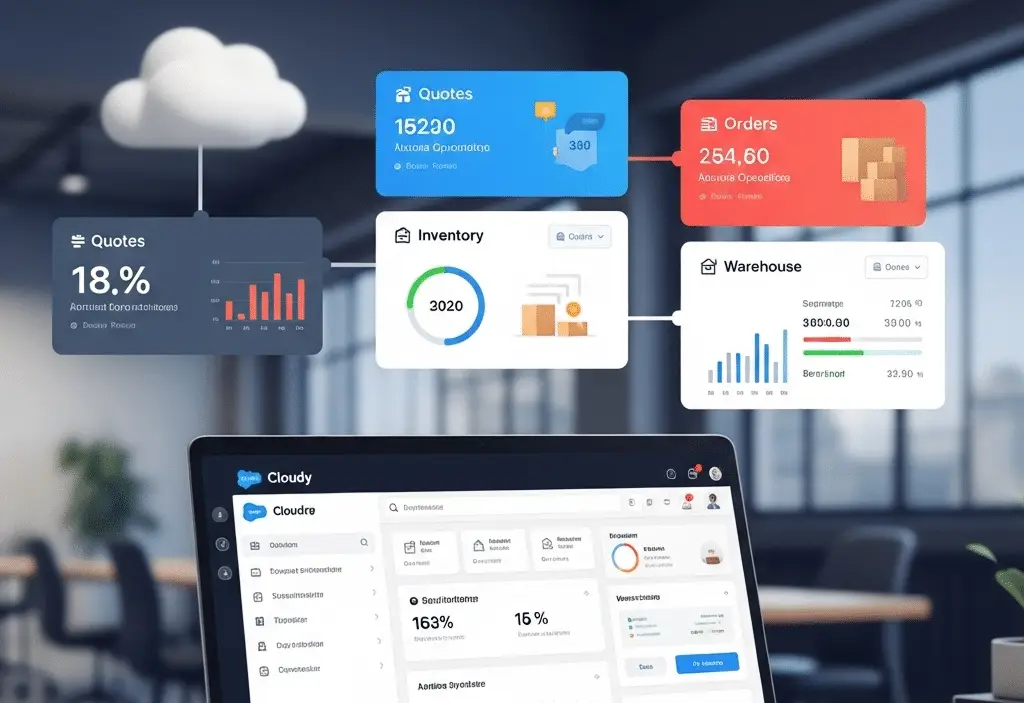
The benefits aren’t theoretical. Businesses moving to native, low-code operations on Salesforce report measurable gains: faster quote creation, fewer stock discrepancies, less manual data entry, and lower licensing costs from consolidating multiple apps into one platform. A solution like Cloudy Business Ops 360 brings quoting, inventory, warehouse, order fulfillment, and billing into a single Salesforce-native suite — the kind of unified system that would take a custom build many months and a large budget to replicate.
For companies that need to keep an external accounting system, native connectors such as a Salesforce–QuickBooks integration keep finance data flowing without the fragile custom API work that traditional ERP projects depend on.
Key Takeaways
The migration from custom ERP development to a Low-Code Salesforce ERP is driven by evidence, not hype:
- Custom ERP is high-risk — 70%+ of projects fail, with average overruns near 189%.
- Low-code is the new normal — Gartner expects 70% of new apps to use it, in a market worth $44.5 billion by 2026.
- Speed and savings are real — deployments run 3–8x faster and cut costs by 40–70%.
- A single platform unifies CRM, operations, and finance without fragile integrations.
- Match the tool to the job — low-code handles standard operations; reserve custom code for true differentiators.
The old way of building ERP from scratch made sense when there was no alternative. Today, there is. A Low-Code Salesforce ERP offers a faster, cheaper, and far less risky route to the same destination — a business that runs on one connected, trustworthy system. If your last ERP project felt like a gamble, the next one doesn’t have to.




 Salesforce ERP
 ERP + CRM Platform
  Inventory Management
  Warehouse Management
  Order Management
  Vendor Management
  Logistics Management
  BOM Management
  Order Fulfillment
  Business Operations
  SaaS Platform for Operations
  Salesforce Cloud ERP Platform
  Xero
Xero
 Zoho books
 Quickbooks
 Shopify
 Acumatica
 SAP
SAP
 Odoo
Odoo
 NetSuite
 Microsoft Dynamics 365
 Sage
Sage

 Agentforce Revenue Management
 Agentforce Revenue Management + Billing
  Salesforce CPQ
 Salesforce Advanced Billing
  Migrate from CPQ to ARM
  Managed Services
 Salesforce Implementation
 Revenue Cloud Implementation
 ServiceNow Consulting Services
 Zoho CRM implementation
 MuleSoft Integration
 Workato Integration
 Microsoft
 Data Cloud
 Tableau
 ·
July 13, 2026
·
7 min read
·
July 13, 2026
·
7 min read