Imagine pricing a shipment on Monday, only to find the duty rate has changed by Friday. For thousands of importers, that is not a worst-case scenario in 2026. It is a normal week. The average effective U.S. tariff rate sat near 2.5% at the start of 2025. By early 2026 it had climbed to roughly 11.8%, the highest level since the early 1940s, according to the Yale Budget Lab. When the cost of crossing a border swings that fast, guessing is no longer an option.
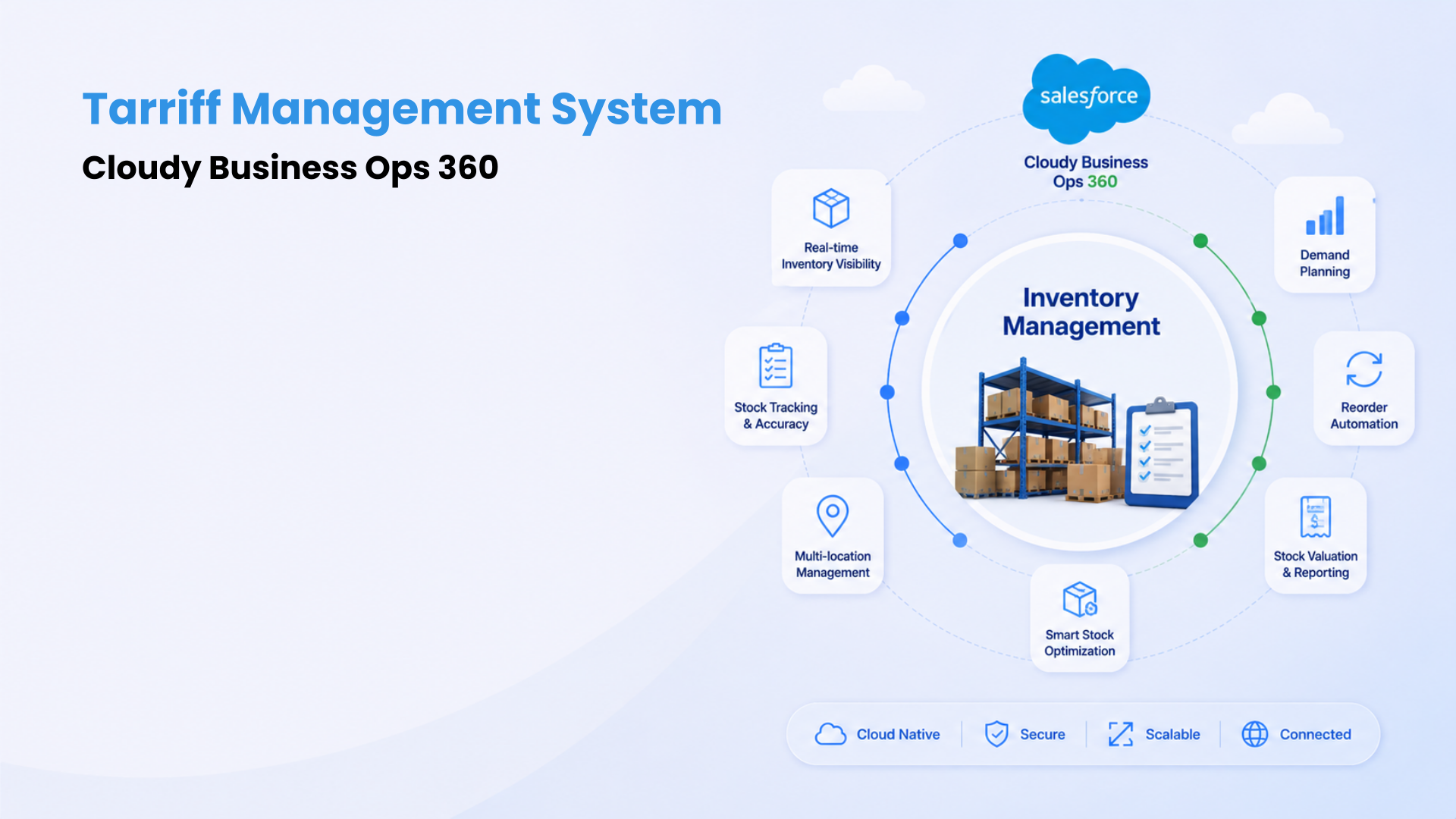
This is exactly the gap that Tariff Management Systems are built to close. They turn unpredictable duties into numbers you can plan around. And for businesses that run on Salesforce, Cloudy Business Ops 360 brings many of those tariff-ready capabilities into the same platform you already use to quote, procure, fulfill, and bill.
This guide explains what Tariff Management Systems do, why they matter right now, and how a Salesforce-native ERP supports smarter, faster tariff decisions.
What Are Tariff Management Systems?
Tariff Management Systems are software platforms that help companies calculate, track, and control the duties and taxes owed when goods cross international borders. Instead of chasing rates in spreadsheets, teams get a single source of truth for what each product actually costs to import.
At their core, Tariff Management Systems answer three questions for every shipment:
- How much duty do I owe? Based on product classification, country of origin, and current rates.
- What is my true landed cost? The full price of a product once duties, freight, insurance, and fees are added.
- Am I compliant? Whether filings, codes, and documents meet customs rules.
Core Capabilities to Look For
Most mature Tariff Management Systems share a common toolkit:
- HS / HTS code classification to assign the right tariff code to each product.
- Landed cost calculation that bundles duties, freight, and fees into one figure.
- Duty and tax determination tied to live rate tables.
- Country-of-origin and rules-of-origin checks for Free Trade Agreement (FTA) eligibility.
- Compliance screening, including restricted-party checks and documentation.
- Scenario modeling to compare sourcing options before you buy.
The strongest platforms also push real-time alerts when rates change, so a Tuesday rate hike does not become a Friday surprise.
Why Tariff Management Systems Matter More Than Ever in 2026
Tariffs used to be a back-office detail. Now they shape pricing, margins, and supplier strategy across nearly every product-driven industry.
The data tells the story:
- The U.S. average effective tariff rate hit the highest point in roughly 80 years during late 2025 and early 2026, per the Yale Budget Lab and the Tax Foundation.
- The Federal Reserve Bank of Minneapolis estimates that, measured by trade restrictiveness, recent policy acts like a universal tariff near 21%, even higher than the headline rate.
- Roughly 91% of procurement leaders have changed sourcing strategies because of tariff uncertainty, and about 71% are adding domestic or nearshore suppliers, according to industry analysis cited by Suplari.
Volatility is the real challenge that Tariff Management Systems are designed to absorb. As trade-compliance specialists at GingerControl note, “tariff stacks change weekly” in 2026. Manual processes simply break under that volume. That pressure is driving fast growth in the category. Gaia Dynamics projects the global trade compliance software market will reach about $2.19 billion in 2026.
In short, Tariff Management Systems have moved from “nice to have” to “need to have” for anyone who imports, exports, or sources across borders.
The Real Cost of Getting Tariffs Wrong
When duties are an afterthought, the damage shows up in several places at once.
Margin Erosion
If you price a product before you know its true landed cost, you can sell at a loss without realizing it. A 10-point swing in duty can wipe out the entire profit on a thin-margin item.
Compliance Penalties
Misclassifying a product or filing the wrong code can trigger fines, shipment holds, and audits. Customs authorities expect accuracy, and “we didn’t know” is not a defense.
Cash Flow Surprises
Unexpected duty bills strain working capital. Without forecasting, a single large shipment can throw off an entire quarter’s budget.
Missed Refunds
Many importers overpay and never claim it back. Duty drawback and retroactive audits can recover real money, but only if your records are clean and searchable. This is one of the quiet advantages of running tariff data inside a connected system rather than scattered files.
Good Tariff Management Systems prevent these problems by making the true cost of every product visible before a decision is made, not after the invoice arrives.
How Cloudy Business Ops 360 Supports Tariff Management
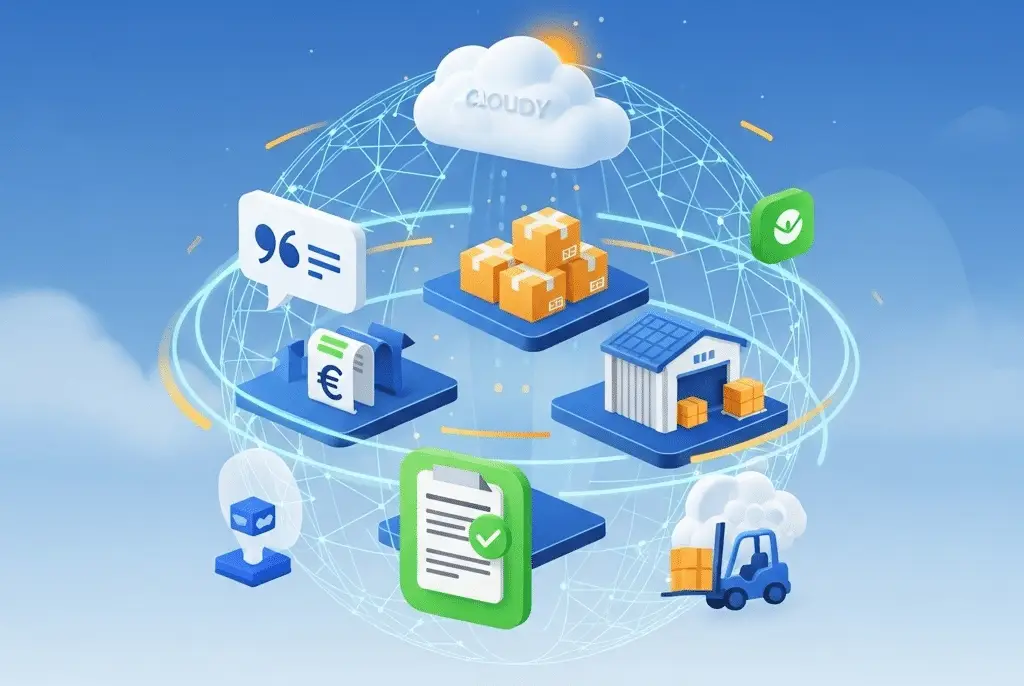
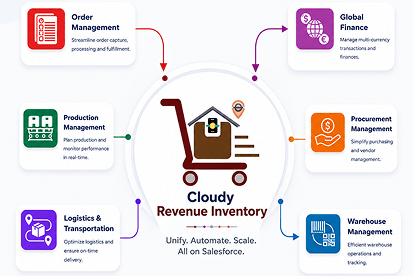
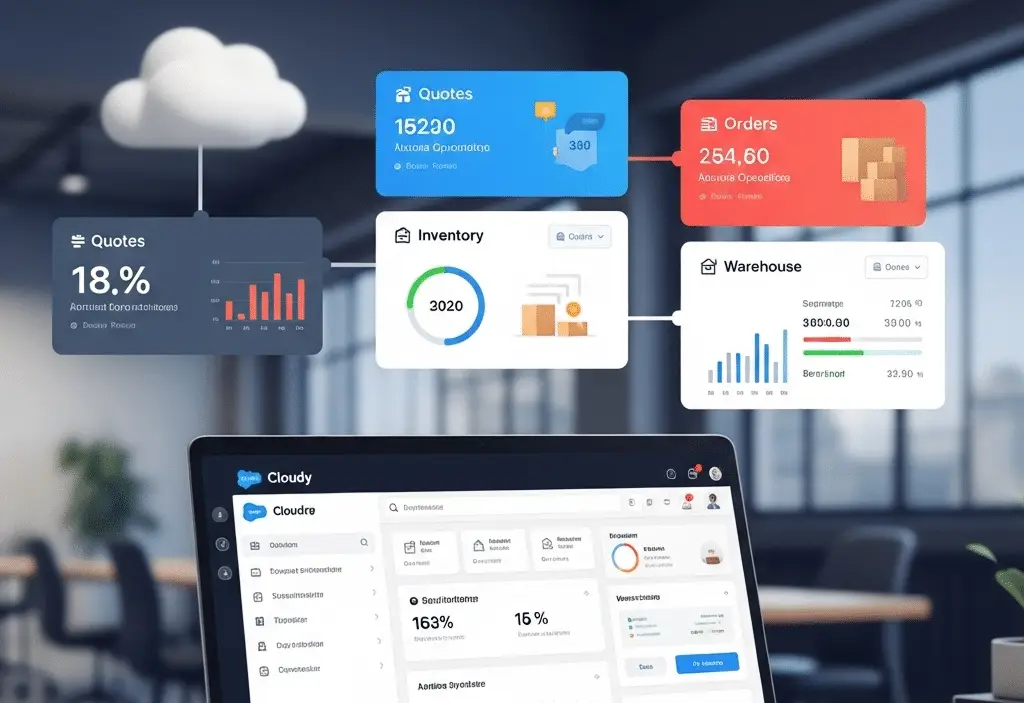
Cloudy Business Ops 360 is a Salesforce-native ERP that unifies quoting, procurement, inventory, order fulfillment, and billing in one app. While it is a full operations platform rather than a standalone customs tool, several of its core features map directly to the work that Tariff Management Systems are designed to handle, and it keeps that work inside the system where your orders and finances already live.
Here is how the pieces fit together, and where they line up with the work Tariff Management Systems normally do.
Multi-Currency Support and Landed Cost Visibility
Tariffs rarely arrive alone. They come with freight, insurance, and currency swings. Cloudy Business Ops 360 includes native multi-currency support, so cross-border purchase orders and supplier costs are recorded in the right currency from the start. That gives finance and procurement teams a cleaner foundation for calculating true landed cost, the single most important number in any tariff decision.
Procurement and Vendor Management
Smart tariff strategy is really a sourcing strategy. Since 71% of procurement leaders are shifting suppliers in response to tariffs, the ability to compare vendors quickly is essential. With procurement and vendor management built in, Cloudy Business Ops 360 lets teams track supplier costs, lead times, and country of origin in one place. That makes it far easier to weigh a higher-tariff supplier against a nearshore alternative and act on the answer.
Inventory and Warehouse Management
Duties are tied to specific items, quantities, and movements. Because Cloudy Business Ops 360 manages item-level inventory and warehouse operations, the data needed to allocate duty costs accurately, what was imported, when, and where it sits, already exists in the system. That item-level detail is exactly what feeds dependable tariff and landed-cost reporting.
Finance, Billing, and Reporting
Tariff data only creates value when it reaches your books. By connecting operations to billing and finance workflows, Cloudy Business Ops 360 helps ensure duty costs flow into pricing and reporting rather than getting lost in a separate spreadsheet. The platform also integrates with accounting tools such as Xero, Zoho Books, and QuickBooks, so landed costs can reconcile cleanly with your financials.
AI Agents With Agentforce
This is where modern operations pull ahead. Cloudy Business Ops 360 is built to work with Salesforce Agentforce, which means AI agents can monitor and act on operational data automatically. A Procurement Agent can flag late purchase orders and suggest reorder quantities, while an Insights Agent can answer plain-language questions about your live operations. Applied to tariffs, that same approach helps teams stay ahead of cost changes instead of reacting to them, which is the entire promise of next-generation Tariff Management Systems.
The key idea: You do not always need a separate bolt-on tool to start managing tariffs well. A tariff-aware ERP keeps duty data next to the orders, suppliers, and invoices it affects.
Comparison: Three Ways to Manage Tariffs
Not every business needs the same setup. Here is how the common approaches compare.
| Approach | Best For | Strengths | Limitations |
|---|
| Manual spreadsheets | Very small importers, few SKUs | Low cost, familiar | Error-prone, no alerts, breaks at scale |
| Standalone tariff / trade compliance software | High-volume, complex customs filings | Deep classification, dedicated compliance tools | Extra system to integrate, can disconnect from finance and orders |
| Tariff-aware ERP (e.g., Cloudy Business Ops 360) | Product-driven SMBs and mid-market firms on Salesforce | Duty data lives with procurement, inventory, and billing; AI-ready; fewer silos | May pair with a specialist customs tool for very advanced filings |
For many growing importers, distributors, and manufacturers, the third option offers the best balance: strong tariff-related visibility without yet another disconnected app. Enterprise Tariff Management Systems often deprioritize businesses in the $50K to $500K annual-duty range, as GingerControl points out, which leaves Salesforce-native ERP a practical, well-supported middle path.
Choosing the Right Approach for Your Business
Use this quick checklist to decide what level of tariff capability you need:
- Do you import from more than one country? If yes, you need landed-cost visibility, not just base prices.
- Are your margins under 20%? Thin margins make accurate duty tracking essential.
- Do you change suppliers often? Then vendor and country-of-origin tracking is a priority.
- Is your team already on Salesforce? A native ERP avoids costly integrations and double data entry.
- Do you file complex customs entries daily? You may want a specialist tool alongside your ERP.
If you answered “yes” to most of these, a tariff-aware operations platform should be the backbone of your strategy, with specialist software added only where filing complexity demands it.
Best Practices for Tariff Management in 2026
Whatever tools you choose, these habits separate teams that thrive from teams that scramble, and they get easier once Tariff Management Systems are doing the heavy lifting:
- Calculate landed cost first. Never quote or price from base cost alone.
- Keep classification clean. Accurate HS/HTS codes are your defense in any audit.
- Centralize your data. Tariff numbers should live next to orders, inventory, and invoices, not in a silo.
- Model before you source. Compare suppliers on true total cost, including duties.
- Automate the alerts. Let the system, or an AI agent, watch for rate changes.
- Review for refunds. Audit past entries for overpayments and drawback opportunities.
- Revisit quarterly. With rates shifting often, last quarter’s strategy may already be stale.
Conclusion: Turn Tariff Chaos Into Control
Tariffs are no longer a predictable line item. With U.S. rates at multi-decade highs and policy shifting almost weekly, the businesses that win are the ones that can see the true cost of every shipment and act on it fast. That is the entire purpose of modern Tariff Management Systems.
Key takeaways:
- Tariff Management Systems calculate duties, landed cost, and compliance in one place.
- They matter more than ever, with U.S. tariffs near their highest level in about 80 years.
- The cost of ignoring tariffs shows up as lost margin, penalties, and cash-flow shocks.
- Cloudy Business Ops 360 supports tariff management through multi-currency, procurement, inventory, finance, and Agentforce-powered AI, all native to Salesforce.
- For most product-driven SMBs and mid-market firms, a tariff-aware ERP is the most practical foundation.
If your operations already run on Salesforce, the simplest first step is to bring tariff data into the same place as your orders, suppliers, and invoices. To see how it works in practice, explore Cloudy Business Ops 360 or book a quick demo with the Cloudy Wave team.
Sources and References
The data and statistics in this article are drawn from the following authoritative sources:
- The Budget Lab at Yale, State of U.S. Tariffs (April 8, 2026) — average effective U.S. tariff rate (~11.8% in early 2026, highest since the early 1940s) and household cost estimates.
- Tax Foundation, Trump Tariffs: The Economic Impact of the Trade War — Tariff Tracker — weighted average applied U.S. tariff rate and tariff-stacking detail.
- Federal Reserve Bank of Minneapolis, New Measure: Tariffs Twice as Restrictive as Popular Estimates (2026) — the ~21% trade-restrictiveness equivalent.
- Penn Wharton Budget Model, Effective Tariff Rates and Revenues (2026) — tariff rate climbing from 2.3% in January 2025.
- Suplari, Tariff Management Software: Best Tools to Plan and Respond to Tariffs (2026) — procurement sourcing statistics (91% adjusting strategies; 71% adding nearshore suppliers).
- Gaia Dynamics, Trade Compliance Software in 2026: Evaluating Vendors for Tariff Management — the $2.19 billion market forecast.
- GingerControl, Trade Compliance Tools for SMB Importers (2026) — weekly tariff-stack changes and the underserved $50K–$500K duty segment.
- Gartner Peer Insights, Global Trade Management Reviews, and SafetyCulture, 10 Best Global Trade Management Software of 2026 — feature-category context.
Tariff figures reflect data published through April 2026 and change frequently; verify current rates before making pricing or sourcing decisions.




 Salesforce ERP
 ERP + CRM Platform
  Inventory Management
  Warehouse Management
  Order Management
  Vendor Management
  Logistics Management
  BOM Management
  Order Fulfillment
  Business Operations
  SaaS Platform for Operations
  Salesforce Cloud ERP Platform
  Xero
Xero
 Zoho books
 Quickbooks
 Shopify
 Acumatica
 SAP
SAP
 Odoo
Odoo
 NetSuite
 Microsoft Dynamics 365
 Sage
Sage



 Agentforce Revenue Management
 Agentforce Revenue Management + Billing
  Salesforce CPQ
 Salesforce Advanced Billing
  Migrate from CPQ to ARM
  Managed Services
 Salesforce Implementation
 Revenue Cloud Implementation
 MuleSoft Integration
 Microsoft
 Data Cloud
 Tableau
 ·
June 1, 2026
·
10 min read
·
June 1, 2026
·
10 min read