If you work in sales operations, RevOps, or Salesforce administration, one question keeps coming up in 2026: is Salesforce CPQ still the right tool? The platform has undergone significant changes, and the Salesforce revenue-management landscape looks quite different than it did three years ago. Understanding the current status of Salesforce CPQ 2026 — what it still does well, where it sits in Salesforce’s product roadmap, and how it compares to newer capabilities like Agentforce Revenue Management — is essential before making any platform decision.
This guide cuts through the noise. Whether you are an existing CPQ customer evaluating your long-term roadmap, a RevOps leader exploring alternatives, or an IT decision-maker planning a new implementation, this 2026 Salesforce CPQ guide gives you the current, accurate picture you need.
What Is Salesforce CPQ?
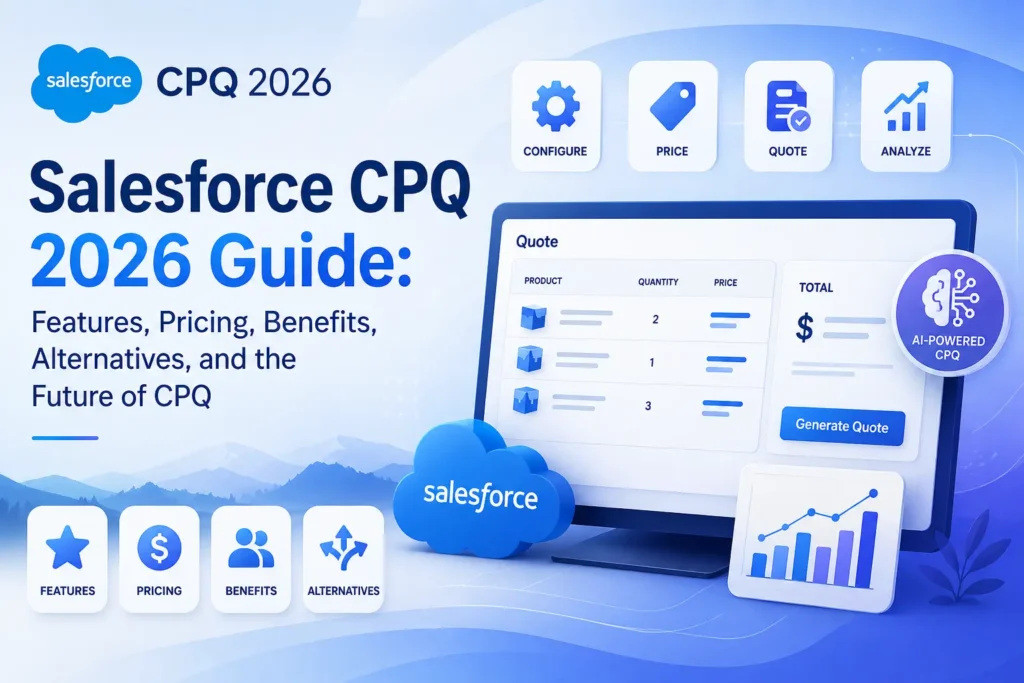
Salesforce CPQ — which stands for Configure, Price, Quote — is a revenue-automation solution built natively on the Salesforce platform. Originally developed by Steelbrick and acquired by Salesforce in 2015, it is designed to help sales teams move from opportunity to signed order faster, with greater accuracy and fewer manual steps.
At its core, Salesforce CPQ helps businesses:
- Configure complex products, bundles, and services using guided selling and product rules
- Price accurately using pricing methods, discount schedules, and price rules
- Manage discounts within defined guardrails and approval thresholds
- Generate professional quotes using branded templates
- Automate approvals for discounts, exceptions, and non-standard terms
- Create contracts directly from approved quotes
- Generate orders and connect downstream fulfillment processes
- Support renewals and amendments for subscription-based revenue
Because CPQ lives entirely within Salesforce CRM, sales reps work within the same platform they already use for leads, opportunities, and accounts. There is no external system to log into, no data duplication, and no manual re-entry between CRM and quoting.
How Does Salesforce CPQ Work?
The CPQ process follows a structured lifecycle that replaces manual, error-prone quoting with guided, rule-driven automation. Here is how a typical Salesforce CPQ workflow operates:
- Product Selection — The rep selects products or services from a centralized product catalog within an opportunity.
- Product Configuration — Rules guide the rep through valid combinations, required options, and feature selections. Invalid configurations are blocked automatically.
- Pricing — The system applies pre-configured list prices, volume breaks, and contracted customer pricing.
- Discounting — Reps apply discounts within pre-set thresholds. Discounts beyond the threshold trigger an approval request.
- Quote Creation — The system generates a formatted, branded quote document using predefined templates.
- Approval Workflow — If required, the quote is routed to the appropriate approvers automatically.
- Contract Generation — Once accepted, a contract record is created and linked to the opportunity.
- Order Generation — The signed contract converts to an order, triggering downstream fulfillment.
- Renewal and Amendment — At contract end, the system surfaces renewal opportunities and allows mid-term amendments.
This end-to-end automation eliminates the spreadsheet-driven quoting that slows sales cycles and introduces pricing errors.
Key Salesforce CPQ Features in 2026
Product Configuration
Salesforce CPQ’s product configuration engine supports configurable products, product bundles, nested bundles, optional features, and product attributes. Product rules enforce valid configuration logic — so reps cannot quote incompatible combinations or miss required components. Guided selling questionnaires help reps select the right products based on customer requirements.
Pricing and Discount Management
The pricing engine supports multiple pricing methods including list price, cost-plus, and block pricing. Discount schedules apply volume-based or tier-based discounting automatically. Price rules execute logic to adjust prices dynamically based on configuration or customer data. This replaces fragmented pricing spreadsheets and manual discount negotiations.
Quote Generation
Quote templates produce professional, branded PDF or DocuSign-ready documents that pull live data directly from Salesforce. Custom templates can segment line items, apply conditional content, and support multi-language or multi-currency requirements.
Approval Automation
Approval workflows route non-standard discounts, pricing exceptions, or specific product combinations to the appropriate approvers without manual escalation. Approvers receive Salesforce notifications or email prompts and can approve directly from within the platform.
Contract Management
CPQ generates contracts from signed quotes, capturing key terms, products, quantities, and pricing. Mid-term amendments — such as adding seats, upgrading products, or changing quantities — are managed within the system, maintaining a clean contract history linked to the account.
Order Generation
Approved and accepted quotes convert to Salesforce orders with a single click. This triggers downstream processes including inventory allocation, provisioning workflows, or ERP handoff, depending on your implementation architecture.
Subscription and Recurring Revenue Support
CPQ supports subscription-based selling through co-termination, proration, and renewal management. Reps can manage subscription start dates, contract alignment, and renewal quoting from within the opportunity workflow. For simpler recurring revenue models, this provides meaningful automation.
Reporting and Salesforce Integration
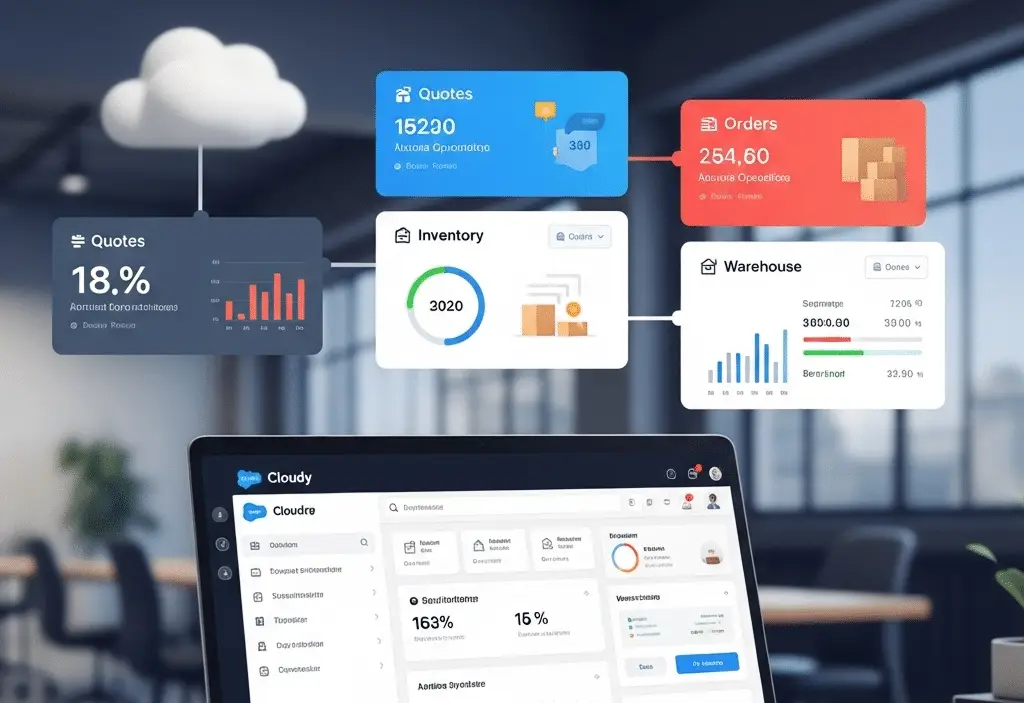
Because CPQ is natively Salesforce, all quoting activity — conversion rates, discount trends, approval cycle times, and revenue by product — is available through standard Salesforce reports and dashboards. Integration with Salesforce Revenue Management tools and ERP systems such as those in the Cloudy Business Ops 360 platform extends this visibility across the full revenue lifecycle.
Benefits of Salesforce CPQ
Organizations that have successfully implemented Salesforce CPQ report meaningful operational improvements across their sales and revenue operations:
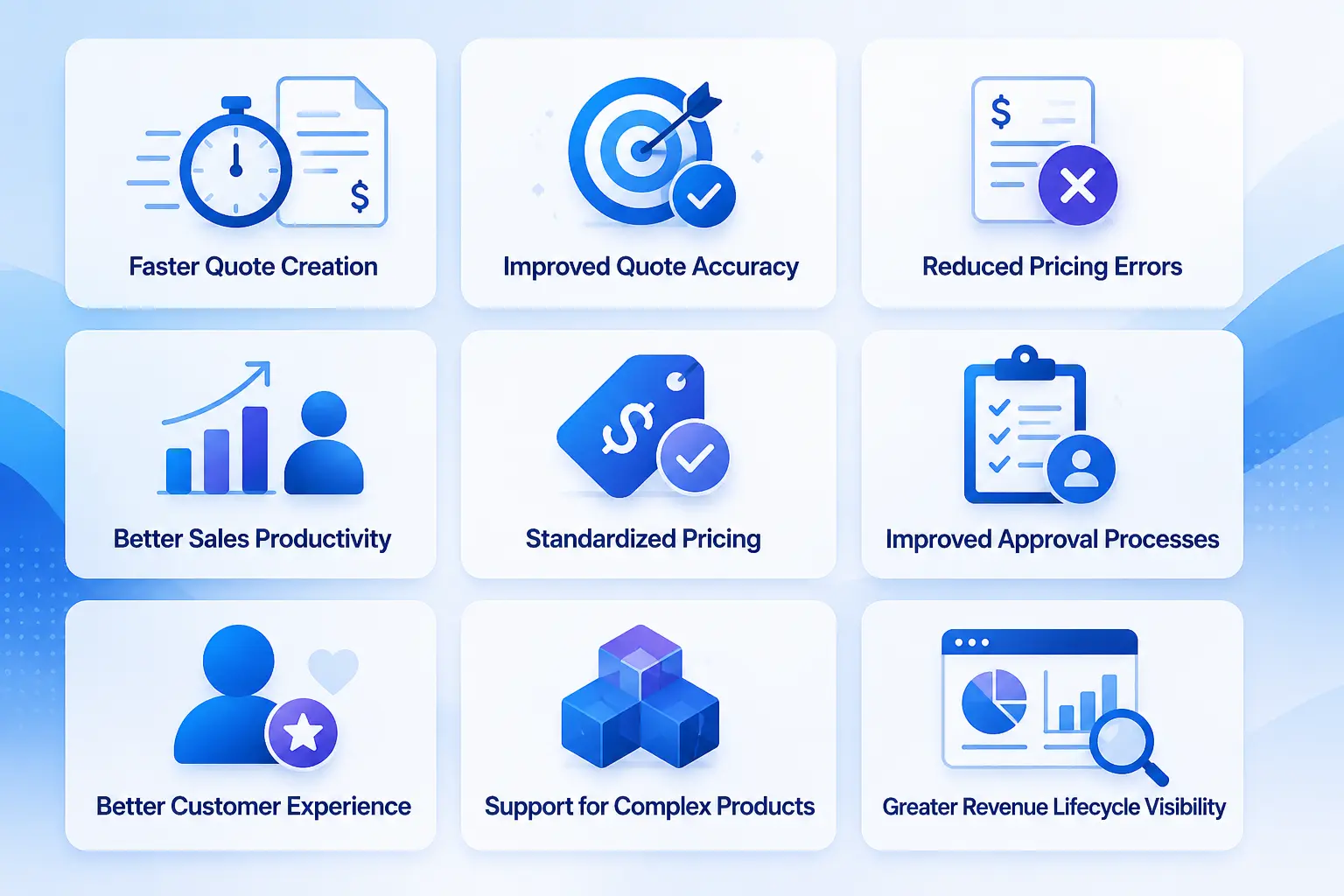
Faster Quote Creation — Guided configuration and automated document generation reduce quote turnaround from days to hours. Sales reps spend less time building quotes and more time selling.
Improved Quote Accuracy — Product rules and pricing automation eliminate the manual errors common in spreadsheet-based quoting — wrong pricing, missing components, or invalid configurations.
Reduced Pricing Errors — Centralized price books and discount guardrails ensure every quote reflects current, approved pricing. This reduces revenue leakage caused by unauthorized discounting.
Better Sales Productivity — When reps do not need to manually build proposals, manage approvals, or chase pricing sign-offs, they can handle more opportunities without increasing headcount.
Standardized Pricing — Finance and sales leadership gain confidence that pricing is consistent across every deal, region, and rep — a significant benefit for companies with complex pricing structures.
Improved Approval Processes — Automated routing replaces email chains and verbal approvals with auditable, time-stamped digital workflows.
Better Customer Experience — Faster, accurate quotes with professional presentation improve the buyer experience and reduce friction in the purchase decision.
Support for Complex Products — Companies with large, configurable product catalogs — manufacturing, technology, professional services — benefit significantly from rule-driven configuration rather than tribal knowledge.
Greater Revenue Lifecycle Visibility — When CPQ is integrated with broader Salesforce revenue tools, leadership gains end-to-end visibility from pipeline to recognized revenue.
Salesforce CPQ Pricing in 2026
Salesforce CPQ pricing depends on multiple factors including your Salesforce edition, existing license agreements, the number of users, implementation complexity, and any add-on modules required. Salesforce does not publish fixed CPQ pricing publicly, and costs vary significantly across organizations.
When evaluating the total investment, consider the following components:
- Software licensing — The CPQ subscription fee per user or org, negotiated directly with Salesforce or through a partner
- Implementation costs — Professional services for configuration, product catalog setup, rule design, and integration
- Customization costs — Apex development, custom flows, or complex pricing logic beyond standard configuration
- Integration costs — Connecting CPQ to ERP systems, billing platforms, or accounting tools
- Data migration costs — Migrating existing product catalogs, pricing data, and historical quotes
- Training costs — Onboarding sales reps, admins, and sales operations teams
- Ongoing administration — Internal or partner resources to maintain and evolve the implementation
For current Salesforce CPQ pricing, contact Salesforce directly or work with a certified Salesforce CPQ implementation partner who can help model the full total cost of ownership based on your specific requirements.
Is Salesforce CPQ Still Supported in 2026?
This is the most important question for existing customers, and the answer requires clarity.
Salesforce CPQ is end of sale — not end of life.
This distinction matters significantly. According to Salesforce’s official guidance on CPQ and Billing, Salesforce has placed CPQ and Billing on end-of-sale status, meaning Salesforce is no longer actively selling CPQ to new customers. However, existing customers can continue using the product, renew their licenses under existing agreements, and continue receiving standard support.
What this means in practice:
- Existing customers can continue using Salesforce CPQ without disruption.
- License renewals remain available under current contract terms.
- Support continues for existing implementations.
- New feature investment from Salesforce is no longer directed toward CPQ. Strategic development is now focused on Agentforce Revenue Management and Revenue Cloud.
- New implementations of Salesforce CPQ are no longer the recommended starting point for organizations that have not yet deployed CPQ.
This is meaningfully different from “discontinued.” Your existing CPQ investment is not suddenly obsolete. However, understanding Salesforce’s strategic direction is essential for long-term planning.
Salesforce Trailhead continues to host CPQ learning resources and Trailmixes for existing customers and partners who need to build or maintain CPQ expertise.
Is Salesforce CPQ Still Supported in 2026?
This is the most important question for existing customers, and the answer requires clarity.
Salesforce CPQ is end of sale — not end of life.
This distinction matters significantly. According to Salesforce’s official guidance on CPQ and Billing, Salesforce has placed CPQ and Billing on end-of-sale status, meaning Salesforce is no longer actively selling CPQ to new customers. However, existing customers can continue using the product, renew their licenses under existing agreements, and continue receiving standard support.
What this means in practice:
- Existing customers can continue using Salesforce CPQ without disruption.
- License renewals remain available under current contract terms.
- Support continues for existing implementations.
- New feature investment from Salesforce is no longer directed toward CPQ. Strategic development is now focused on Agentforce Revenue Management and Revenue Cloud.
- New implementations of Salesforce CPQ are no longer the recommended starting point for organizations that have not yet deployed CPQ.
This is meaningfully different from “discontinued.” Your existing CPQ investment is not suddenly obsolete. However, understanding Salesforce’s strategic direction is essential for long-term planning.
Salesforce Trailhead continues to host CPQ learning resources and Trailmixes for existing customers and partners who need to build or maintain CPQ expertise.
Salesforce CPQ vs. Agentforce Revenue Management
Salesforce’s strategic revenue management direction has consolidated around Revenue Cloud and Agentforce Revenue Management — a more unified approach to the entire product-to-cash lifecycle. Here is how the two compare:
| Area | Salesforce CPQ | Agentforce Revenue Management |
|---|
| Primary purpose | Configure, Price, Quote | Full revenue lifecycle management |
| Product configuration | Strong, rule-driven | Modernized catalog and configuration |
| Pricing | Flexible pricing engine | Dynamic and usage-based pricing support |
| Quoting | Document-based quote automation | Integrated quote and order management |
| Contracts | Contract generation and amendments | Unified contract lifecycle management |
| Orders | Order generation | Order management and orchestration |
| Billing | Requires CPQ Billing add-on | Native billing and invoicing |
| Usage-based models | Limited | Built-in usage pricing and metering |
| Revenue lifecycle | Partial (CPQ to order) | End-to-end product-to-cash |
| AI/Agent capabilities | Minimal native AI | Agentforce-powered revenue agents |
| Strategic direction | End of sale | Active Salesforce investment |
| Best suited for | Existing CPQ customers | New implementations, complex revenue models |
The key takeaway: Salesforce CPQ remains a capable quoting solution for existing customers. Agentforce Revenue Management is designed for organizations that need a more unified, modern architecture that connects CPQ, billing, usage management, and revenue recognition in a single platform.
Salesforce CPQ vs. Revenue Cloud
Revenue Cloud is Salesforce’s broader revenue operations platform, of which Agentforce Revenue Management is now the centerpiece. While Salesforce CPQ focused primarily on the quoting step, Revenue Cloud addresses the full revenue lifecycle:
- Product catalog management at scale
- Configure, Price, Quote
- Contract lifecycle management
- Order management and orchestration
- Billing and invoicing
- Usage-based and consumption pricing
- Asset lifecycle management
- Revenue operations analytics
For companies with straightforward product catalogs and simple pricing models, Salesforce CPQ historically provided an effective solution. For companies dealing with recurring revenue, complex subscription management, usage-based pricing, or multi-entity billing, the broader Revenue Cloud architecture addresses requirements that CPQ alone cannot fully meet.
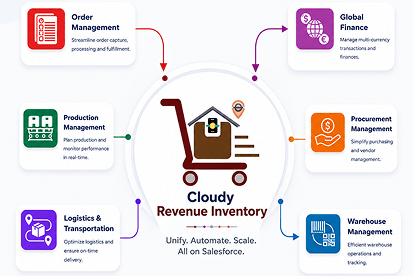
If you are exploring how to extend your Salesforce revenue capabilities across operations and inventory as well, platforms like Cloudy Business Ops 360 offer complementary Salesforce-native solutions that connect sales, operations, warehousing, and accounting in one unified environment.
Salesforce CPQ Alternatives in 2026
Organizations evaluating their CPQ strategy in 2026 have several credible options depending on their size, complexity, and technology environment:
Agentforce Revenue Management / Revenue Cloud — Salesforce’s own strategic successor. Recommended for organizations planning new implementations or those with complex revenue lifecycle requirements. Explore Salesforce Revenue Management consulting to evaluate fit.
Oracle CPQ — A strong enterprise option for large organizations with complex manufacturing, high-volume B2B, or multi-country requirements. Significant implementation investment required.
SAP CPQ — Suited for organizations already deeply invested in the SAP ecosystem. Best when native SAP integration outweighs Salesforce-first considerations.
Microsoft Dynamics 365 Sales + CPQ — A viable path for organizations standardized on the Microsoft technology stack, though Salesforce-native advantages are lost.
NetSuite CPQ — Relevant for organizations where NetSuite is the ERP and operational system of record. Better suited for mid-market businesses looking to minimize integration complexity.
Salesforce-native operational platforms — Solutions like Cloudy Business Ops 360, which extend Salesforce natively across sales, procurement, inventory, and billing, can serve as a complementary or alternative path for businesses seeking tighter operational integration without adding external CPQ vendors.
No single platform is the right choice for every organization. The decision should be driven by your existing technology stack, product complexity, revenue model, integration requirements, and internal Salesforce expertise.
Should You Continue Using Salesforce CPQ in 2026?
Here is a practical framework for making this decision.
Continue with Salesforce CPQ if:
- You have a mature, well-functioning CPQ implementation that your team relies on daily
- Your current system meets your quoting, approval, and contract management requirements
- You have significant customizations that would require substantial re-implementation effort
- A migration would disrupt active sales operations or ongoing contract management
- Your current support and renewal arrangements remain commercially suitable
- Your revenue model is relatively straightforward (simple subscriptions, standard pricing)
Consider evaluating newer revenue-management solutions if:
- You are implementing CPQ for the first time and want to align with Salesforce’s current investment
- You need capabilities beyond quoting — billing, usage pricing, revenue recognition, asset lifecycle
- Your product or pricing model is evolving toward consumption, hybrid, or usage-based structures
- You are planning a broader Salesforce Revenue Cloud transformation
- You want to leverage Agentforce AI capabilities across the revenue lifecycle
- Your existing CPQ implementation has accumulated significant technical debt
Before committing to either path, engage a Salesforce CPQ consulting partner to conduct a proper assessment of your current architecture, business requirements, and migration complexity.
Salesforce CPQ Implementation Best Practices
Whether you are implementing CPQ for the first time or optimizing an existing deployment, these principles consistently produce better outcomes:
- Define business requirements first. Document your quoting workflows, pricing logic, and approval thresholds before touching configuration.
- Standardize your product catalog. CPQ works best when products, bundles, and pricing are rationalized and clean.
- Minimize unnecessary customization. Use standard CPQ features wherever possible. Customization increases maintenance burden.
- Design approval processes carefully. Overly complex approval chains slow sales cycles. Design for the 80% case, not every exception.
- Clean existing Salesforce data. Accounts, contacts, price books, and products should be accurate before CPQ goes live.
- Plan integrations early. ERP, billing, and accounting integrations require lead time. Do not treat them as afterthoughts.
- Test complex quote scenarios. Run real-world quoting scenarios — bundles, discounts, amendments — before launch.
- Prepare your sales team. User adoption is the most common point of failure. Invest in training and change management.
- Monitor CPQ performance. Large product catalogs and complex rules can impact performance. Monitor page load and quote generation times.
- Create a revenue architecture roadmap. Your CPQ implementation should fit into a broader long-term strategy for Salesforce revenue management and operations.
Common Salesforce CPQ Challenges
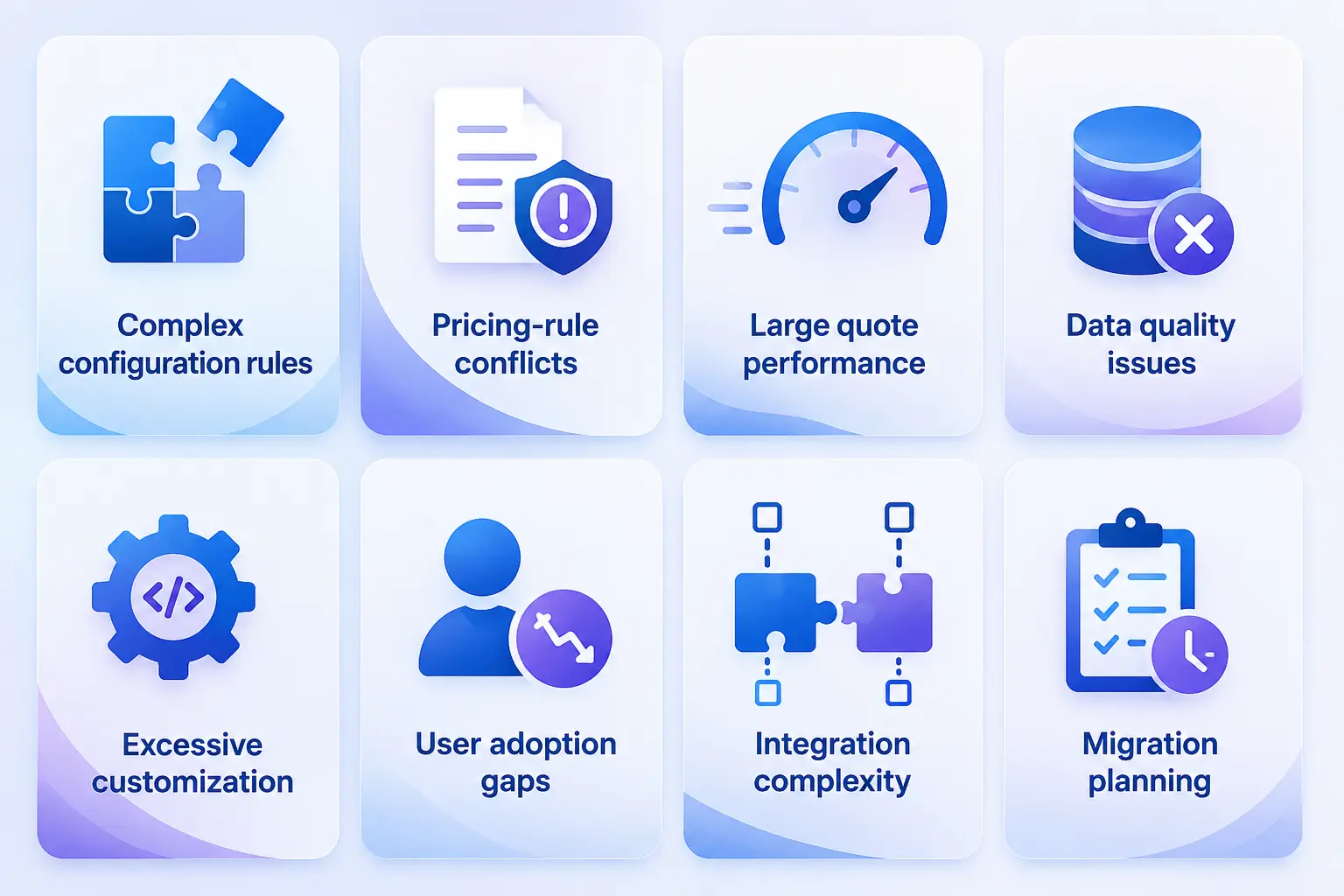
Complex configuration rules — Large rule sets become difficult to maintain. Mitigation: document all rules thoroughly and conduct regular configuration audits.
Pricing-rule conflicts — Overlapping price rules produce unexpected results. Mitigation: use a structured naming and sequencing convention from day one.
Large quote performance — Quotes with hundreds of line items can be slow to load or generate. Mitigation: optimize product rules and consider asynchronous quote generation.
Data quality issues — Inaccurate price books or product data cause quoting errors. Mitigation: treat data governance as a prerequisite, not an afterthought.
Excessive customization — Apex-heavy implementations become fragile during Salesforce releases. Mitigation: preference standard configuration over code.
User adoption gaps — Sales reps resist new tools if CPQ slows them down initially. Mitigation: invest in guided training and gather early feedback during rollout.
Integration complexity — Connecting CPQ to ERP or billing systems requires careful data mapping and error handling. Mitigation: plan integrations during design, not after go-live.
Migration planning — Moving from CPQ to a newer platform is complex if data and customizations are entangled. Mitigation: maintain clean configuration boundaries and thorough documentation throughout your CPQ lifecycle.
Conclusion
The Salesforce CPQ 2026 landscape is nuanced but navigable. The platform is not discontinued — it is end of sale, meaning existing customers retain full access, support, and renewal rights. If your CPQ implementation is working well and meeting your business requirements, there is no immediate reason to disrupt it.
However, the direction of Salesforce’s strategic investment is clear. Agentforce Revenue Management and Revenue Cloud represent the future for organizations that want Salesforce-native revenue lifecycle management — particularly as revenue models grow more complex with subscriptions, usage pricing, and multi-channel selling.
The most important step for any organization in 2026 is to assess honestly: does your current CPQ architecture serve your revenue operations well, or has it become a constraint? If you are a CPQ customer in good standing, continue investing in optimization. If you are starting fresh or facing significant revenue model evolution, align with Salesforce’s current platform direction from the outset.
Working with an experienced Salesforce CPQ implementation partner or Salesforce Revenue Management consulting team will help you make this decision with the context, technical depth, and business alignment it deserves.





 Salesforce ERP
 ERP + CRM Platform
  Inventory Management
  Warehouse Management
  Order Management
  Vendor Management
  Logistics Management
  BOM Management
  Order Fulfillment
  Business Operations
  SaaS Platform for Operations
  Salesforce Cloud ERP Platform
  Xero
Xero
 Zoho books
 Quickbooks
 Shopify
 Acumatica
 SAP
SAP
 Odoo
Odoo
 NetSuite
 Microsoft Dynamics 365
 Sage
Sage

 Agentforce Revenue Management
 Agentforce Revenue Management + Billing
  Salesforce CPQ
 Salesforce Advanced Billing
  Migrate from CPQ to ARM
  Managed Services
 Salesforce Implementation
 Revenue Cloud Implementation
 ServiceNow Consulting Services
 Zoho CRM implementation
 MuleSoft Integration
 Workato Integration
 Microsoft
 Data Cloud
 Tableau
 ·
August 31, 2026
·
15 min read
·
August 31, 2026
·
15 min read