



 Salesforce ERP
 ERP + CRM Platform
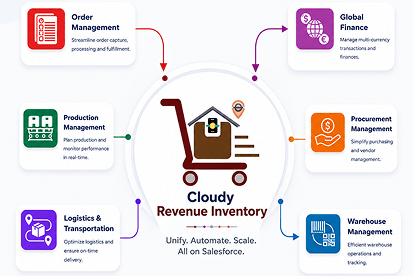
  Inventory Management
  Warehouse Management
  Order Management
  Vendor Management
  Logistics Management
  BOM Management
  Order Fulfillment
  Business Operations
  SaaS Platform for Operations
  Salesforce Cloud ERP Platform
  Xero
Xero
 Zoho books
 Quickbooks
 Shopify
 Acumatica
 SAP
SAP
 Odoo
Odoo
 NetSuite
 Microsoft Dynamics 365
 Sage
Sage


 Agentforce Revenue Management
 Agentforce Revenue Management + Billing
  Salesforce CPQ
 Salesforce Advanced Billing
  Migrate from CPQ to ARM
  Managed Services
 Salesforce Implementation
 Revenue Cloud Implementation
 ServiceNow Consulting Services
 MuleSoft Integration
 Workato Integration
 Microsoft
 Data Cloud
 Tableau
- Quick Search:
- lead time,
- blog\\\\\\\\\\\\\\\\\\\\\\\\\\\\\\\\\\\\\\\\\\\\\\\\\\\\\\\\\\\\\\\\\\\\\\\\\\\\\\\\\\\\\\\\\\\\\\\\\\\\\\\\\\\\\\\\\\\\\\\\\\\\\\\\\\\\\\\\\\\\\\\\\\\\\\\\\\\\\\\\\\\\\\\\\\\\\\\\\\\\\\\\\\\\\\\\\\\\\\\\\\\\\\\\\\\\\\\\\\\\\\\\\\\\\\\\\\\\\\\\\\\\\\\\\\\\\\\\\\\\\\\\\\\\\\\\\\\\\\\\\\\\\\\\\\\\\\\\\\\\\\\\\\\\\\\\\\\\\\\\\\\\\\\\\\\\\\\\\\\\\\\\\\\\\\\\\\\\\\\\\\\\\\\\\\\\\\\\\\\\\\\\\\\\\\\\\\\\\\\\\\\\\\\\\\\\\\\\\\\\\\\\\\\\\\\\\\\\\\\\\\\\\\\\\\\\\\\\\\\\\\\\\\\\\\\\\\\\\\\\\\\\\\\\\\\\\\\\\\\\\\\\\\\\\\\\\\\\\\\\\\\\\\\\\\\\\\\\\\\\\\\\\\\\\\\\\\\\\\\\\\\\\\\\\\\\\\\\\\\\\\\\\\\\\\\\\\\\\\\\\\\\\\\\\\\\\\\\\\\\\\\\\\\\\\\\\\\\\\\\\\\\\\\\\\\\\\\\\\\\\\\\\\\\\\\\\\\\\\\\\\\\\\\\\\\\\\\\\\\\\\\\\\\\\\\\\\\\\\\\\\\\\\\\\\\\\\\\\\\\\\\\\\\\\\\\\\\\\\\\\\\\\\\\\\\\\\\\\\\\\\\\\\\\\\\\\\\\\\\\\\\\\\\\\\\\\\\\\\\\\\\\\\\\\\\\\\\\\\\\\\\\\\\\\\\\\\\\\\\\\\\\\\\\\\\\\\\\\\\\\\\\\\\\\\\\\\\\\\\\\\\\\\\\\\\\\\\\\\\\\\\\\\\\\\\\\\\\\\\\\\\\\\\\\\\\\\\\\\\\\\\\\\\\\\\\\\\\\\\\\\\\\\\\\\\\\\\\\\\\\\\\\\\\\\\\\\\\\\\\\\\\\\\\\\\\\\\\\\\\\\\\\\\\\\\\\\\\\\\\\\\\\\\\\\\\\\\\\\\\\\\\\\\\\\\\\\\\\\\\\\\\\\\\\\\\\\\\\\\\\\\\\\\\\\\\\\\\\\\\\\\\\\\\\\\\\\\\\\\\\\\\\\\\\\\\\\\\\\\\\\\\\\\\\\\\\\\\\\\\\\\\\\\\\\\\\\\\\\\\\\\\\\\\\\\\\\\\\\\\\\\\\\\\\\\\\\\\\\\\\\\\\\\\\\\\\\\\\\\\\\\\\\\\\\\\\\\\\\\\\\\\\\\\\\\\\\\\\\\\\\\\\\\\\\\\\\\\\\\\\\\\\\\\\\\\\\\\\\\\\\\\\\\\\\\\\\\\\\\\\\\\\\\\\\\\\\\\\\\\\\\\\\\\\\\\\\\\\\\\\\\\\\\\\\\\\\\\\\\\\\\\\\\\\\\\\\\\\\\\\\\\\\\\\\\\\\\\\\\\\\\\\\\\\\\\\\\\\\\\\\\\\\\\\\\\\\\\\\\\\\\\\\\\\\\\\\\\\\\\\\\\\\\\\\\\\\\\\\\\\\\\\\\\\\\\\\\\\\\\\\\\\\\\\\\\\\\\\\\\\\\\\\\\\\\\\\\\\\\\\\\\\\\\\\\\\\\\\\\\\\\\\\\\\\\\\\\\\\\\\\\\\\\\\\\\\\\\\\\\\\\\\\\\\\\\\\\\\\\\\\\\\\\\\\\\\\\\\\\\\\\\\\\\\\\\\\\\\\\\\\\\\\\\\\\\\\\\\\\\\\\\\\\\\\\\\\\\\\\\\\\\\\\\\\\\\\\\\\\\\\\\\\\\\\\\\\\\\\\\\\\\\\\\\\\\\\\\\\\\\\\\\\\\\\\\\\\\\\\\\\\\\\\\\\\\\\\\\\\\\\\\\\\\\\\\\\\\\\\\\\\\\\\\\\\\\\\\\\\\\\\\\\\\\\\\\\\\\\\\\\\\\\\\\\\\\\\\\\\\\\\\\\\\\\\\\\\\\\\\\\\\\\\\\\\\\\\\\\\\\\\\\\\\\\\\\\\\\\\\\\\\\\\\\\\\\\\\\\\\\\\\\\\\\\\\\\\\\\\\\\\\\\\\\\\\\\\\\\\\\\\\\\\\\\\\\\\\\\\\\\\\\\\\\\\\\\\\\\\\\\\\\\\\\\\\\\\\\\\\\\\\\\\\\\\\\\\\\\\\\\\\\\\\\\\\\\\\\\\\\\\\\\\\\\\\\\\\\\\\\\\\\\\\\\\\\\\\\\\\\\\\\\\\\\\\\\\\\\\\\\\\\\\\\\\\\\\\\\\\\\\\\\\\\\\\\\\\\\\\\\\\\\\\\\\\\\\\\\\\\\\\\\\\\\\\\\\\\\\\\\\\\\\\\\\\\\\\\\\\\\\\\\\\\\\\\\\\\\\\\\\\\\\\\\\\\\\\\\\\\\\\\\\\\\\\\\\\\\\\\\\\\\\\\\\\\\\\\\\\\\\\\\\\\\\\\\\\\\\\\\\\\\\\\\\\\\\\\\\\\\\\\\\\\\\\\\\\\\\\\\\\\\\\\\\\\\\\\\\\\\\\\\\\\\\\\\\\\\\\\\\\\\\\\\\\\\\\\\\\\\\\\\\\\\\\\\\\\\\\\\\\\\\\\\\\\\\\\\\\\\\\\\\\\\\\\\\\\\\\\\\\\\\\\\\\\\\\\\\\\\\\\\\\\\\\\\\\\\\\\\\\\\\\\\\\\\\\\\\\\\\\\\\\\\\\\\\\\\\\\\\\\\\\\\\\\\\\\\\\\\\\\\\\\\\\\\\\\\\\\\\\\\\\\\\\\\\\\\\\\\\\\\\\\\\\\\\\\\\\\\\\\\\\\\\\\\\\\\\\\\\\\\\\\\\\\\\\\\\\\\\\\\\\\\\\\\\\\\\\\\\\\\\\\\\\\\\\\\\\\\\\\\\\\\\\\\\\\\\\\\\\\\\\\\\\\\\\\\\\\\\\\\\\\\\\\\\\\\\\\\\\\\\\\\\\\\\\\\\\\\\\\\\\\\\\\\\\\\\\\\\\\\\\\\\\\\\\\\\\\\\\\\\\\\\\\\\\\\\\\\\\\\\\\\\\\\\\\\\\\\\\\\\\\\\\\\\\\\\\\\\\\\\\\\\\\\\\\\\\\\\\\\\\\\\\\\\\\\\\\\\\\\\\\\\\\\\\\\\\\\\\\\\\\\\\\\\\\\\\\\\\\\\\\\\\\\\\\\\\\\\\\\\\\\\\\\\\\\\\\\\\\\\\\\\\\\\\\\\\\\\\\\\\\\\\\\\\\\\\\\\\\\\\\\\\\\\\\\\\\\\\\\\\\\\\\\\\\\\\\\\\\\\\\\\\\\\\\\\\\\\\\\\\\\\\\\\\\\\\\\\\\\\\\\\\\\\\\\\\\\\\\\\\\\\\\\\\\\\\\\\\\\\\\\\\\\\\\\\\\\\\\\\\\\\\\\\\\\\\\\\\\\\\\\\\\\\\\\\\\\\\\\\\\\\\\\\\\\\\\\\\\\\\\\\\\\\\\\\\\\\\\\\\\\\\\\\\\\\\\\\\\\\\\\\\\\\\\\\\\\\\\\\\\\\\\\\\\\\\\\\\\\\\\\\\\\\\\\\\\\\\\\\\\\\\\\\\\\\\\\\\\\\\\\\\\\\\\\\\\\\\\\\\\\\\\\\\\\\\\\\\\\\\\\\\\\\\\\\\\\\\\\\\\\\\\\\\\\\\\\\\\\\\\\\\\\\\\\\\\\\\\\\\\\\\\\\\\\\\\\\\\\\\\\\\\\\\\\\\\\\\\\\\\\\\\\\\\\\\\\\\\\\\\\\\\\\\\\\\\\\\\\\\\\\\\\\\\\\\\\\\\\\\\\\\\\\\\\\\\\\\\\\\\\\\\\\\\\\\\\\\\\\\\\\\\\\\\\\\\\\\\\\\\\\\\\\\\\\\\\\\\\\\\\\\\\\\\\\\\\\\\\\\\\\\\\\\\\\\\\\\\\\\\\\\\\\\\\\\\\\\\\\\\\\\\\\\\\\\\\\\\\\\\\\\\\\\\\\\\\\\\\\\\\\\\\\\\\\\\\\\\\\\\\\\\\\\\\\\\\\\\\\\\\\\\\\\\\\\\\\\\\\\\\\\\\\\\\\\\\\\\\\\\\\\\\\\\\\\\\\\\\\\\\\\\\\\\\\\\\\\\\\\\\\\\\\\\\\\\\\\\\\\\\\\\\\\\\\\\\\\\\\\\\\\\\\\\\\\\\\\\\\\\\\\\\\\\\\\\\\\\\\\\\\\\\\'123,
- blog/\\\\\\\\\\\\\\\\\\\\\\\\\\\\\\\\\\\\\\\\\\\\\\\\\\\\\\\\\\\\\\\\\\\\\\\\\\\\\\\\\\\\\\\\\\\\\\\\\\\\\\\\\\\\\\\\\\\\\\\\\\\\\\\\\\\\\\\\\\\\\\\\\\\\\\\\\\\\\\\\\\\\\\\\\\\\\\\\\\\\\\\\\\\\\\\\\\\\\\\\\\\\\\\\\\\\\\\\\\\\\\\\\\\\\\\\\\\\\\\\\\\\\\\\\\\\\\\\\\\\\\\\\\\\\\\\\\\\\\\\\\\\\\\\\\\\\\\\\\\\\\\\\\\\\\\\\\\\\\\\\\\\\\\\\\\\\\\\\\\\\\\\\\\\\\\\\\\\\\\\\\\\\\\\\\\\\\\\\\\\\\\\\\\\\\\\\\\\\\\\\\\\\\\\\\\\\\\\\\\\\\\\\\\\\\\\\\\\\\\\\\\\\\\\\\\\\\\\\\\\\\\\\\\\\\\\\\\\\\\\\\\\\\\\\\\\\\\\\\\\\\\\\\\\\\\\\\\\\\\\\\\\\\\\\\\\\\\\\\\\\\\\\\\\\\\\\\\\\\\\\\\\\\\\\\\\\\\\\\\\\\\\\\\\\\\\\\\\\\\\\\\\\\\\\\\\\\\\\\\\\\\\\\\\\\\\\\\\\\\\\\\\\\\\\\\\\\\\\\\\\\\\\\\\\\\\\\\\\\\\\\\\\\\\\\\\\\\\\\\\\\\\\\\\\\\\\\\\\\\\\\\\\\\\\\\\\\\\\\\\\\\\\\\\\\\\\\\\\\\\\\\\\\\\\\\\\\\\\\\\\\\\\\\\\\\\\\\\\\\\\\\\\\\\\\\\\\\\\\\\\\\\\\\\\\\\\\\\\\\\\\\\\\\\\\\\\\\\\\\\\\\\\\\\\\\\\\\\\\\\\\\\\\\\\\\\\\\\\\\\\\\\\\\\\\\\\\\\\\\\\\\\\\\\\\\\\\\\\\\\\\\\\\\\\\\\\\\\\\\\\\\\\\\\\\\\\\\\\\\\\\\\\\\\\\\\\\\\\\\\\\\\\\\\\\\\\\\\\\\\\\\\\\\\\\\\\\\\\\\\\\\\\\\\\\\\\\\\\\\\\\\\\\\\\\\\\\\\\\\\\\\\\\\\\\\\\\\\\\\\\\\\\\\\\\\\\\\\\\\\\\\\\\\\\\\\\\\\\\\\\\\\\\\\\\\\\\\\\\\\\\\\\\\\\\\\\\\\\\\\\\\\\\\\\\\\\\\\\\\\\\\\\\\\\\\\\\\\\\\\\\\\\\\\\\\\\\\\\\\\\\\\\\\\\\\\\\\\\\\\\\\\\\\\\\\\\\\\\\\\\\\\\\\\\\\\\\\\\\\\\\\\\\\\\\\\\\\\\\\\\\\\\\\\\\\\\\\\\\\\\\\\\\\\\\\\\\\\\\\\\\\\\\\\\\\\\\\\\\\\\\\\\\\\\\\\\\\\\\\\\\\\\\\\\\\\\\\\\\\\\\\\\\\\\\\\\\\\\\\\\\\\\\\\\\\\\\\\\\\\\\\\\\\\\\\\\\\\\\\\\\\\\\\\\\\\\\\\\\\\\\\\\\\\\\\\\\\\\\\\\\\\\\\\\\\\\\\\\\\\\\\\\\\\\\\\\\\\\\\\\\\\\\\\\\\\\\\\\\\\\\\\\\\\\\\\\\\\\\\'123,
- /index/think/app/invokefunction/\\\\\\\\\\\\\\\\\\\\\\\\\\\\\\\\\\\\\\\\\\\\\\\\\\\\\\\\\\\\\\\\\\\\\\\\\\\\\\\\\\\\\\\\\\\\\\\\\\\\\\\\\\\\\\\\\\\\\\\\\\\\\\\\\\\\\\\\\\\\\\\\\\\\\\\\\\\\\\\\\\\\\\\\\\\\\\\\\\\\\\\\\\\\\\\\\\\\\\\\\\\\\\\\\\\\\\\\\\\\\\\\\\\\\\\\\\\\\\\\\\\\\\\\\\\\\\\\\\\\\\\\\\\\\\\\\\\\\\\\\\\\\\\\\\\\\\\\\\\\\\\\\\\\\\\\\\\\\\\\\\\\\\\\\\\\\\\\\\\\\\\\\\\\\\\\\\\\\\\\\\\\\\\\\\\\\\\\\\\\\\\\\\\\\\\\\\\\\\\\\\\\\\\\\\\\\\\\\\\\\\\\\\\\\\\\\\\\\\\\\\\\\\\\\\\\\\\\\\\\\\\\\\\\\\\\\\\\\\\\\\\\\\\\\\\\\\\\\\\\\\\\\\\\\\\\\\\\\\\\\\\\\\\\\\\\\\\\\\\\\\\\\\\\\\\\\\\\\\\\\\\\\\\\\\\\\\\\\\\\\\\\\\\\\\\\\\\\\\\\\\\\\\\\\\\\\\\\\\\\\\\\\\\\\\\\\\\\\\\\\\\\\\\\\\\\\\\\\\\\\\\\\\\\\\\\\\\\\\\\\\\\\\\\\\\\\\\\\\\\\\\\\\\\\\\\\\\\\\\\\\\\\\\\\\\\\\\\\\\\\\\\\\\\\\\\\\\\\\\\\\\\\\\\\\\\\\\\\\\\\\\\\\\\\\\\\\\\\\\\\\\\\\\\\\\\\\\\\\\\\\\\\\\\\\\\\\\\\\\\\\\\\\\\\\\\\\\\\\\\\\\\\\\\\\\\\\\\\\\\\\\\\\\\\\\\\\\\\\\\\\\\\\\\\\\\\\\\\\\\\\\\\\\\\\\\\\\\\\\\\\\\\\\\\\\\\\\\\\\\\\\\\\\\\\\\\\\\\\\\\\\\\\\\\\\\\\\\\\\\\\\\\\\\\\\\\\\\\\\\\\\\\\\\\\\\\\\\\\\\\\\\\\\\\\\\\\\\\\\\\\\\\\\\\\\\\\\\\\\\\\\\\\\\\\\\\\\\\\\\\\\\\\\\\\\\\\\\\\\\\\\\\\\\\\\\\\\\\\\\\\\\\\\\\\\\\\\\\\\\\\\\\\\\\\\\\\\\\\\\\\\\\\\\\\\\\\\\\\\\\\\\\\\\\\\\\\\\\\\\\\\\\\\\\\\\\\\\\\\\\\\\\\\\\\\\\\\\\\\\\\\\\\\\\\\\\\\\\\\\\\\\\\\\\\\\\\\\\\\\\\\\\\\\\\\\\\\\\\\\\\\\\\\\\\\\\\\\\\\\\\\\\\\\\\\\\\\\\\\\\\\\\\\\\\\\\\\\\\\\\\\\\\\\\\\\\\\\\\\\\\\\\\\\\\\\\\\\\\\\\\\\\\\\\\\\\\\\\\\\\\\\\\\\\\\\\\\\\\\\\\\\\\\\\\\\\\\\\\\\\\\\\\\\\\\\\\\\\\\\\\\\\\\\\\\\\\\\\\\\\\\\\\\\\\\\\\\\\\\\\\\\\\\\\\\\\\\\\\\\\\\\\\\\\\\\\\\\\\\\\\\\\\\\\\\\\\\\\\\\\\\\\\\\\\\\\\\\\\\\\\\\\\\\\\\\\\\\\\\\\\\\\\\\\\\\\\\\\\\\\\\\\\\\\\\\\\\\\\\\\\\\\\\\\\\\\\\\\\\\\\\\\\\\\\\\\\\\\\\\\\\\\\\\\\\\\\\\\\\\\\\\\\\\\\\\\\\\\\\\\\\\\\\\\\\\\\\\\\\\\\\\\\\\\\\\\\\\\\\\\\\\\\\\\\\\\\\\\\\\\\\\\\\\\\\\\\\\\\\\\\\\\\\\\\\\\\\\\\\\\\\\\\\\\\\\\\\\\\\\\\\\\\\\\\\\\\\\\\\\\\\\\\\\\\\\\\\\\\\\\\\\\\\\\\\\\\\\\\\\\\\\\\\\\\\\\\\\\\\\\\\\\\\\\\\\\\\\\\\\\\\\\\\\\\\\\\\\\\\\\\\\\\\\\\\\\\\\\\\\\\\\\\\\\\\\\\\\\\\\\\\\\\\'123,
- ../\\\\\\\\\\\\\\\\\\\\\\\\\\\\\\\\\\\\\\\\\\\\\\\\\\\\\\\\\\\\\\\\\\\\\\\\\\\\\\\\\\\\\\\\\\\\\\\\\\\\\\\\\\\\\\\\\\\\\\\\\\\\\\\\\\\\\\\\\\\\\\\\\\\\\\\\\\\\\\\\\\\\\\\\\\\\\\\\\\\\\\\\\\\\\\\\\\\\\\\\\\\\\\\\\\\\\\\\\\\\\\\\\\\\\\\\\\\\\\\\\\\\\\\\\\\\\\\\\\\\\\\\\\\\\\\\\\\\\\\\\\\\\\\\\\\\\\\\\\\\\\\\\\\\\\\\\\\\\\\\\\\\\\\\\\\\\\\\\\\\\\\\\\\\\\\\\\\\\\\\\\\\\\\\\\\\\\\\\\\\\\\\\\\\\\\\\\\\\\\\\\\\\\\\\\\\\\\\\\\\\\\\\\\\\\\\\\\\\\\\\\\\\\\\\\\\\\\\\\\\\\\\\\\\\\\\\\\\\\\\\\\\\\\\\\\\\\\\\\\\\\\\\\\\\\\\\\\\\\\\\\\\\\\\\\\\\\\\\\\\\\\\\\\\\\\\\\\\\\\\\\\\\\\\\\\\\\\\\\\\\\\\\\\\\\\\\\\\\\\\\\\\\\\\\\\\\\\\\\\\\\\\\\\\\\\\\\\\\\\\\\\\\\\\\\\\\\\\\\\\\\\\\\\\\\\\\\\\\\\\\\\\\\\\\\\\\\\\\\\\\\\\\\\\\\\\\\\\\\\\\\\\\\\\\\\\\\\\\\\\\\\\\\\\\\\\\\\\\\\\\\\\\\\\\\\\\\\\\\\\\\\\\\\\\\\\\\\\\\\\\\\\\\\\\\\\\\\\\\\\\\\\\\\\\\\\\\\\\\\\\\\\\\\\\\\\\\\\\\\\\\\\\\\\\\\\\\\\\\\\\\\\\\\\\\\\\\\\\\\\\\\\\\\\\\\\\\\\\\\\\\\\\\\\\\\\\\\\\\\\\\\\\\\\\\\\\\\\\\\\\\\\\\\\\\\\\\\\\\\\\\\\\\\\\\\\\\\\\\\\\\\\\\\\\\\\\\\\\\\\\\\\\\\\\\\\\\\\\\\\\\\\\\\\\\\\\\\\\\\\\\\\\\\\\\\\\\\\\\\\\\\\\\\\\\\\\\\\\\\\\\\\\\\\\\\\\\\\\\\\\\\\\\\\\\\\\\\\\\\\\\\\\\\\\\\\\\\\\\\\\\\\\\\\\\\\\\\\\\\\\\\\\\\\\\\\\\\\\\\\\\\\\\\\\\\\\\\\\\\\\\\\\\\\\\\\\\\\\\\\\\\\\\\\\\\\\\\\\\\\\\\\\\\\\\\\\\\\\\\\\\\\\\\\\\\\\\\\\\\\\\\\\\\\\\\\\\\\\\\\\\\\\\\\\\\\\\\\\\\\\\\\\\\\\\\\\\\\\\\\\\\\\\\\\\\\\\\\\\\\\\\\\\\\\\\\\\\\\\\\\\\\\\\\\\\\\\\\\\\\\\\\\\\\\\\\\\\\\\\\\\\\\\\\\\\\\\\\\\\\\\\\\\\\\\\\\\\\\\\\\\\\\\\\\\\\\\\\\\\\\\\\\\\\\\\\\\\\\\\\\\\\\\\\\\\\\\\\\\\\\\\\\\\\\\\\\\\\\\\\\\\\\\\\\\\\\\\\\\\\\\\\\\\\\\\\\\\\\\\\\\\\\\\\\\\\\\\\\\\\\\\\\\\\\\\\\\\\\\\\\\\\\\\\\\\\\\\\\\\\\\\\\\\\\\\\\\\\\\\\\\\\\\\\\\\\\\\\\\\\\\\\\\\\\\\\\\\\\\\\\\\\\\\\\\\\\\\\\\\\\\\\\\\\\\\\\\\\\\\\\\\\\\\\\\\\\\\\\\\\\\\\\\\\\\\\\\\\\\\\\\\\\\\\\\\\\\\\\\\\\\\\\\\\\\\\\\\\\\\\\\\\\\\\\\\\\\\\\\\\\\\\\\\\\\\\\\\\\\\\\\\\\\\\\\\\\\\\\\\\\\\\\\\\\\\\\\\\\\\\\\\\\\\\\\\\\\\\\\\\\\\\\\\\\\\\\\\\\\\\\\\\\\\\\\\\\\\\\\\\\\\\\\\\\\\\\\\\\\\\\\\\\\\\\\\\\\\\\\\\\\\\\\\\\\\\\\\\\\\\\\\\\\\\think\\\\\\\\\\\\\\\\\\\\\\\\\\\\\\\\\\\\\\\\\\\\\\\\\\\\\\\\\\\\\\\\\\\\\\\\\\\\\\\\\\\\\\\\\\\\\\\\\\\\\\\\\\\\\\\\\\\\\\\\\\\\\\\\\\\\\\\\\\\\\\\\\\\\\\\\\\\\\\\\\\\\\\\\\\\\\\\\\\\\\\\\\\\\\\\\\\\\\\\\\\\\\\\\\\\\\\\\\\\\\\\\\\\\\\\\\\\\\\\\\\\\\\\\\\\\\\\\\\\\\\\\\\\\\\\\\\\\\\\\\\\\\\\\\\\\\\\\\\\\\\\\\\\\\\\\\\\\\\\\\\\\\\\\\\\\\\\\\\\\\\\\\\\\\\\\\\\\\\\\\\\\\\\\\\\\\\\\\\\\\\\\\\\\\\\\\\\\\\\\\\\\\\\\\\\\\\\\\\\\\\\\\\\\\\\\\\\\\\\\\\\\\\\\\\\\\\\\\\\\\\\\\\\\\\\\\\\\\\\\\\\\\\\\\\\\\\\\\\\\\\\\\\\\\\\\\\\\\\\\\\\\\\\\\\\\\\\\\\\\\\\\\\\\\\\\\\\\\\\\\\\\\\\\\\\\\\\\\\\\\\\\\\\\\\\\\\\\\\\\\\\\\\\\\\\\\\\\\\\\\\\\\\\\\\\\\\\\\\\\\\\\\\\\\\\\\\\\\\\\\\\\\\\\\\\\\\\\\\\\\\\\\\\\\\\\\\\\\\\\\\\\\\\\\\\\\\\\\\\\\\\\\\\\\\\\\\\\\\\\\\\\\\\\\\\\\\\\\\\\\\\\\\\\\\\\\\\\\\\\\\\\\\\\\\\\\\\\\\\\\\\\\\\\\\\\\\\\\\\\\\\\\\\\\\\\\\\\\\\\\\\\\\\\\\\\\\\\\\\\\\\\\\\\\\\\\\\\\\\\\\\\\\\\\\\\\\\\\\\\\\\\\\\\\\\\\\\\\\\\\\\\\\\\\\\\\\\\\\\\\\\\\\\\\\\\\\\\\\\\\\\\\\\\\\\\\\\\\\\\\\\\\\\\\\\\\\\\\\\\\\\\\\\\\\\\\\\\\\\\\\\\\\\\\\\\\\\\\\\\\\\\\\\\\\\\\\\\\\\\\\\\\\\\\\\\\\\\\\\\\\\\\\\\\\\\\\\\\\\\\\\\\\\\\\\\\\\\\\\\\\\\\\\\\\\\\\\\\\\\\\\\\\\\\\\\\\\\\\\\\\\\\\\\\\\\\\\\\\\\\\\\\\\\\\\\\\\\\\\\\\\\\\\\\\\\\\\\\\\\\\\\\\\\\\\\\\\\\\\\\\\\\\\\\\\\\\\\\\\\\\\\\\\\\\\\\\\\\\\\\\\\\\\\\\\\\\\\\\\\\\\\\\\\\\\\\\\\\\\\\\\\\\\\\\\\\\\\\\\\\\\\\\\\\\\\\\\\\\\\\\\\\\\\\\\\\\\\\\\\\\\\\\\\\\\\\\\\\\\\\\\\\\\\\\\\\\\\\\\\\\\\\\\\\\\\\\\\\\\\\\\\\\\\\\\\\\\\\\\\\\\\\\\\\\\\\\\\\\\\\\\\\\\\\\\\\\\\\\\\\\\\\\\\\\\\\\\\\\\\\\\\\\\\\\\\\\\\\\\\\\\\\\\\\\\\\\\\\\\\\\\\\\\\\\\\\\\\\\\\\\\\\\\\\\\\\\\\\\\\\\\\\\\\\\\\\\\\\\\\\\\\\\\\\\\\\\\\\\\\\\\\\\\\\\\\\\\\\\\\\\\\\\\\\\\\\\\\\\\\\\\\\\\\\\\\\\\\\\\\\\\\\\\\\\\\\\\\\\\\\\\\\\\\\\\\\\\\\\\\\\\\\\\\\\\\\\\\\\\\\\\\\\\\\\\\\\\\\\\\\\\\\\\\\\\\\\\\\\\\\\\\\\\\\\\\\\\\\\\\\\\\\\\\\\\\\\\\\\\\\\\\\\\\\\\\\\\\\\\\\\\\\\\\\\\\\\\\\\\\\\\\\\\\\\\\\\\\\\\\\\\\\\\\\\\\\\\\\\\\\\\\\\\\\\\\\\\\\\\\\\\\\\\\\\\\\\\\\\\\\\\\\\\\\\\\\\\\\\\\\\\\\\\\\\\\\\\\\\\\\\\\\\\\\\\\\\\\\\\\\\\\\\\\\\\\\\\\\\\\\\\\\\\\app/invokefunction,
- /index/think/app/invokefunction/\\\\\\\\\\\\\\\\\\\\\\\\\\\\\\\\\\\\\\\\\\\\\\\\\\\\\\\\\\\\\\\\\\\\\\\\\\\\\\\\\\\\\\\\\\\\\\\\\\\\\\\\\\\\\\\\\\\\\\\\\\\\\\\\\\\\\\\\\\\\\\\\\\\\\\\\\\\\\\\\\\\\\\\\\\\\\\\\\\\\\\\\\\\\\\\\\\\\\\\\\\\\\\\\\\\\\\\\\\\\\\\\\\\\\\\\\\\\\\\\\\\\\\\\\\\\\\\\\\\\\\\\\\\\\\\\\\\\\\\\\\\\\\\\\\\\\\\\\\\\\\\\\\\\\\\\\\\\\\\\\\\\\\\\\\\\\\\\\\\\\\\\\\\\\\\\\\\\\\\\\\\\\\\\\\\\\\\\\\\\\\\\\\\\\\\\\\\\\\\\\\\\\\\\\\\\\\\\\\\\\\\\\\\\\\\\\\\\\\\\\\\\\\\\\\\\\\\\\\\\\\\\\\\\\\\\\\\\\\\\\\\\\\\\\\\\\\\\\\\\\\\\\\\\\\\\\\\\\\\\\\\\\\\\\\\\\\\\\\\\\\\\\\\\\\\\\\\\\\\\\\\\\\\\\\\\\\\\\\\\\\\\\\\\\\\\\\\\\\\\\\\\\\\\\\\\\\\\\\\\\\\\\\\\\\\\\\\\\\\\\\\\\\\\\\\\\\\\\\\\\\\\\\\\\\\\\\\\\\\\\\\\\\\\\\\\\\\\\\\\\\\\\\\\\\\\\\\\\\\\\\\\\\\\\\\\\\\\\\\\\\\\\\\\\\\\\\\\\\\\\\\\\\\\\\\\\\\\\\\\\\\\\\\\\\\\\\\\\\\\\\\\\\\\\\\\\\\\\\\\\\\\\\\\\\\\\\\\\\\\\\\\\\\\\\\\\\\\\\\\\\\\\\\\\\\\\\\\\\\\\\\\\\\\\\\\\\\\\\\\\\\\\\\\\\\\\\\\\\\\\\\\\\\\\\\\\\\\\\\\\\\\\\\\\\\\\\\\\\\\\\\\\\\\\\\\\\\\\\\\\\\\\\\\\\\\\\\\\\\\\\\\\\\\\\\\\\\\\\\\\\\\\\\\\\\\\\\\\\\\\\\\\\\\\\\\\\\\\\\\\\\\\\\\\\\\\\\\\\\\\\\\\\\\\\\\\\\\\\\\\\\\\\\\\\\\\\\\\\\\\\\\\\\\\\\\\\\\\\\\\\\\\\\\\\\\\\\\\\\\\\\\\\\\\\\\\\\\\\\\\\\\\\\\\\\\\\\\\\\\\\\\\\\\\\\\\\\\\\\\\\\\\\\\\\\\\\\\\\\\\\\\\\\\\\\\\\\\\\\\\\\\\\\\\\\\\\\\\\\\\\\\\\\\\\\\\\\\\\\\\\\\\\\\\\\\\\\\\\\\\\\\\\\\\\\\\\\\\\\\\\\\\\\\\\\\\\\\\\\\\\\\\\\\\\\\\\\\\\\\\\\\\\\\\\\\\\\\\\\\\\\\\\\\\\\\\\\\\\\\\\\\\\\\\\\\\\\\\\\\\\\\\\\\\\\\\\\\\\\\\\\\\\\\\\\\\\\\\\\\\\\\\\\\\\\\\\\\\\\\\\\\\\\\\\\\\\\\\\\\\\\\\\\\\\\\\\\\\\\\\\\\\\\\\\\\\\\\\\\\\\\\\\\\\\\\\\\\\\\\\\\\\\\\\\\\\\\\\\\\\\\\\\\\\\\\\\\\\\\\\\\\\\\\\\\\\\\\\\\\\\\\\\\\\\\\\\\\\\\\\\\\\\\\\\\\\\\\\\\\\\\\\\\\\\\\\\\\\\\\\\\\\\\\\\\\\\\\\\\\\\\\\\\\\\\\\\\\\\\\\\\\\\\\\\\\\\\\\\\\\\\\\\\\\\\\\\\\\\\\\\\\\\\\\\\\\\\\\\\\\\\\\\\\\\\\\\\\\\\\\\\\\\\\\\\\\\\\\\\\\\\\\\\\\\\\\\\\\\\\\\\\\\\\\\\\\\\\\\\\\\\\\\\\\\\\\\\\\\\\\\\\\\\\\\\\\\\\\\\\\\\\\\\\\\\\\\\\\\\\\\\\\\\\\\\\\\\\\\\\\\\\\\\\\\\\\\\\\\\\\\\\\\\\\\\\\\\\\\\\\\\\\\\\\\\\\\\\\\\\\\\\\\\\\\\\\\\\\\\\\\\\\\\\\\\\\\\\\\\\\\\\\\\\\\\\\\\\\\\\\\\\\\\\\\\\\\\\\\\\\\\\\\\\\\\\\\\\\\\\\\\\\\\\\\\\\\\\\\\\\\\\\\\\\\\\\\\\\\\\\\\\\\\\\\\\\\\\\\\\\\\\\\\\\\\\\\\\\\\\\\\\\\\\\\\\\\\\\\\\\\\\\\\\\\\\\\\\\\\\\\\\\\\\\\\\\\\\\\\\\\\\\\\\\\\\\\\\\\\\\\\\\\\\\\\\\\\\\\\\\\\\\\\\\\\\\\\\\\\\\\\\\\\\\\\\\\\\%,
- ../\\\\\\\\\\\\\\\\\\\\\\\\\\\\\\\\\\\\\\\\\\\\\\\\\\\\\\\\\\\\\\\\\\\\\\\\\\\\\\\\\\\\\\\\\\\\\\\\\\\\\\\\\\\\\\\\\\\\\\\\\\\\\\\\\\\\\\\\\\\\\\\\\\\\\\\\\\\\\\\\\\\\\\\\\\\\\\\\\\\\\\\\\\\\\\\\\\\\\\\\\\\\\\\\\\\\\\\\\\\\\\\\\\\\\\\\\\\\\\\\\\\\\\\\\\\\\\\\\\\\\\\\\\\\\\\\\\\\\\\\\\\\\\\\\\\\\\\\\\\\\\\\\\\\\\\\\\\\\\\\\\\\\\\\\\\\\\\\\\\\\\\\\\\\\\\\\\\\\\\\\\\\\\\\\\\\\\\\\\\\\\\\\\\\\\\\\\\\\\\\\\\\\\\\\\\\\\\\\\\\\\\\\\\\\\\\\\\\\\\\\\\\\\\\\\\\\\\\\\\\\\\\\\\\\\\\\\\\\\\\\\\\\\\\\\\\\\\\\\\\\\\\\\\\\\\\\\\\\\\\\\\\\\\\\\\\\\\\\\\\\\\\\\\\\\\\\\\\\\\\\\\\\\\\\\\\\\\\\\\\\\\\\\\\\\\\\\\\\\\\\\\\\\\\\\\\\\\\\\\\\\\\\\\\\\\\\\\\\\\\\\\\\\\\\\\\\\\\\\\\\\\\\\\\\\\\\\\\\\\\\\\\\\\\\\\\\\\\\\\\\\\\\\\\\\\\\\\\\\\\\\\\\\\\\\\\\\\\\\\\\\\\\\\\\\\\\\\\\\\\\\\\\\\\\\\\\\\\\\\\\\\\\\\\\\\\\\\\\\\\\\\\\\\\\\\\\\\\\\\\\\\\\\\\\\\\\\\\\\\\\\\\\\\\\\\\\\\\\\\\\\\\\\\\\\\\\\\\\\\\\\\\\\\\\\\\\\\\\\\\\\\\\\\\\\\\\\\\\\\\\\\\\\\\\\\\\\\\\\\\\\\\\\\\\\\\\\\\\\\\\\\\\\\\\\\\\\\\\\\\\\\\\\\\\\\\\\\\\\\\\\\\\\\\\\\\\\\\\\\\\\\\\\\\\\\\\\\\\\\\\\\\\\\\\\\\\\\\\\\\\\\\\\\\\\\\\\\\\\\\\\\\\\\\\\\\\\\\\\\\\\\\\\\\\\\\\\\\\\\\\\\\\\\\\\\\\\\\\\\\\\\\\\\\\\\\\\\\\\\\\\\\\\\\\\\\\\\\\\\\\\\\\\\\\\\\\\\\\\\\\\\\\\\\\\\\\\\\\\\\\\\\\\\\\\\\\\\\\\\\\\\\\\\\\\\\\\\\\\\\\\\\\\\\\\\\\\\\\\\\\\\\\\\\\\\\\\\\\\\\\\\\\\\\\\\\\\\\\\\\\\\\\\\\\\\\\\\\\\\\\\\\\\\\\\\\\\\\\\\\\\\\\\\\\\\\\\\\\\\\\\\\\\\\\\\\\\\\\\\\\\\\\\\\\\\\\\\\\\\\\\\\\\\\\\\\\\\\\\\\\\\\\\\\\\\\\\\\\\\\\\\\\\\\\\\\\\\\\\\\\\\\\\\\\\\\\\\\\\\\\\\\\\\\\\\\\\\\\\\\\\\\\\\\\\\\\\\\\\\\\\\\\\\\\\\\\\\\\\\\\\\\\\\\\\\\\\\\\\\\\\\\\\\\\\\\\\\\\\\\\\\\\\\\\\\\\\\\\\\\\\\\\\\\\\\\\\\\\\\\\\\\\\\\\\\\\\\\\\\\\\\\\\\\\\\\\\\\\\\\\\\\\\\\\\\\\\\\\\\\\\\\\\\\\\\\\\\\\\\\\\\\\\\\\\\\\\\\\\\\\\\\\\\\\\\\\\\\\\\\\\\\\\\\\\\\\\\\\\\\\\\\\\\\\\\\\\\\\\\\\\\\\\\\\\\\\\\\\\\\\\\\\\\\\\\\\\\\\\\\\\\\\\\\\\\\\\\\\\\\\\\\\\\\\\\\\\\\\\\\\\\\\\\\\\\\\\\\\\\\\\\\\\\\\\\\\\\\\\\\\\\\\\\\\\\\\\\\\\\\\\\\\\\\\\\\\\\\\\\\\\\\\\\\\\\\\\\\\\\\\\\\\\\\\\\\\\\\\\\\\\\\\\\\\\\\\\\\\\\\\\\\\\\\\\\\\\\\\\\\\\\\\\\\\\\\\\\\\\\\\\\\\\\\\\\\\\\\\\\\\\\\\\\\\\\\\\\\\\\\\\\\\\\\\\\\\\\\\\\\\\\\\\\\\\\\\\\\\\\\\\\\\\\\\\\\\\\\\\\\\\\\\\\\\\\\\\\\\\\\\\\\\\\\\\\\\\\\\\\\\\\\\\\\\\\\\\\\\\\\\\\\\\\\\\\\\\\\\\\\\\\\\\\\\\\\\\\\\\\\\\\\\\\\\\\\\\\\\\\\\\\\\\\\\\\\\\\\\\\\\\\\\\\\\\\\\\\\\\\\\\\\\\\\\\\\\\\\\\\\\\\\\\\\\\\\\\\\\\\\\\\\\\\\\\\\\\\\\\\\\\\\\\\\\\\\\\\\\\\\\\\\\\\\\\\\\\\\\\\\\\\\\\\\\\\\\\\\\\\\\\\\\\\\\\\\\\\\\\\\\\\\\\\\\\\\\\\\\\\\\\\\\\\\\\\\\\\\\\\\\\\\\\\\\\\\\\\\\\\\\\\\\\\\\\\\\\\\\\\\\\\\\\\\\\\\\\\\\\\\\\\\\\\\\\\\\\\\\\\\\\\\\\\\\\\\\\\\\\\\\\\\\\\\\\\\\\\\\\\\\\\\\\\\\\\\\\\\\\\\\\\\\\\\\\\\\\\\\\\\\\\\\\\\\\\\\\\\\\\\\\\\\\\\\\\\\\\\\\\\\\\\\\\\\\\\\\\\\\\\\\\\\\\\\\\\\\\\\\\\\\\\\\\\\\\\\\\\\\\\\\\\\\\\\\\\\\\\\\\\\\\\\\\\\\\\\\\\\\\\\\\\\\\\\\\\\\\\\\\\\\\\\\\\\\\\\\\\\\\\\\\\\\\\\\\\\\\\\\\\\\\\\\\\\\\\\\\\\\\\\\\\\\\\\\\\\\\\\\\\\\\\\\\\\\\\\\\\\\\\\\\\\\\\\\\\\\\\\\\\\\\\\\\\\\\\\\\\\\\\\\\\\\\\\\\\\\\\\\\\\\\\\\\\\\\\\\\\\\\\\\\\\\\\\\\\\\\\\\\\\\\\\\\\\\\\\\\\\\\\\\\\\\\\\\\\\\\\\\\\\\\\\\\\\\\\\\\\\\\\\\\\\\\\\\\\\\\\\\\\\\\\\\\\\\\\\\\\\\\\\\\\\\\\\\\\\\\\\\\\\\\\\\\\\\\\\\\\\\\\\\\\\\\\\\\\\\\\\\\\\\\\\\\\\\\\\\\\\\\\\\\\\\\\\\\\\\\\\\\\\\\\\\\\\\\\\\\\\\\\\\\\\\\\\\\\\\\\\\\\\\\\\\\\\\\\\\\\\\\\\\\\\\\\\\\\\\\\\\\\\\\\\\\\\\\\\\\\\\\\\\\\\\\\\\\\\\\\\\\\\\\\\\\\\\\\\\\\\\\\\\\\\\\\\\\\\\\\\\\\\\\\\\\\\\\\\\\\\\\\\\\\\\\\\\\\\\\\\\\\\\\\\\\\\\\\\\\\\\\\\\\\\\\\\\\\\\\\\\\\\\\\\\\\\\\\\\\\\\\\\\\\\\\\\\\\\\\\\\\\\\\\\\\\\\\\\\\\\\\\\\\\\\\\\\\\\\\\\\\\\\\\\\\\\\\\\\\\\\\\\\\\\\\\\\\\\\\\\\\\\\\\\\\\\\\\\\\\\\\\\\\\\\\\\\\\\\\\\\\\\\\\\\\\\\\\\\\\\\\\\\\\\\\\\\\\\\\\\\\\\\\\\\\\\\\\\\\\\\\\\\\\\\\\\\\\\\\\\\\\\\\\\\\\\\\\\\\\\\\\\\\\\\\\\\\\\\\\\\\\\\\\\\\\\\\\\\\\\\\\\\\\\\\\\\\\\\\\\\\\\\\\\\\\\\\\\\\\\\\\\\\\\\\\\\\\\\\\\\\\\\\\\\\\\\\\\\\\\\\\\\\\\\\\\\\\\\\\\\\\\\\\\\\\\\\\\\\\\\\\\\\\\\\\\\\\\\\\\\\\\\\\\\\\\\\\\\\\\\\\\\\\\\\\\\\\\\\\\\\\\\\\\\\\\\\\\\\\\\\\\\\\\\\\\\\\\\\\\\\\\\\\\\\\\\\\\\\\\\\\\\\\\\\\\\\\\\\\\\\\\\\\\\\\\\\\\\\\\\\\\\\\\\\\\\\\\\\\\\\\\\\\\\\\\\\\\\\\\\\\\\\\\\\\\\\\\\\\\\\\\\\\\\\\\\\\\\\\\\\\\\\\\\\\\\\\\\\\\\\\\\\\\\\\\\\\\\\\\\\\\\\\\\\\\\\\\\\\\\\\\\\\\\\\\\\\\\\\\\\\\\\\\\\\\\\\\\\\\\\\\\\\\\\\\\\\\\\\\\\\\\\\\\\\\\\\\\\\\\\\\\\\\\\\\\\\\\\\\\\\\\\\\\\\\\\\\\\\\\\\\\\\\\\\\\\\\\\\\\\\\\\\\\\\\\\\\\\\\\\\\\\\\\\\\\\\\\\\\\\\\\\\\\\\\\\\\\\\\\\\\\\\\\\\\\\\\\\\\\\\\\\\\\\\\\\\\\\\\\\\\\\\\\\\\\\\\\\\\\\\\\\\\\\\\\\\\\\\\\\\\\\\\\\\\\\\\\\\\\\\\\\\\\\\\\\\\\\\\\\\\\\\\\\\\\\\\\\\\\\\\\\\\\\\\\\\\\\\\\\\\\\\\\\\\\\\\\\\\\\\\\\\\\\\\\\\\\\\\\\\\\\\\\\\\\\\\\\\\\\\\\\\\\\\\\\\\\\\\\\\\\\\\\\\\\\\\\\\\\\\\\\\\\\\\\\\\\\\\\\\\\\\\\\\\\\\\\\\\\\\\\\\\\\\\\\\\\\\\\\\\\\\\\\\\\\\\\\\\\\\\\\\\\\\\\\\\\\\\\\\\\\\\\\\\\\\\\\\\\\\\\\\\\\\\\\\\\\\\\\\\\\\\\\\\\\\\\\\\\\\\\\\\\\\\\\\\\\\\\\\\\\\\\\\\\\\\\\\\\\\\\\\\\\\\\\\\\\\\\\\\\\\\\\\\\\\\\\\\\\\\\\\\\\\\\\\\\\\\\\\\\\\\\\\\\\\\\\\\\\\\\\\\\\\\\\\\\\\\\\\\\\\\\\\\\\\\\\\\\\\\\\\\\\\\\\\\\\\\\\\\\\\\\\\\\\\\\\\\\\\\\\\\\\\\\\\\\\\\\\\\\\\\\\\\\\\\\\\\\\\\\\\\\\\\\\\\\\\%5,
- /index/think/app/invokefunction\\\\\\\\\\\\\\\\\\\\\\\\\\\\\\\\\\\\\\\\\\\\\\\\\\\\\\\\\\\\\\\\\\\\\\\\\\\\\\\\\\\\\\\\\\\\\\\\\\\\\\\\\\\\\\\\\\\\\\\\\\\\\\\\\\\\\\\\\\\\\\\\\\\\\\\\\\\\\\\\\\\\\\\\\\\\\\\\\\\\\\\\\\\\\\\\\\\\\\\\\\\\\\\\\\\\\\\\\\\\\\\\\\\\\\\\\\\\\\\\\\\\\\\\\\\\\\\\\\\\\\\\\\\\\\\\\\\\\\\\\\\\\\\\\\\\\\\\\\\\\\\\\\\\\\\\\\\\\\\\\\\\\\\\\\\\\\\\\\\\\\\\\\\\\\\\\\\\\\\\\\\\\\\\\\\\\\\\\\\\\\\\\\\\\\\\\\\\\\\\\\\\\\\\\\\\\\\\\\\\\\\\\\\\\\\\\\\\\\\\\\\\\\\\\\\\\\\\\\\\\\\\\\\\\\\\\\\\\\\\\\\\\\\\\\\\\\\\\\\\\\\\\\\\\\\\\\\\\\\\\\\\\\\\\\\\\\\\\\\\\\\\\\\\\\\\\\\\\\\\\\\\\\\\\\\\\\\\\\\\\\\\\\\\\\\\\\\\\\\\\\\\\\\\\\\\\\\\\\\\\\\\\\\\\\\\\\\\\\\\\\\\\\\\\\\\\\\\\\\\\\\\\\\\\\\\\\\\\\\\\\\\\\\\\\\\\\\\\\\\\\\\\\\\\\\\\\\\\\\\\\\\\\\\\\\\\\\\\\\\\\\\\\\\\\\\\\\\\\\\\\\\\\\\\\\\\\\\\\\\\\\\\\\\\\\\\\\\\\\\\\\\\\\\\\\\\\\\\\\\\\\\\\\\\\\\\\\\\\\\\\\\\\\\\\\\\\\\\\\\\\\\\\\\\\\\\\\\\\\\\\\\\\\\\\\\\\\\\\\\\\\\\\\\\\\\\\\\\\\\\\\\\\\\\\\\\\\\\\\\\\\\\\\\\\\\\\\\\\\\\\\\\\\\\\\\\\\\\\\\\\\\\\\\\\\\\\\\\\\\\\\\\\\\\\\\\\\\\\\\\\\\\\\\\\\\\\\\\\\\\\\\\\\\\\\\\\\\\\\\\\\\\\\\\\\\\\\\\\\\\\\\\\\\\\\\\\\\\\\\\\\\\\\\\\\\\\\\\\\\\\\\\\\\\\\\\\\\\\\\\\\\\\\\\\\\\\\\\\\\\\\\\\\\\\\\\\\\\\\\\\\\\\\\\\\\\\\\\\\\\\\\\\\\\\\\\\\\\\\\\\\\\\\\\\\\\\\\\\\\\\\\\\\\\\\\\\\\\\\\\\\\\\\\\\\\\\\\\\\\\\\\\\\\\\\\\\\\\\\\\\\\\\\\\\\\\\\\\\\\\\\\\\\\\\\\\\\\\\\\\\\\\\\\\\\\\\\\\\\\\\\\\\\\\\\\\\\\\\\\\\\\\\\\\\\\\\\\\\\\\\\\\\\\\\\\\\\\\\\\\\\\\\\\\\\\\\\\\\\\\\\\\\\\\\\\\\\\\\\\\\\\\\\\\\\\\\\\\\\\\\\\\\\\\\\\\\\\\\\\\\\\\\\\\\\\\\\\\\\\\\\\\\\\\\\\\\\\\\\\\\\\\\\\\\\\\\\\\\\\\\\\\\\\\\\\\\\\\\\\\\\\\\\\\\\\\\\\\\\\\\\\\\\\\\\\\\\\\\\\\\\\\\\\\\\\\\\\\\\\\\\\\\\\\\\\\\\\\\\\\\\\\\\\\\\\\\\\\\\\\\\\\\\\\\\\\\\\\\\\\\\\\\\\\\\\\\\\\\\\\\\\\\\\\\\\\\\\\\\\\\\\\\\\\\\\\\\\\\\\\\\\\\\\\\\\\\\\\\\\\\\\\\\\\\\\\\\\\\\\\\\\\\\\\\\\\\\\\\\\\\\\\\\\\\\\\\\\\\\\\\\\\\\\\\\\\\\\\\\\\\\\\\\\\\\\\\\\\\\\\\\\\\\\\\\\\\\\\\\\\\\\\\\\\\\\\\\\\\\\\\\\\\\\\\\\\\\\\\\\\\\\\\\\\\\\\\\\\\\\\\\\\\\\\\\\\\\\\\\\\\\\\\\\\\\\\\\\\\\\\\\\\\\\\\\\\\\\\\\\\\\\\\\\\\\\\\\\\\\\\\\\\\\\\\\\\\\\\\\\\\\\\\\\\\\\\\\\\\\\\\\\\\\\\\\\\\\\\\\\\\\\\\\\\\\\\\\\\\\\\\\\\\\\\\\\\\\\\\\\\\\\\\\\\\\\\\\\\\\\\\\\\\\\\\\\\\\\\\\\\\\\\\\\\\\\\\\\\\\\\\\\\\\\\\\\\\\\\\\\\\\\\\\\\\\\\\\\\\\\\\\\\\\\\\\\\\\\\\\\\\\\\\\\\\\\\\\\\\\\\\\\\\\\\\\\\\\\\\\\\\\\\\\\\\\\\\\\\\\\\\\\\\\\\\\\\\\\\\\\\\\\\\\\\\\\\\\\\\\\\\\\\\\\\\\\\\\\\\\\\\\\\\\\\\\\\\\\\\\\\\\\\\\\\\\\\\\\\\\\\\\\\\\\\\\\\\\\\\\\\\\\\\\\\\\\\\\\\\\\\\\\\\\\\\\\\\\\\\\\\\\\\\\\\\\\\\\\\\\\\\\\\\\\\\\\\\\\\\\\\\\\\\\\\\\\\\\\\\\\\\\\\\\\\\\\\\\\\\\\\\\\\\\\\\\\\\\\\\\\\\\\\\\\\\\\\\\\\\\\\\\\\\\\\\\\\\\\\\\\\\\\\\\\\\\\\\\\\\\\\\\\\\\\\\\\\\\\\\\\\\\\\\\\\\\\\\\\\\\\\\\\\\\\\\\\\\\\\\\\\\\\\\\\\\\\\\\\\\\\\\\\\\\\\\\\\\\\\\\\\\\\\\\\\\\\\\\\\\\\\\\\\\\\\\\\\\\\\\\\\\\\\\\\\\\\\\\\\\\\\\\\\\\\\\\\\\\\\\\\\\\\\\\\\\\\\\\\\\\\\\\\\\\\\\\\\\\\\\\\\\\\\\\\\\\\\\\\\\\\\\\\\\\\\\\\\\\\\\\\\\\\\\\\\\\\\\\\\\\\\\\\\\\\\\\\\\\\\\\\\\\\\\\\\\\\\\\\\\\\\\\\\\\\\\\\\\\\\\\\\\\\\\\\\\\\\\\\\\\\\\\\\\\\\\\\\\\\\\\\\\\\\\\\\\\\\\\\\\\\\\\\\\\\\\\\\\\\\\\\\\\\\\\\\\\\\\\\\\\\\\\\\\\\\\\\\\\\\\\\\\\\\\\\\\\\\\\\\\\\\\\\\\\\\\\\\\\\\\\\\\\\\\\\\\\\\\\\\\\\\\\\\\\\\\\\\\\\\\\\\\\\\\\\\\\\\\\\\\\\\\\\\\\\\\\\\\\\\\\\\\\\\\\\\\\\\\\\\\\\\\\\\\\\\\\\\\\\\\\\\\\\\\\\\\\\\\\\\\\\\\\\\\\\\\\\\\\\\\\\\\\\\\\\\\\\\\\\\\\\\\\\\\\\\\\\\\\\\\\\\\\\\\\\\\\\\\\\\\\\\\\\\\\\\\\\\\\\\\\\\\\\\\\\\\\\\\\\\\\\\\\\\\\\\\\\\\\\\\\\\\\\\\\\\\\\\\\\\\\\\\\\\\\\\\\\\\\\\\\\\\\\\\\\\\\\\\\\\\\\\\\\\\\\\\\\\\\\\\\\\\\\\\\\\\\\\\\\\\\\\\\\\\\\\\\\\\\\\\\\\\\\\\\\\\\\\\\\\\\\\\\\\\\\\\\\\\\\\\\\\\\\\\\\\\\\\\\\\\\\\\\\\\\\\\\\\\\\\\\\\\\\\\\\\\\\\\\\\\\\\\\\\\\\\\\\\\\\\\\\\\\\\\\\\\\\\\\\\\\\\\\\\\\\\\\\\\\\\\\\\\\\\\\\\\\\\\\\\\\\\\\\\\\\\\\\\\\\\\\\\\\\\\\\\\\\\\\\\\\\\\\\\\\\\\\\\\\\\\\\\\\\\\\\\\\\\\\\\\\\\\\\\\\\\\\\\\\\\\\\\\\\\\\\\\\\\\\\\\\\\\\\\\\\\\\\\\\\\\\\\\\\\\\\\\\\\\\\\\\\\\\\\\\\\\\\\\\\\\\\\\\\\\\\\\\\\\\\\\\\\\\\\\\\\\\\\\\\\\\\\\\\\\\\\\\\\\\\\\\\\\\\\\\\\\\\\\\\\\\\\\\\\\\\\\\\\\\\\\\\\\\\\\\\\\\\\\\\\\\\\\\\\\\\\\\\\\\\\\\\\\\\\\\\\\\\\\\\\\\\\\\\\\\\\\\\\\\\\\\\\\\\\\\\\\\\\\\\\\\\\\\\\\\\\\\\\\\\\\\\\\\\\\\\\\\\\\\\\\\\\\\\\\\\\\\\\\\\\\\\\\\\\\\\\\\\\\\\\\\\\\\\\\\\\\\\\\\\\\\\\\\\\\\\\\\\\\\\\\\\\\\\\\\\\\\\\\\\\\\\\\\\\\\\\\\\\\\\\\\\\\\\\\\\\\\\\\\\\\\\\\\\\\\\\\\\\\\\\\\\\\\\\\\\\\\\\\\\\\\\\\\\\\\\\\\\\\\\\\\\\\\\\\\\\\\\\\\\\\\\\\\\\\\\\\\\\\\\\\\\\\\\\\\\\\\\\\\\\\\\\\\\\\\\\\\\\\\\\\\\\\\\\\\\\\\\\\\\\\\\\\\\\\\\\\\\\\\\\\\\\\\\\\\\\\\\\\\\\\\\\\\\\\\\\\\\\\\\\\\\\\\\\\\\\\\\\\\\\\\\\\\\\\\\\\\\\\\\\\\\\\\\\\\\\\\\\\\\\\\\\\\\\\\\\\\\\\\\\\\\\\\\\\\\\\\\\\\\\\\\\\\\\\\\\\\\\\\\\\\\\\\\\\\\\\\\\\\\\\\\\\\\\\\\\\\\\\\\\\\\\\\\\\\\\\\'123,
- /index/think/app/invokefunction\\\\\\\\\\\\\\\\\\\\\\\\\\\\\\\\\\\\\\\\\\\\\\\\\\\\\\\\\\\\\\\\\\\\\\\\\\\\\\\\\\\\\\\\\\\\\\\\\\\\\\\\\\\\\\\\\\\\\\\\\\\\\\\\\\\\\\\\\\\\\\\\\\\\\\\\\\\\\\\\\\\\\\\\\\\\\\\\\\\\\\\\\\\\\\\\\\\\\\\\\\\\\\\\\\\\\\\\\\\\\\\\\\\\\\\\\\\\\\\\\\\\\\\\\\\\\\\\,
- bill+creation
Salesforce
 By Saurabh Wankhede
·
May 25, 2026
·
17 min read
By Saurabh Wankhede
·
May 25, 2026
·
17 min read
Salesforce CPQ Migration Challenges in 2026 — And Why Cloudy Business Ops 360 Is the Smarter Path Forward
By Saurabh Wankhede
·
May 25, 2026
·
17 min read
Done Waiting on CPQ? There's a Better Way.
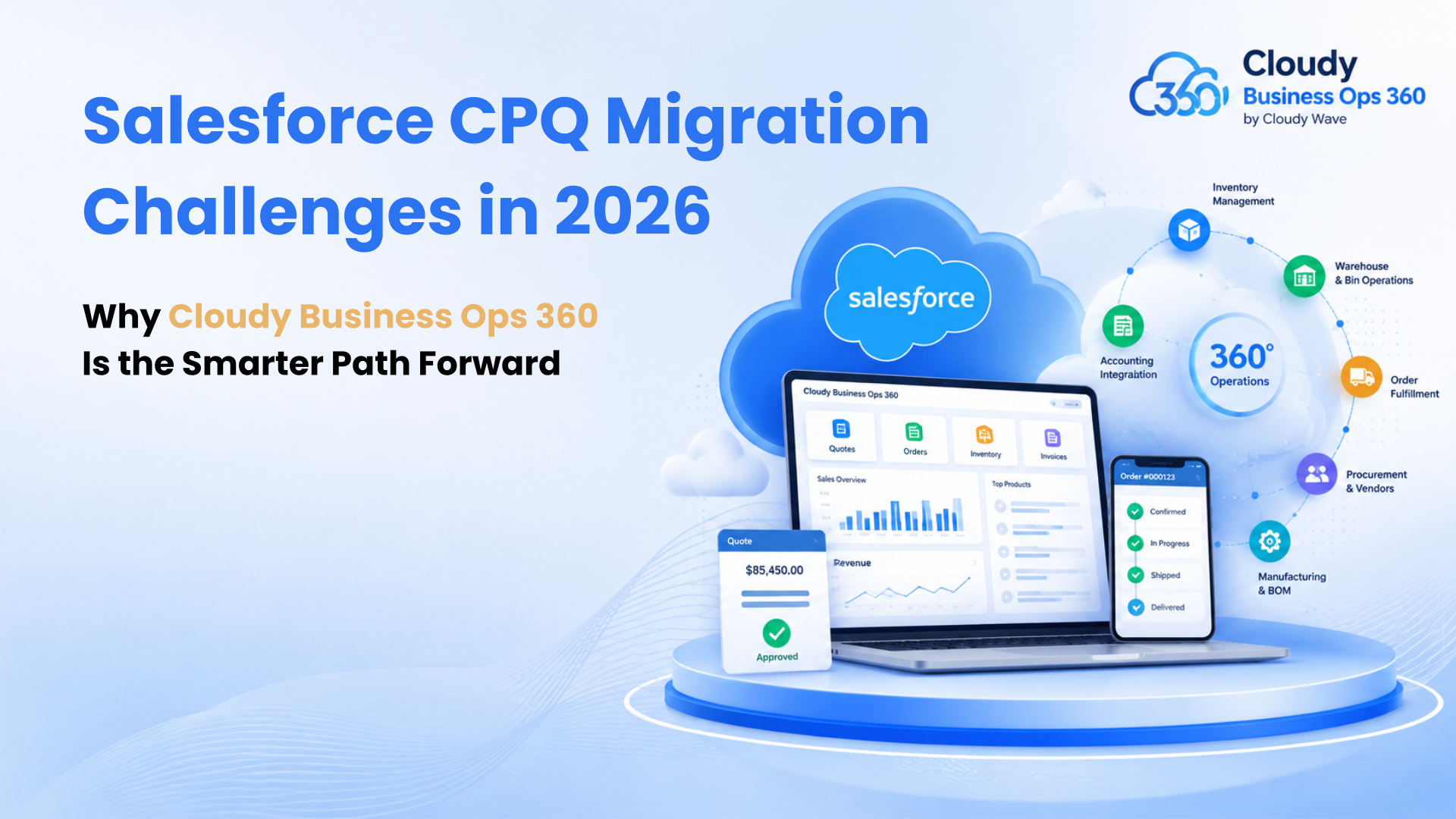
Cloudy Business Ops 360 gives you quotes, inventory, orders, and billing — all inside Salesforce — without the 18-month rebuild or the $200/user price tag.
If your business runs on Salesforce CPQ, 2026 is the year the pressure becomes impossible to ignore.
In March 2025, Salesforce officially declared CPQ End-of-Sale — no new customers, no new features, no future roadmap. The product that powered quoting and pricing for thousands of businesses is frozen. And the path Salesforce is pushing everyone toward — Revenue Cloud Advanced — comes with a cost, complexity, and timeline that many organizations simply are not prepared for.
The result? Over 6,000+ businesses are now navigating one of the most consequential platform decisions they have faced in years: migrate to Revenue Cloud Advanced, find a smarter alternative, or watch technical debt silently compound until it becomes a crisis.
This article breaks down exactly what the Salesforce CPQ migration involves in 2026 — the real costs, the architectural realities, the timeline surprises — and positions Cloudy Business Ops 360 by Cloudy Wave as a purpose-built, Salesforce-native alternative that solves what CPQ leaves behind, without the rebuild nightmare.
The State of Salesforce CPQ in 2026
To understand why this decision matters right now, it helps to see the full timeline clearly.
Salesforce acquired SteelBrick — the company behind CPQ — in 2015 for approximately $360 million. The promise was rapid innovation and tight native integration. What followed was a decade-long slowdown: the product roadmap stagnated, meaningful updates stopped arriving by 2021, and performance limitations went unresolved year after year.
In March 2025, Salesforce confirmed what insiders had expected: CPQ entered its End-of-Sale phase. No new licenses. No new features. Full End-of-Life projected around 2029–2030.
Here is what that timeline means in practice for 2026:
- Every month on legacy CPQ adds compounding technical debt — estimated at $400,000–$800,000 in year one alone
- Salesforce’s innovation is entirely focused on Revenue Cloud Advanced — CPQ will not catch up
- The talent pool for CPQ expertise is shrinking — skilled specialists are moving to newer platforms
- A hurried migration in 2027 or 2028, triggered by commercial pressure, will be significantly more expensive and disruptive than one planned today
The question organizations need to answer is not whether to act — it is which path gives them the most control, the least disruption, and the strongest long-term foundation.
The Fundamental Problem: It Is Not an Upgrade — It Is a Rebuild
The single most dangerous misconception about Salesforce CPQ migration is that it functions like a software upgrade. Salesforce’s marketing language — “natural evolution,” “Revenue Cloud is the future of CPQ” — reinforces this framing.
Implementation experts, partner organizations, and businesses that have already attempted the transition are unambiguous: migrating from Salesforce CPQ to Revenue Cloud Advanced is a complete reimplementation project, not a version update.
There is no automated migration tool. No native data transfer path. No configuration translator. Every pricing rule, approval workflow, product bundle, custom object, and integration that your organization has built over years must be evaluated, redesigned, and rebuilt from the ground up using Revenue Cloud’s completely different architecture.
This is not a small distinction. It fundamentally changes the budget, timeline, risk profile, and organizational burden of the project.
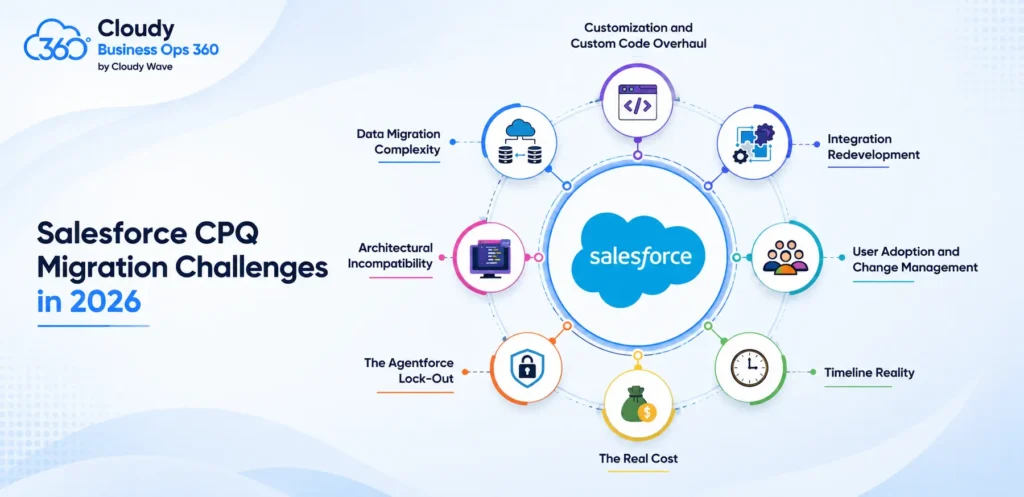
Challenge 1: Architectural Incompatibility
The root cause of almost every CPQ migration challenge is architecture. Salesforce CPQ runs as a managed package sitting on top of Salesforce — a bolt-on system with its own object model, its own pricing engine (a JavaScript-based Quote Calculator Plugin), and its own workflow logic.
Revenue Cloud Advanced is built natively on Salesforce Core — the same infrastructure that powers Sales Cloud and Service Cloud. It uses standard Salesforce objects (Quote, Order, Contract), a server-side high-performance pricing engine, and OmniStudio for UI customization.
These are not compatible systems. Moving between them requires rebuilding:
- Product Catalog Management (PCM): The entire product and bundle structure must be reimplemented using Revenue Cloud’s attribute-based catalog system
- Pricing engine: CPQ’s JavaScript-based QCP pricing logic does not transfer; every calculation rule must be rebuilt in the native server-side engine
- Approval workflows: Multi-stage CPQ approval chains must be redesigned using Revenue Cloud’s workflow tools
- Quote templates: Document generation templates do not carry over and must be recreated
Organizations with large product catalogs or complex pricing configurations — hundreds of price rules, tiered discount structures, bundled product logic — face the most significant rebuild effort here.
Challenge 2: Data Migration Complexity
Data migration in a Salesforce CPQ migration is far more involved than it appears on the surface. Most project teams discover this mid-project, after timelines and budgets have already been set.
The core problem: CPQ and Revenue Cloud use different data models. CPQ operates on custom objects specific to the managed package. Revenue Cloud uses standard Salesforce objects. Data cannot be copied between them — it must be transformed, remapped, and revalidated record by record.
Common data migration decisions in 2026:
Most organizations are adopting a bridge strategy — the most practical approach available:
- All new deals and quotes are created in Revenue Cloud Advanced from go-live
- Existing contracts and active quotes remain in CPQ, accessible in read-only mode
- As existing CPQ contracts reach their renewal date, they are transitioned into Revenue Cloud
- CPQ is retired gradually over 12–24 months rather than switched off overnight
This approach significantly reduces go-live risk, but it requires maintaining two systems in parallel — adding administrative complexity that must be planned and resourced.
Additional data challenges:
- Custom objects built for CPQ rarely map directly to Revenue Cloud’s standard object model — custom development is needed to bridge the gap
- Product catalog data is often found to be outdated or duplicated during migration audits, adding weeks of data clean-up
- Pricing rules, discount logic, and configuration rules must be validated line-by-line after migration to ensure financial accuracy
Challenge 3: Customization and Custom Code Overhaul
Most enterprise CPQ implementations are not vanilla. They are layered with custom Apex code, Visualforce pages, Lightning components, and bespoke business logic built over years to fit specific operational requirements.
None of this carries over to Revenue Cloud Advanced.
Apex triggers written against CPQ objects do not fire against Revenue Cloud’s native objects. Visualforce pages built on CPQ data structures require substantial modification or full retirement. Lightning components connected to CPQ-specific APIs must be rewritten for compatibility with Revenue Cloud’s architecture.
Beyond code, there is a subtler challenge: identifying what is still needed. Over years of CPQ use, many organizations accumulate what implementation partners call “ghost products” and “zombie rules” — inactive configurations, deprecated workarounds, and redundant logic that has never been cleaned up. The migration audit is the opportunity to remove this technical debt permanently — but doing so adds time and requires deep business knowledge alongside technical expertise.
Revenue Cloud Advanced also introduces new metadata types — Product Catalog Management components, pricing rule dependencies, OmniStudio configurations — that behave differently from standard Salesforce metadata. Teams that underestimate this complexity frequently encounter deployment failures and environment inconsistencies during build and testing phases.
Integration Redevelopment Challenges
CPQ implementations are rarely standalone. They sit at the center of a web of enterprise integrations that all require redevelopment when moving to Revenue Cloud.a
Challenge 4: Integration Redevelopment
Salesforce CPQ sits at the center of most organizations’ revenue operations stack. It connects to ERP systems, billing platforms, accounting tools, contract management solutions, and more. Every one of those integrations was built against CPQ’s specific object model and APIs.
When CPQ is replaced by Revenue Cloud Advanced, every integration must be reassessed and often fully redeveloped.
The most common integration redevelopment requirements include:
- ERP systems (SAP, Oracle, NetSuite): Order and revenue data flows must be remapped to Revenue Cloud’s native objects
- Billing platforms (Zuora, Stripe, Avalara): Invoice triggers and billing logic need rebuilding
- Accounting tools (QuickBooks, Xero, Zoho Books): Financial sync configurations must be updated
- Contract Lifecycle Management (DocuSign, Conga): CLM connectors built for CPQ objects require redevelopment
- MuleSoft integrations: Complex middleware configurations often add 3–4 weeks to migration timelines on their own
Integration failures are consistently cited as one of the top causes of CPQ migration delays. Organizations that treat integration redevelopment as a final-phase activity — rather than a parallel workstream — pay for this decision in extended timelines and go-live delays.
Common integration redevelopment requirements:
- ERP systems (SAP, Oracle, NetSuite): Order and revenue data flows must be remapped
- Billing platforms (Zuora, Stripe Billing, Avalara): Invoice and billing triggers need rebuilding
- Contract Lifecycle Management (DocuSign, Conga): CLM connectors built for CPQ objects require updates
- Service Cloud and other Salesforce Clouds: Cross-cloud workflows need re-architecting
Revenue Cloud must integrate with your ERP, billing system, and any custom applications. Many organizations discover integration complexity — plan 3–4 weeks for this phase alone. Don’t wait until the end to test.
Integration failures during CPQ migrations are one of the top causes of go-live delays. Organizations that begin integration redevelopment early in the project — rather than treating it as a final phase — consistently achieve better outcomes.
Challenge 5: The Agentforce Lock-Out — The 2026 Differentiator
This is the dimension that makes a 2026 migration conversation fundamentally different from 2024 or 2025.
Salesforce has repositioned Revenue Cloud Advanced as the foundational platform for Agentforce Revenue Management — its autonomous AI layer for revenue operations. Agentforce AI agents can generate quotes autonomously, recommend optimal pricing based on deal context, identify renewal risk before it materializes, and route approvals without human intervention.
None of this is accessible from Salesforce CPQ.
Agentforce requires native Salesforce Core platform architecture to function. CPQ’s managed package structure is architecturally incompatible with the Agentforce reasoning engine, which requires direct access to native Salesforce objects and Data Cloud integration. Organizations remaining on legacy CPQ are not just missing features — they are structurally excluded from the AI-driven revenue capability their competitors are beginning to deploy.
For CIOs and CROs evaluating this decision in 2026, the Agentforce dimension reframes the question from “when do we migrate?” to “how long can we afford to be excluded from AI-driven selling?”
Challenge 6: The Real Cost in 2026
Cost is where many organizations experience the sharpest disconnect between their initial expectations and the reality of Salesforce CPQ migration.
Salesforce increased list prices by approximately 6% in 2025, affecting all 2026 renewal and procurement conversations. Revenue Cloud Advanced pricing, as published in 2026, is:
- Revenue Cloud Growth: $150 per user per month (billed annually) — requires active Sales or Service Cloud license
- Revenue Cloud Advanced: $200 per user per month (billed annually) — requires active Sales or Service Cloud license
For a 500-user sales organization, this represents $300,000–$750,000 in additional annual licensing costs before a single line of implementation work begins.
The Agentforce add-ons — increasingly necessary to access Revenue Cloud’s AI capabilities — add further:
- Agentforce employee add-on: $125–$150 per user per month for unlimited employee-facing AI agent usage
- Agentforce 1 Edition: $550 per user per month with bundled Flex Credits and Data Cloud entitlement
Beyond licensing, implementation costs for mid-to-enterprise migrations consistently range from $250,000 to $1 million or more, depending on customization depth, integration complexity, and data migration scope. External consulting fees, which are nearly always required for organizations with heavily customized CPQ environments, are in addition to these figures.
The hidden cost of waiting:
Every year on legacy CPQ compounds technical debt estimated at $400,000–$800,000 annually. The pool of CPQ-to-RCA implementation specialists is shrinking as talent shifts to newer platforms — meaning delayed migrations will face both higher consulting rates and fewer qualified partners available.
Challenge 7: Timeline Reality
The most common timeline mistake in CPQ migration planning is treating it as a software upgrade with a predictable cutover date.
Based on 2026 implementation data across mid-market and enterprise organizations, realistic timelines look like this:
| Organization Profile | Realistic Timeline |
|---|---|
| Small org, minimal customization | 4–8 months |
| Mid-market, moderate customization | 10–14 months |
| Enterprise, heavy customization + integrations | 16–24 months |
| Global enterprise, multiple product lines | 24+ months |
A well-structured migration follows six phases:
- Discovery and Audit (6–8 weeks): Document every CPQ configuration, custom object, code file, integration, and active quote volume. Identify and eliminate ghost products and zombie rules before touching a single record.
- Design and Gap Analysis (4–6 weeks): Map CPQ processes to Revenue Cloud equivalents; identify where RCA covers needs out-of-the-box and where custom development is required.
- Build (3–6 months): Reconstruct product catalog, pricing rules, approval workflows, and quote generation in Revenue Cloud’s native environment.
- Integration Rebuild (3–4 weeks, concurrent): Redevelop ERP, billing, accounting, and CLM connectors in parallel with the main build.
- Parallel Testing (4–6 weeks): Run identical business scenarios in both CPQ and Revenue Cloud simultaneously. Validate pricing outputs, discount logic, approval routing, and integration data flows before any cutover decision.
- Phased Rollout and Hypercare (6–10 weeks): Pilot with 10–20 users or one product line. Expand by business unit with dedicated post-go-live support before full organization-wide cutover.
Challenge 8: User Adoption and Change Management
Even technically successful migrations fail commercially when users don’t adopt the new platform.
Revenue Cloud Advanced presents a different user interface, different quoting flows, and a different mobile experience compared to CPQ. Sales reps who have built years of muscle memory around CPQ’s workflow encounter a genuine learning curve. Administrators who have mastered CPQ’s configuration model — price rules, quote templates, approval chains — must substantially upskill to manage Revenue Cloud effectively.
The organizational challenge compounds when migrations are layered on top of other concurrent transformation initiatives. Change fatigue is real, and it consistently ranks among the top reasons migrations underperform commercially even when they succeed technically.
Dedicated change management — with executive sponsorship, structured communication, and a clear “what’s in it for me” narrative for every affected team — is not optional. It is a prerequisite for achieving ROI from the migration investment.
Salesforce CPQ vs. Revenue Cloud Advanced vs. Cloudy Business Ops 360
Understanding the landscape requires an honest comparison of all three options.
| Capability | Salesforce CPQ (Legacy) | Revenue Cloud Advanced | Cloudy Business Ops 360 |
|---|---|---|---|
| Platform Architecture | Managed package (bolt-on) | Salesforce Core native | Salesforce Core native |
| Quote & Pricing | Mature, frozen | Rebuilt, maturing | Native Quote Line Editor |
| Inventory Management | Not available | Not available | Real-time, multi-warehouse |
| Order Management | Limited | Limited | Full order lifecycle |
| Warehouse & Bin Operations | Not available | Not available | Full bin-level tracking |
| Procurement & Vendor Mgmt | Not available | Not available | End-to-end procurement |
| Billing & Invoicing | External integration required | Native | Native |
| Multi-Currency | Supported | Supported | Supported |
| Accounting Integration | External only | External only | QuickBooks, Xero, Zoho Books |
| Document Generation | Template-based | Template-based | Native PDF generator |
| Agentforce AI Compatibility | Not compatible | Full native access | Salesforce Core compatible |
| Pricing (per user/month) | Existing contract | $150–$200 + add-ons | $40–$70 |
| Implementation Timeline | N/A (existing) | 12–24 months | Less than one week |
| Product Roadmap | Frozen (EOS) | Active | Active |
| AppExchange Certified | Yes | Yes | Yes |
How Cloudy Business Ops 360 Solves What CPQ Leaves Behind
Cloudy Business Ops 360 is Cloudy Wave’s all-in-one business operations platform, built natively on Salesforce and certified on the AppExchange. It is designed for exactly the kind of organization that is looking beyond CPQ’s quoting-only focus — toward a unified platform that handles the full operational lifecycle from quote to fulfillment, all within Salesforce.
Where CPQ stops at the quote, Cloudy Business Ops 360 keeps going.
What It Covers That CPQ Never Did
Quote-to-Cash Operations The platform includes a native Quote Line Editor, Bundle Line Editor for kitting and product bundling, multi-pricing support, and automated document generation for quotes, invoices, purchase orders, and sales orders — all without leaving Salesforce.
Inventory and Warehouse Management Real-time inventory tracking with multi-warehouse support, bin-level allocation, low stock alerts, inventory image tracking, barcode and QR code generation, and inventory transfer management. CPQ has never touched this domain. Revenue Cloud Advanced still doesn’t.
Order and Fulfillment Management Full sales order lifecycle — from quote creation through fulfillment, delivery tracking, order amendment, sales returns, and pending item management. Finance and operations teams get the visibility they’ve always needed alongside the sales data that was previously siloed in CPQ.
Procurement and Vendor Management Purchase order editor, vendor management, lead time tracking, inbound shipment management, and full procurement traceability — connecting supply-side operations to the same platform as customer-facing quotes and orders.
Financial Operations Payment capture (online and offline), payment allocation, debit and credit notes, refunds, tax calculation across jurisdictions, multi-currency support, and reconciliation — all native to Salesforce, with optional accounting integrations for QuickBooks, Xero, and Zoho Books.
Manufacturing and Supply Chain Bill of Materials (BOM), production batch tracking, and end-to-end supply chain visibility for businesses that build as well as sell.
Pricing That Makes Sense
| Plan | Price | Best For |
|---|---|---|
| Starter | $40/user/month | Individuals and small businesses |
| Growth | $60/user/month | Growing teams and mid-sized businesses |
| Enterprise | $70/user/month | Large enterprises needing unlimited scalability |
Accounting integrations (QuickBooks, Xero, Zoho Books) are available as add-ons at $3,000/org/year.
Compare this to Revenue Cloud Advanced at $150–$200 per user per month — before Agentforce add-ons — and the cost differential for a 50-user organization amounts to $66,000–$96,000 per year in licensing savings alone.
Implementation in Days, Not Months
Where Revenue Cloud Advanced migrations require 12–24 months of rebuild effort, Cloudy Business Ops 360 is designed for fast deployment. Most organizations are fully operational in less than one week. The Cloudy Wave team provides hands-on onboarding, configuration support, and training — ensuring go-live is measured in days, not quarters.
This is not a compromise on capability. It is the result of building natively on Salesforce from day one, rather than attempting to migrate a decade of managed package architecture to a new platform.
Who Cloudy Wave Serves
Cloudy Business Ops 360 is purpose-built for product-driven industries — the businesses where CPQ’s quoting capability was genuinely useful but never sufficient:
- Wholesale and Distribution
- Retail and eCommerce
- Manufacturing and Assembly
- Trading and Import-Export
- Logistics and Warehousing
- Supply Chain and Procurement
- Consumer Goods and CPG
- Healthcare and Medical Supply
- Automotive and Parts
- Construction and Infrastructure
- Agriculture and Agri-Supply
- Professional Services and Financial Services
With 80+ clients globally and a 95% implementation success rate, Cloudy Wave has built a track record across complex operational environments — including multi-entity, multi-warehouse, and multi-currency organizations that CPQ was never designed to fully support.
Migration Best Practices for 2026
Whether your organization ultimately migrates to Revenue Cloud Advanced or transitions to Cloudy Business Ops 360, these principles consistently separate successful transitions from costly ones.
Start with a rigorous audit. Before any build begins, document every CPQ configuration, custom object, code file, integration, and data volume. Most legacy CPQ environments contain years of accumulated ghost products and zombie rules. Removing this debt before migration reduces rebuild complexity and improves long-term maintainability.
Design for where you are going, not where you have been. The most consistent failure mode is attempting to replicate CPQ exactly in a new platform. Use the transition as an opportunity to redesign processes for efficiency — remove unnecessary approval steps, consolidate pricing rules, streamline product hierarchies.
Run parallel testing before any cutover. Whether migrating to Revenue Cloud or transitioning to Cloudy Business Ops 360, validate that business scenarios produce identical outputs in both systems before switching users. Price accuracy, discount logic, and approval routing are the highest-risk areas and require dedicated testing time.
Phase your rollout. Never attempt a big-bang migration. Start with one product line, one business unit, or one geography. Resolve issues at small scale before expanding to the full organization.
Secure executive sponsorship before day one. Sales leaders, CFOs, and RevOps heads must be aligned on the rationale, the timeline, and the success metrics before any user-facing change occurs. Migrations without visible leadership support consistently underperform at the adoption stage.
Plan Agentforce as a Phase 2 initiative. If you are migrating to Revenue Cloud Advanced, do not attempt to implement Agentforce concurrently. Establish Revenue Cloud stability first, then layer in AI capabilities in a distinct, subsequent phase.
Conclusion: 2026 Is the Year to Act — and to Act Strategically
The Salesforce CPQ migration challenge is real. The costs are significant. The timelines are long. And the platform Salesforce is steering everyone toward — Revenue Cloud Advanced — is a complete rebuild, not an upgrade.
But the conversation in 2026 is not simply “when do we migrate to Revenue Cloud?” It is “what does our revenue and operations platform need to look like for the next decade, and which path gets us there with the least disruption and the strongest ROI?”
Key takeaways:
- CPQ is End-of-Sale as of March 2025; End-of-Life projected 2029–2030
- Revenue Cloud Advanced migration is a full rebuild — 12–24 months, $250K–$1M+ implementation costs, $150–$200/user/month licensing
- Technical debt on legacy CPQ compounds at $400K–$800K per year
- Legacy CPQ is architecturally incompatible with Agentforce — organizations staying behind are locked out of AI-driven revenue operations
- Cloudy Business Ops 360 delivers quote, order, inventory, warehouse, procurement, and billing operations natively on Salesforce — starting at $40/user/month, live in under one week
- With 80+ global clients and a 95% implementation success rate, Cloudy Wave has the track record to back the capability
The businesses that win the next phase are not the ones with the most expensive platform. They are the ones that make the right strategic decision now — and execute it with precision.
References and Sources:
- Cloudy Wave: Cloudy Business Ops 360 Product Page
- Bluvium: The Legacy CPQ to Revenue Cloud Migration — A 2026 Survival Guide (January 2026)
- Folio3 CRM: Salesforce CPQ to Revenue Cloud Migration — Complete Business Owner’s Guide (April 2026)
- ServicePath: When Your CPQ Becomes Your Ceiling — The 2026 Revenue Architecture Decision (February 2026)
- DealHub: What is Salesforce CPQ Data Migration? (April 2026)
- Noltic: Full Salesforce Revenue Cloud Guide for 2026 (February 2026)
- ServicePath: Legacy Salesforce CPQ Is Breaking RevOps — What End-of-Sale Means for 2026 (November 2025)
- Salesforce Ben / Gearset: 3 Important Tips: Migrating from Salesforce CPQ to Revenue Management (RCA) (December 2025)
- Redress Compliance: Salesforce Licensing Changes 2026 (February 2026)
- MagicFuse: Agentforce Cost in 2026 — Flex Credits and Pricing Models (April 2026)
- Conga: Salesforce CPQ End of Life — The Cost of Waiting to Migrate (December 2025)
Why Pay $200/User When $40 Does More?
While Revenue Cloud Advanced rebuilds your stack over 18 months, Cloudy Business Ops 360 goes live in under a week — with inventory, fulfillment, and billing CPQ never offered.
Frequently Asked Questions
Yes. Salesforce officially declared CPQ End-of-Sale in March 2025. In 2026, existing customers can renew licenses and receive support, but no new features are being developed. Full End-of-Life, when all support terminates, is projected around 2029–2030. The product is frozen and the innovation gap with Revenue Cloud Advanced is widening every quarter.
Salesforce CPQ is focused exclusively on the Configure-Price-Quote process — generating accurate quotes and managing pricing rules. Cloudy Business Ops 360 goes significantly further: it adds inventory management, warehouse and bin operations, order fulfillment, procurement and vendor management, manufacturing and BOM, payment and financial reconciliation, and accounting integrations — all within a single Salesforce-native application. It also starts at $40/user/month, compared to CPQ's legacy pricing and Revenue Cloud Advanced's $150–$200/user/month.
Most organizations are fully operational within one week. The platform is designed for fast deployment and the Cloudy Wave team provides hands-on onboarding, configuration support, and training throughout the go-live process. This contrasts sharply with Revenue Cloud Advanced migrations, which typically require 12–24 months for mid-to-enterprise organizations.
Yes. Because Cloudy Business Ops 360 is built natively on Salesforce and certified on the AppExchange, it works seamlessly alongside your existing Salesforce environment — including Sales Cloud, Service Cloud, and Experience Cloud. There are no middleware dependencies, no external system requirements, and no data sync risks. It extends your Salesforce investment rather than competing with it.
Yes. Multi-currency support is available across all plan tiers. Multi-legal entity support is available in the Growth plan (up to 2 entities) and the Enterprise plan (unlimited entities). Multi-warehouse tracking follows the same structure: 1 warehouse on Starter, up to 2 on Growth, unlimited on Enterprise.
Cloudy Business Ops 360 integrates natively with QuickBooks, Xero, and Zoho Books via configurable field mappings. Each integration is available as an add-on at $3,000/org/year and enables real-time syncing of invoices, payments, customer records, and tax data between the operational platform and your accounting system.
The right answer depends on your specific business model. Organizations with complex subscription management, revenue recognition requirements under ASC 606 or IFRS 15, and a deep strategic commitment to Salesforce as their single revenue control plane may find Revenue Cloud Advanced a strong long-term fit — provided they are prepared for the 12–24 month rebuild timeline and significantly higher licensing costs. Organizations that need broader operational capability — inventory, warehousing, procurement, fulfillment — alongside quoting and billing, at a fraction of the cost and implementation complexity, will find Cloudy Business Ops 360 a more practical and more powerful fit. It is purpose-built for the operational realities of product-driven businesses that CPQ was never designed to fully serve.
Saurabh Wankhede
Content Strategist
CPQ Is Frozen. Your Business Can't Afford to Be.
Every month on legacy CPQ adds $400K+ in technical debt. Cloudy Business Ops 360 is your fastest, most cost-effective path to a modern Salesforce-native operations platform.
Related Blogs
 CPQ
CPQ Salesforce CPQ 2026 Guide: Features, Pricing, Benefits, Alternatives, and the Future of CPQ
If you work in sales operations, RevOps, or Salesforce administration, one question keeps coming up in…
 DocGen
 Salesforce Document Generation Pricing in 2026: Plans, Costs, and What You're Actually Getting
If you're evaluating Salesforce document generation and e-signature tools in 2026, you've probably already noticed that…
 Agentforce
 Are AI Agents Replacing Salesforce Admins-or Changing Their Role?
IntroductionBarely a week goes by in the Salesforce ecosystem without someone raising the question: Will AI…
Download Company Deck
Thank You!
Your download will begin shortly.
Loading…