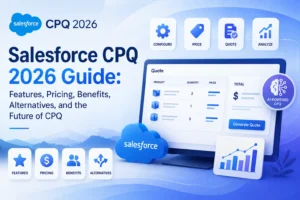
If you run a small business and have ever explored Salesforce CPQ (Configure, Price, Quote), you already know the sticker shock. At $75 per user per month — on top of an existing Salesforce CRM subscription — the cost quickly spirals beyond what most growing businesses can justify. And that’s before factoring in the steep learning curve, lengthy implementation timelines, and dedicated admin overhead.
The good news? The CPQ software market has exploded with powerful, affordable alternatives designed specifically with small and mid-sized businesses in mind. According to a 2024 report by Grand View Research, the global CPQ software market is expected to surpass $3.9 billion by 2030, growing at a CAGR of 9.1% — and a large chunk of that growth is being driven by SMB-focused solutions.
This guide breaks down the best Salesforce CPQ alternatives available today, comparing pricing, features, integrations, and ideal use cases. Whether you’re a SaaS startup, a services company, or a product-based business, there’s a right-sized solution for you.
What Is CPQ Software and Why Do Small Businesses Need It?
CPQ stands for Configure, Price, Quote. It’s a category of sales software that helps businesses:
- Configure complex products or service packages
- Apply accurate pricing rules, discounts, and bundles
- Generate professional, branded quotes and proposals rapidly
- Reduce human error in pricing calculations
- Accelerate the sales cycle and close deals faster
For small businesses, CPQ tools directly impact revenue. Research by Salesforce itself found that companies using CPQ software see 49% faster quote generation and a 105% increase in average deal sizes compared to manual quoting processes.
Why Small Businesses Look for Salesforce CPQ Alternatives
Salesforce CPQ is powerful — but it’s built for enterprise. Here’s why small businesses commonly seek alternatives:
- Cost: Salesforce CPQ starts at $75/user/month, requiring an existing Salesforce Sales Cloud subscription ($25–$300/user/month)
- Complexity: Implementation typically takes 3–6 months and may require a certified Salesforce consultant
- Overkill: Many small businesses don’t need enterprise-grade configuration logic or deeply nested pricing rules
- Rigid ecosystem: You’re locked into the Salesforce environment, even if your team uses HubSpot, Pipedrive, or another CRM
The result? Businesses end up paying for features they never use, fighting with a system that slows them down instead of speeding them up.
Key Features to Look for in a CPQ Alternative
Before diving into specific tools, here are the critical features that any quality CPQ platform should offer — regardless of company size:
Core CPQ Capabilities
- Product catalog management with variants and bundles
- Flexible pricing rules (volume discounts, tiered pricing, promotional pricing)
- Quote templates with branding and customization
- Electronic signature integration
- Approval workflows for discounts
Integrations
- CRM connectivity (HubSpot, Pipedrive, Zoho, Salesforce)
- Accounting and billing tools (QuickBooks, Xero, Stripe)
- Document management (Google Drive, Dropbox)
Usability
- Intuitive UI with minimal training required
- Mobile-friendly access
- Fast onboarding (days, not months)
Pricing
- Transparent, flat-rate or per-user pricing
- No hidden implementation fees
- Free trial or freemium tier
Our #1 Editor’s Pick: Cloudy Business Ops 360 by Cloudy Wave
🏆 Top Recommended Salesforce CPQ Alternative for Small Businesses
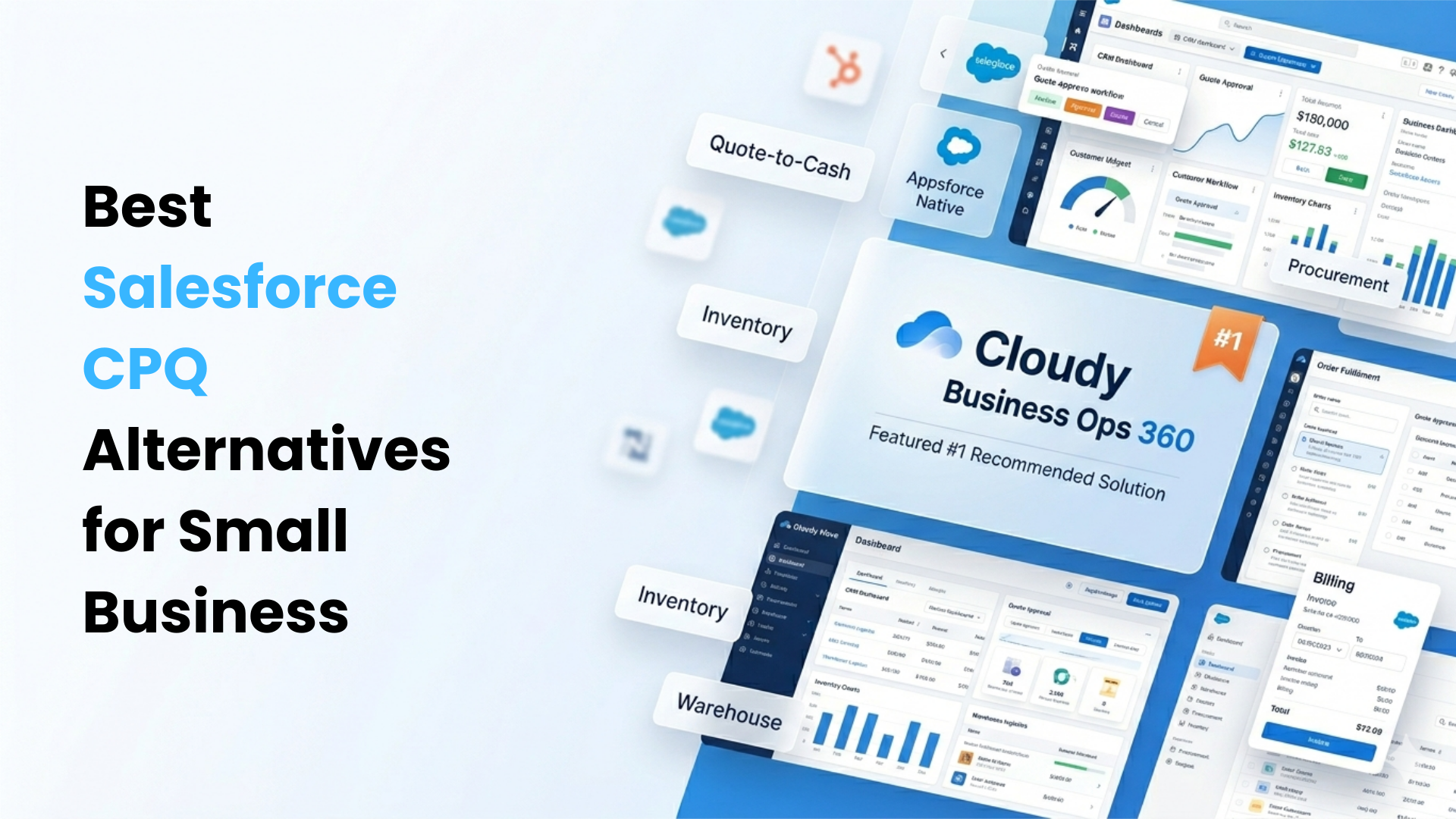
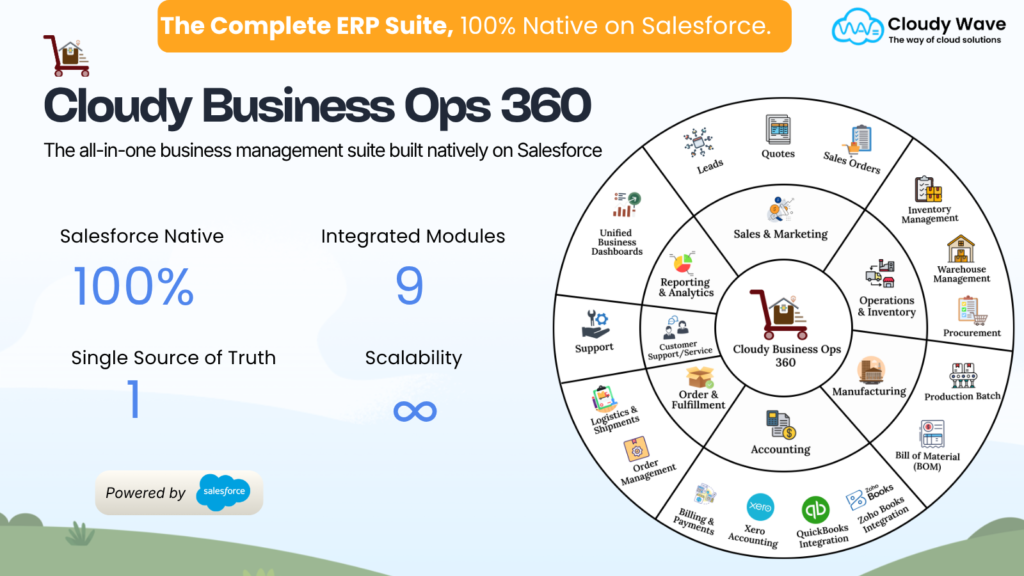
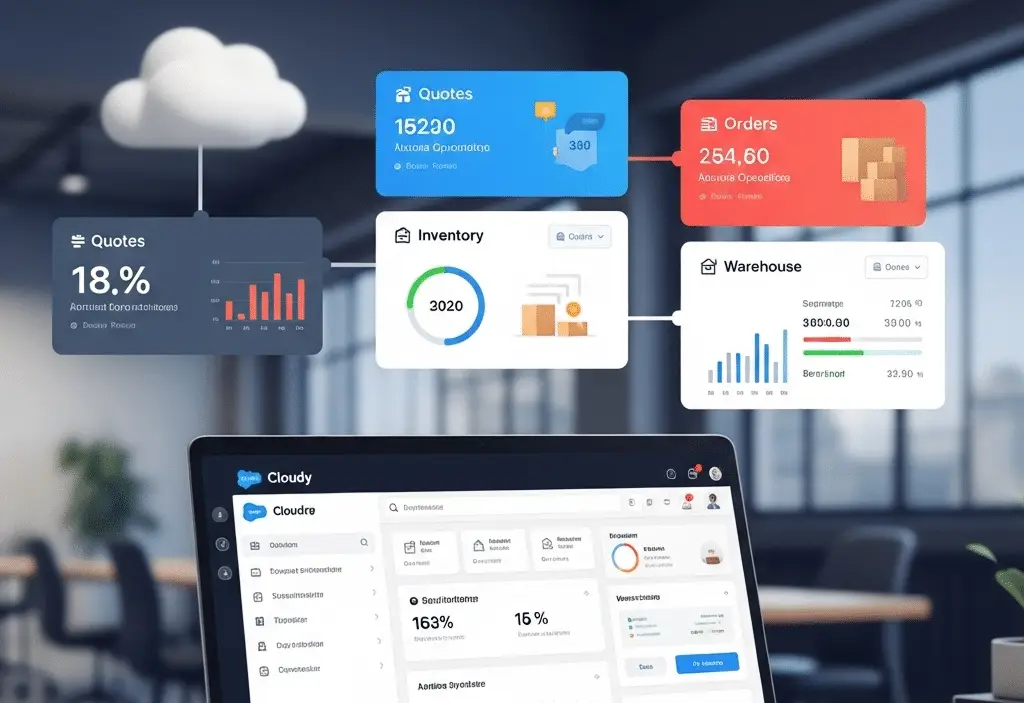
If your business runs on Salesforce — or plans to — Cloudy Business Ops 360 is the single most powerful and cost-effective Salesforce CPQ alternative available today. Built natively on the Salesforce platform, it eliminates fragile third-party integrations while delivering a complete Quote-to-Cash, inventory, and operations experience in one unified app.
Why it earns the top spot: Most CPQ tools solve only one piece of the puzzle — quoting. Cloudy Business Ops 360 solves the entire operational lifecycle: from product catalog and quoting, to order fulfillment, warehouse management, procurement, billing, and finance — all without leaving Salesforce.
→ Explore Cloudy Business Ops 360
#1 Hero Pick — Cloudy Business Ops 360 (by Cloudy Wave)
Best for: Small and mid-sized businesses on Salesforce that need end-to-end operations, quoting, and fulfillment in one native platform
What Is Cloudy Business Ops 360?
Cloudy Business Ops 360 is a Salesforce-native ERP and CPQ platform built by Cloudy Wave — a certified Salesforce ISV and Consulting Partner with over 10 years of Salesforce excellence and 80+ global clients. Available on the Salesforce AppExchange, it is purpose-built for SMBs that need more than a standalone quoting tool but don’t want to pay enterprise-level prices for a bloated system.
The tagline says it all: Quote. Procure. Fulfill. Collect. One App for Everything.
Unlike traditional CPQ alternatives that stop at sending a quote, Cloudy Business Ops 360 covers the full operational arc — from configuring a price quote to fulfilling the order and collecting payment — all within the Salesforce environment your team already knows.
Why Cloudy Business Ops 360 Beats Salesforce CPQ for Small Businesses
| Feature | Salesforce CPQ | Cloudy Business Ops 360 |
|---|
| Salesforce-native | ✅ | ✅ |
| Quote generation | ✅ | ✅ |
| Inventory management | ❌ | ✅ |
| Warehouse management | ❌ | ✅ |
| Order fulfillment | ❌ | ✅ |
| Procurement | ❌ | ✅ |
| Billing & finance | Partial | ✅ |
| Multi-currency support | ✅ | ✅ |
| SMB-friendly pricing | ❌ | ✅ |
| Implementation time | 3–6 months | Days to weeks |
Core Modules and Key Features
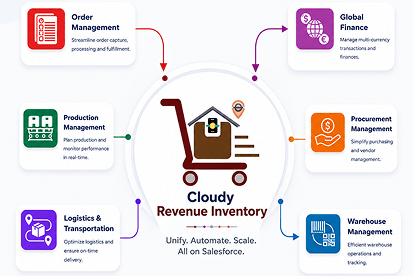
Cloudy Business Ops 360 is organized around the complete business operations lifecycle:
Quoting & Sales Operations
- Product and item catalog with variant and bundle support
- Flexible pricing rules for discounts, tiers, and multi-currency transactions
- Professional, branded quote generation directly within Salesforce CRM
- Approval workflows for discount authorizations
- Integration with Cloudy DocGen & Signer for instant e-signatures on quotes
Inventory Management
- Real-time stock tracking across multiple locations
- Low-stock alerts and reorder triggers
- Item categorization with variants, SKUs, and units of measure
- Full audit trail for stock movements
Warehouse Management
- Bin and location-level inventory tracking
- Pick, pack, and ship workflows
- Inbound receiving and quality check processes
- Returns management
Order & Fulfillment Management
- End-to-end sales order processing
- Partial fulfillments and backorder handling
- Delivery scheduling and shipment tracking
- Customer order status visibility
Procurement & Purchase Orders
- Vendor management within Salesforce
- Purchase order creation, approval, and tracking
- Goods receipt and three-way matching (PO → Receipt → Invoice)
- Supplier performance tracking
Billing & Finance
- Invoice generation from fulfilled orders
- Payment collection tracking
- Multi-currency billing support
- Revenue and outstanding receivables reporting
Industries Served
Cloudy Business Ops 360 is designed for product-driven businesses across a wide range of industries, including wholesale & distribution, retail & eCommerce, manufacturing & assembly, trading & import/export, logistics & warehousing, healthcare & medical supply, automotive & parts, construction, agriculture, and professional services.
What Makes It Stand Out
1. Truly Salesforce-native — no integration overhead
Most CPQ alternatives sync with Salesforce via API, creating data lag, sync errors, and maintenance burden. Cloudy Business Ops 360 lives inside your Salesforce org as an AppExchange app. Your sales, ops, and finance teams work from a single source of truth — no duplicate data entry, no broken connections.
2. Complete Quote-to-Cash coverage
Competing tools handle quoting. Cloudy Business Ops 360 handles quoting plus everything that happens after the deal closes: order processing, fulfillment, warehouse ops, invoicing, and collections. For small businesses, this eliminates the need for 3–4 separate software subscriptions.
3. Built by Salesforce experts, for real businesses
Cloudy Wave is a certified Salesforce ISV and Consulting Partner. Cloudy Business Ops 360 is built by a team with over a decade of Salesforce implementation experience serving 80+ global clients across industries.
4. Fast time-to-value
Unlike Salesforce CPQ’s notoriously long implementation cycles, Cloudy Business Ops 360 is designed for rapid deployment. Most SMB teams are operational within days to weeks, not months.
5. Backed by real customer outcomes
“Cloudy Wave played a key role in building our complex financial operations with Salesforce ERP software. Their deep technical expertise, combined with a responsive and reliable approach, helped us streamline processes and scale efficiently.” — Razi Amin, Founder, ASPEN Capital Solutions LLC
“Over the past 8 years, Cloudy Wave has consistently delivered exceptional value. Their expertise in Salesforce ERP software… has transformed our operations and enhanced our overall business performance.” — Jason Siverman, Founder & Chief Evangelist, BenefitsGuide
Pricing
Cloudy Business Ops 360 is available on the Salesforce AppExchange. Pricing is SMB-friendly and significantly more cost-effective than Salesforce CPQ when total platform cost is considered. Contact Cloudy Wave for a free demo and tailored quote.
Pros:
- Complete operational coverage — quoting through collections — in one Salesforce-native app
- No data sync issues or integration headaches
- Built and supported by certified Salesforce experts
- Fast implementation with dedicated onboarding support
- Trusted by 80+ businesses globally across 15+ industries
Cons:
- Requires an existing Salesforce org (not suitable for non-Salesforce businesses)
- Best value when you need both CPQ and operational features — pure quote-only teams may find it more than they need
Ideal for: B2B distributors, manufacturers, wholesale businesses, eCommerce operators, and any SMB running on Salesforce that needs quoting, inventory, fulfillment, and billing in one place.
Other Top Salesforce CPQ Alternatives for Small Businesses
While Cloudy Business Ops 360 earns our top recommendation for Salesforce-based businesses, the following tools serve specific use cases well — particularly for teams not on Salesforce or with simpler quoting needs.
2. PandaDoc
Best for: Proposal-heavy sales teams and service businesses
PandaDoc is one of the most popular Salesforce CPQ alternatives for small businesses that prioritize document quality and deal velocity. It combines CPQ functionality with powerful proposal creation, e-signatures, and analytics.
Key Features:
- Drag-and-drop proposal and quote builder
- Built-in e-signature (legally binding, SOC 2 compliant)
- Product catalog with pricing rules and optional items
- Real-time document analytics (opens, time spent per section)
- 750+ integrations including HubSpot, Pipedrive, Stripe, and Salesforce
Pricing:
- Starter: $19/user/month
- Business: $49/user/month
- Enterprise: Custom
Pros:
- Beautiful, professional templates out of the box
- Excellent CRM integrations
- Fast onboarding — most teams are live within a day
Cons:
- Not ideal for highly complex product configuration
- No inventory or fulfillment functionality
- Analytics features locked to higher tiers
Ideal for: Agencies, consulting firms, SaaS companies, and any business with complex proposals but straightforward pricing.
3. QuoteWerks
Best for: B2B distributors and resellers needing deep product catalog support
QuoteWerks has been a reliable quoting solution since 1993 and remains one of the most feature-rich CPQ alternatives for small businesses in distribution, IT reselling, and manufacturing.
Key Features:
- Connects directly to supplier price feeds (Ingram Micro, TD SYNNEX, etc.)
- Supports complex product bundling and configurations
- Integrates with 20+ CRMs and accounting tools
- Real-time pricing updates
- Optional QuoteValet add-on for customer-facing interactive quotes
Pricing:
- Standard: $15/user/month
- Professional: $21/user/month
- Corporate: $30/user/month
Pros:
- Extremely affordable for feature depth
- Outstanding for resellers and distributors
- Long track record and active user community
Cons:
- Dated UI compared to newer tools
- No native inventory or warehouse management
- Steeper learning curve for non-technical users
Ideal for: IT resellers, managed service providers (MSPs), and technology distributors not on Salesforce.
4. HubSpot Sales Hub (with Quotes)
Best for: Small businesses already using HubSpot CRM
If your team is already running on HubSpot, the native quoting functionality in Sales Hub covers the needs of most small businesses without adding extra software.
Key Features:
- Quotes linked directly to deals in HubSpot CRM
- Product library with pricing and discount rules
- E-signatures (Sales Hub Professional and above)
- Stripe integration for payment collection
- Quote approval workflows
Pricing:
- Free (basic quotes)
- Sales Hub Starter: $20/user/month
- Sales Hub Professional: $100/user/month
Pros:
- Seamless native CRM integration — no data sync issues
- Excellent reporting and pipeline visibility
- No extra software to manage
Cons:
- No inventory, fulfillment, or warehouse management
- Professional plan required for e-signatures and approval flows
Ideal for: Service businesses and inbound sales teams using HubSpot with simple product catalogs.
5. Zoho CRM with Zoho CPQ
Best for: Budget-conscious small businesses wanting an all-in-one ecosystem outside of Salesforce
Zoho offers one of the most cost-effective Salesforce CPQ alternatives through its tightly integrated CRM and CPQ combo. Zoho One gives small businesses a broad toolset at a fraction of enterprise costs.
Key Features:
- Product configurator with rules-based pricing
- Discount approval workflows
- Quote, invoice, and order generation from one platform
- Integration with Zoho Books for billing
- Built-in e-signature (Zoho Sign)
Pricing:
- Zoho CPQ: From $39/user/month
- Zoho One (includes 50+ apps): $37/user/month (billed annually)
Pros:
- Exceptional value — entire business suite for less than Salesforce CPQ alone
- Strong configurator for mid-complexity products
- Regular product updates and innovation
Cons:
- Not Salesforce-native — a separate ecosystem entirely
- Some integrations with non-Zoho tools are less polished
Ideal for: Small businesses that prefer the Zoho ecosystem over Salesforce and need an affordable all-in-one solution.
6. DealHub
Best for: SaaS and subscription businesses with complex pricing models
DealHub is a modern revenue platform that excels at subscription billing, guided selling, and digital sales rooms for growing B2B companies.
Key Features:
- Guided selling playbooks (DealRoom)
- Subscription management and renewals
- Contract lifecycle management
- CPQ with dynamic pricing and bundling
- Native Salesforce, HubSpot, and Microsoft Dynamics integrations
Pricing: Custom (typically $30–$60/user/month based on team size)
Pros:
- Excellent for SaaS and recurring revenue models
- Modern, buyer-friendly digital sales room experience
- Strong onboarding support
Cons:
- No inventory, warehouse, or operations management
- Pricing is not transparent — requires a demo
- Overkill for simple product catalogs
Ideal for: B2B SaaS companies and subscription businesses with complex pricing packages.
7. Proposify
Best for: Sales teams focused on beautiful, interactive proposals
Proposify emphasizes design, brand consistency, and sales analytics — a strong choice for businesses where proposal quality directly influences deal outcomes.
Key Features:
- Template library with drag-and-drop editor
- Interactive pricing tables (clients can choose options/quantities)
- E-signatures and client comment threads
- Metrics dashboard (close rates, viewed sections, time to sign)
- Integrations with HubSpot, Salesforce, Stripe, and Slack
Pricing:
- Team: $49/user/month
- Business: Custom
Pros:
- Best-in-class proposal design
- Interactive pricing tables are a differentiator
- Strong analytics for sales coaching
Cons:
- More expensive than most alternatives
- Limited product configurator for complex SKUs
- No operational or fulfillment capabilities
Ideal for: Marketing agencies, design firms, and consultants where the proposal itself is a sales tool.
8. Freshsales (Freshworks CRM)
Best for: Small teams wanting a lightweight CRM with built-in quoting
Freshsales is a modern, AI-powered CRM with built-in quoting capabilities — a productive middle ground for teams that find Salesforce overkill and Zoho complex.
Key Features:
- Native quote generation inside CRM
- Product catalog management
- Deal pipeline with quote status tracking
- Freddy AI for deal insights and scoring
- Integration with Freshbooks, Xero, QuickBooks
Pricing:
- Growth: $18/user/month
- Pro: $47/user/month
- Enterprise: $83/user/month
Pros:
- Clean, modern interface with minimal learning curve
- Excellent mobile app
- Strong customer support reputation
Cons:
- CPQ features are less advanced than dedicated tools
- No inventory or operational management
- Limited for complex product bundles
Ideal for: Small sales teams (1–25 reps) needing CRM and basic quoting in one tool.
9. Qwilr
Best for: Teams that want web-based interactive proposals instead of PDFs
Qwilr creates interactive web pages rather than PDFs, offering a modern buying experience increasingly expected by digitally native buyers.
Key Features:
- Web-based proposal pages with interactive pricing
- Accept/reject options with e-signature
- Real-time engagement analytics
- Payment collection via Stripe
- HubSpot, Salesforce, Pipedrive integrations
Pricing:
- Business: $35/user/month
- Enterprise: $59/user/month
Pros:
- Unique buyer experience that stands out in crowded inboxes
- Built-in ROI and pricing calculators
- Excellent analytics
Cons:
- Not suited for businesses with large or complex product catalogs
- No operational capabilities beyond quoting
- Web format may not be preferred by all B2B buyers
Ideal for: Tech companies, SaaS, and digital agencies selling to digitally native buyers.
10. Bitrix24
Best for: Very small teams or startups needing free CPQ features
Bitrix24 is a free (for small teams) all-in-one platform that includes CRM, project management, and basic CPQ features — hard to beat for bootstrapped startups.
Key Features:
- Quotes, invoices, and orders within CRM
- Product catalog
- E-signature support
- Free for up to 5 users
- Mobile app for iOS and Android
Pricing:
- Free: Up to 5 users
- Basic: $61/month for 5 users
- Standard: $124/month for 50 users
Pros:
- Genuinely free tier with meaningful CPQ features
- Covers CRM, quoting, and project management
- Good for businesses starting from scratch
Cons:
- Notoriously cluttered UI
- No advanced inventory or fulfillment features
- Slow customer support on lower plans
Ideal for: Micro-businesses, solopreneurs, and startups with very tight budgets and minimal product complexity.
Quick Comparison Table
| Tool | Starting Price | Best For | E-Signature | Inventory / Ops | Salesforce-Native |
|---|
| 🏆 Cloudy Business Ops 360 | Contact for pricing | End-to-end ops on Salesforce | ✅ (via DocGen) | ✅✅ Full ERP | ✅ AppExchange |
| PandaDoc | $19/user/mo | Proposals & services | ✅ | ❌ | Via integration |
| QuoteWerks | $15/user/mo | Resellers & distributors | ✅ | Limited | Via integration |
| HubSpot Sales Hub | Free | HubSpot users | ✅ (Pro+) | ❌ | ✅ Native |
| Zoho CPQ | $39/user/mo | Zoho ecosystem | ✅ | Partial | Via integration |
| DealHub | Custom | SaaS / subscriptions | ✅ | ❌ | Via integration |
| Proposify | $49/user/mo | Design-led proposals | ✅ | ❌ | Via integration |
| Freshsales | $18/user/mo | Small CRM+quote teams | ✅ | ❌ | Via integration |
| Qwilr | $35/user/mo | Interactive web quotes | ✅ | ❌ | Via integration |
| Bitrix24 | Free | Bootstrapped startups | ✅ | ❌ | ❌ |
How to Choose the Right Salesforce CPQ Alternative
Step 1: Are You on Salesforce?
Yes → Cloudy Business Ops 360 should be your first evaluation. It’s Salesforce-native, covers quoting plus full operations, and eliminates integration complexity entirely.
No → Consider your primary need: proposals (PandaDoc, Proposify, Qwilr), CRM-native quoting (HubSpot, Freshsales, Zoho), or reseller quoting (QuoteWerks).
Step 2: Assess Your Product Complexity
- Simple services or flat-rate products → PandaDoc, HubSpot, Freshsales, or Qwilr
- Bundled or configurable products → Cloudy Business Ops 360, Zoho CPQ, DealHub, or QuoteWerks
- Products requiring inventory and fulfillment tracking → Cloudy Business Ops 360 is the only tool in this list covering both CPQ and full operational fulfillment natively on Salesforce
Step 3: Consider Your Existing CRM
- Salesforce → Cloudy Business Ops 360 extends your existing Salesforce investment without adding complexity
- HubSpot → Use HubSpot Sales Hub natively; pair with PandaDoc for richer proposals
- Zoho → Zoho CPQ is the natural fit
- Other CRM → PandaDoc, Proposify, or QuoteWerks offer strong integrations
Step 4: Factor in Total Cost of Ownership
Don’t just compare per-user rates. Calculate the full stack cost: CPQ + CRM + inventory management + billing + integrations + implementation time. When evaluated holistically, Cloudy Business Ops 360 replaces 3–4 separate tools for Salesforce-based businesses, dramatically reducing total platform spend.
The Real Cost of Salesforce CPQ vs. Alternatives
For a 5-person sales team over 12 months:
| Platform | Monthly Cost (5 users) | Annual Cost |
|---|
| Salesforce Sales Cloud (Professional) | $375 | $4,500 |
| Salesforce CPQ add-on | $375 | $4,500 |
| Salesforce CPQ Total | $750/month | $9,000/year |
| Cloudy Business Ops 360 (on existing Salesforce org) | Contact for SMB pricing | Significantly lower |
| PandaDoc Business | $245 | $2,940 |
| Zoho One (includes CPQ + CRM) | $185 | $2,220 |
| Freshsales Pro | $235 | $2,820 |
For businesses already invested in Salesforce, adding Cloudy Business Ops 360 replaces separate CPQ, inventory, and fulfillment software — delivering far better ROI than Salesforce CPQ or a patchwork of standalone tools.
Conclusion: Key Takeaways
The CPQ software landscape has never offered more viable Salesforce CPQ alternatives for small businesses. Here are the key takeaways:
- Cloudy Business Ops 360 is the #1 choice for Salesforce users — it’s the only tool in this roundup combining native CPQ with full ERP functionality (inventory, warehouse, fulfillment, billing) inside Salesforce, making it a complete operational platform, not just a quoting add-on.
- Salesforce CPQ is expensive and complex for most small businesses — costing $75+/user/month on top of existing Salesforce subscriptions, with 3–6 month implementation timelines.
- For non-Salesforce businesses, PandaDoc is the best proposal-focused option, QuoteWerks leads for distributors and resellers, and Zoho CPQ delivers the best all-in-one value outside the Salesforce ecosystem.
- Match the tool to your complexity: simple service businesses thrive with PandaDoc or HubSpot; product businesses with SKUs, inventory, and order fulfillment need the operational depth that only Cloudy Business Ops 360 delivers natively within Salesforce.
- Total cost matters more than per-user pricing: a platform that replaces 3–4 tools delivers better ROI than the cheapest standalone option.
- The best alternative is the one your team actually uses — prioritize ease of adoption alongside features. Native CRM integration and fast onboarding win here.
Start with a free demo of Cloudy Business Ops 360 if you’re on Salesforce — it’s the fastest path to replacing Salesforce CPQ while gaining the operational capabilities your growing business actually needs.
External Sources & References






 Salesforce ERP
 ERP + CRM Platform
  Inventory Management
  Warehouse Management
  Order Management
  Vendor Management
  Logistics Management
  BOM Management
  Order Fulfillment
  Business Operations
  SaaS Platform for Operations
  Salesforce Cloud ERP Platform
  Xero
Xero
 Zoho books
 Quickbooks
 Shopify
 Acumatica
 SAP
SAP
 Odoo
Odoo
 NetSuite
 Microsoft Dynamics 365
 Sage
Sage



 Agentforce Revenue Management
 Agentforce Revenue Management + Billing
  Salesforce CPQ
 Salesforce Advanced Billing
  Migrate from CPQ to ARM
  Managed Services
 Salesforce Implementation
 Revenue Cloud Implementation
 ServiceNow Consulting Services
 Zoho CRM implementation
 MuleSoft Integration
 Workato Integration
 Microsoft
 Data Cloud
 Tableau
 ·
May 13, 2026
·
15 min read
·
May 13, 2026
·
15 min read