



 Salesforce ERP
 ERP + CRM Platform
  Inventory Management
  Warehouse Management
  Order Management
  Vendor Management
  Logistics Management
  BOM Management
  Order Fulfillment
  Business Operations
  Salesforce Platform as a Service
  Salesforce Cloud Platform
  Xero
Xero
 Zoho books
 Quickbooks
 Shopify



Cloudy Wave | Salesforce OEM Partner
Salesforce Platform as a Service (PaaS)
Build and Run Custom Business Apps Natively on the Salesforce Platform — No Servers, No Middleware
Salesforce Platform as a Service (PaaS) gives you a complete, cloud-native environment to design, build, deploy, and scale custom applications — with one data model, one security layer, and zero infrastructure to manage. Cloudy Wave helps you harness the Salesforce PaaS to build apps that run end-to-end on the world's leading enterprise cloud.
☁ 100% Salesforce Native
🏅 Salesforce OEM Partner
🧩 Built on the Lightning Platform
⚡ Live on AppExchange
Trusted by Leading Companies
Our Globally 80+ Clients.








The Basics
What Is Salesforce Platform as a Service (PaaS)?
Platform as a Service (PaaS) is a cloud computing model that provides a ready-made environment — servers, storage, database, networking, and development tools — so teams can build and run applications without managing the underlying infrastructure.
Salesforce Platform as a Service applies that model to the Salesforce ecosystem. Often called the Salesforce Platform or Lightning Platform (formerly Force.com), it lets developers and businesses build custom applications directly on Salesforce — using the same data model, security, and automation that power Salesforce CRM. Because everything runs on a multitenant cloud, there are no servers to provision, no middleware to maintain, and no separate environments to keep in sync.
In short: with the Salesforce PaaS, the platform handles the infrastructure, scaling, security, and upgrades — so your team focuses on building apps, not running data centers.
One platform. One data model. Zero infrastructure to manage.
Why Build on Salesforce
100%
Salesforce Native
0
Servers to Manage
1
Source of Truth
∞
Elastic Scalability
The Platform Advantage
Salesforce Wasn't Built as Just a CRM. It's a Platform — and You Can Build on It.
Native means no middleware, no sync errors, and one single source of truth across every app you build.
One Data Model
Your records live in one place. An Account in CRM is the same Account in every custom app — no duplicates, no integrations to reconcile.
One Security Layer
Apps inherit Salesforce's profiles, permission sets, and sharing rules automatically. Build features, not a new security system.
One User Interface
Lightning Experience, mobile, and components give every app a consistent, familiar UI your users already know.
One Automation Engine
Flow, Apex, and platform events work across every app you build, so logic and workflows are reusable end to end.
One AI Layer
Native AI and analytics operate on your unified data, so intelligence is built in rather than bolted on.
One Vendor Relationship
One platform, one trust layer, one support relationship — instead of stitching together separate clouds and tools.
What's Inside
Everything You Need to Build Apps on the Salesforce Platform
The Salesforce PaaS ships with a complete toolkit for building enterprise-grade applications — low-code to pro-code, all on one cloud.

Low-Code App Builder
Design data models, page layouts, and apps visually with clicks-not-code tools, so business teams can build alongside developers.
✦ Ship apps faster with less custom code

Flow Automation
Automate complex business processes — approvals, notifications, record updates — with a visual, no-code automation engine.
✦ Automate workflows without writing code

Apex & Lightning Web Components
When you need pro-code, build custom logic in Apex and modern UIs with Lightning Web Components on the same platform.
✦ Go pro-code without leaving the platform
Multitenant Cloud Architecture
Apps run on a secure, multitenant cloud that scales automatically and upgrades three times a year — with no downtime or migrations.
✦ Scale and stay current automatically

Unified Database & Metadata Model
A single, metadata-driven data layer means your app's structure, security, and logic are defined once and applied everywhere.
✦ Define once, run everywhere

Open APIs & Integration
REST, SOAP, Bulk, and streaming APIs connect the platform to external systems, payment gateways, and accounting tools.
✦ Connect to anything via open APIs
AppExchange Distribution
Package and distribute apps built on the platform through Salesforce AppExchange, the world's leading enterprise app marketplace.
✦ Build once, distribute to thousands
Enterprise Security & Compliance
Field-level encryption, role-based access, audit trails, and Salesforce Shield compatibility are built into every app.
✦ Inherit enterprise-grade security
Cloud Models Explained
PaaS vs SaaS vs IaaS — Where the Salesforce Platform Fits
Understanding the three cloud service models makes it clear why building on a PaaS like Salesforce is so efficient.
| Model | What It Provides | Who Manages Infrastructure | Example |
|---|---|---|---|
| IaaS (Infrastructure as a Service) | Raw compute, storage, and networking | You manage OS, runtime, and apps | Generic cloud servers |
| PaaS (Platform as a Service) | A ready environment to build & run apps | Provider manages infrastructure; you build apps | Salesforce Platform |
| SaaS (Software as a Service) | Finished applications used as-is | Provider manages everything | Salesforce CRM, Cloudy Business Ops 360 |
With Salesforce Platform as a Service, the provider handles servers, scaling, security, and upgrades — you focus purely on building apps. The result is faster delivery, lower cost, and one trusted platform from infrastructure to interface.
Use Cases
What You Can Build on Salesforce Platform as a Service
From internal tools to full commercial products, the Salesforce PaaS supports a wide range of applications.
Custom Business Apps
ERP, operations, field service, and industry-specific apps that extend Salesforce beyond CRM.
ERPOperationsField Service
CRM Extensions
Add custom objects, automation, and UI to tailor Salesforce to your exact business processes.
Custom ObjectsAutomationUI
AppExchange Products
Package and sell commercial apps to the global Salesforce customer base as an ISV or OEM partner.
ISVOEMMarketplace
Customer & Partner Portals
Build secure self-service experiences on Experience Cloud, on the same data and security layer.
PortalsSelf-ServiceExperience Cloud
Workflow & Automation Apps
Automate approvals, document generation, and operational processes with Flow and Apex.
WorkflowApprovalsDocGen
Analytics & Reporting Apps
Build dashboards and reporting tools on unified Salesforce data for real-time insight.
DashboardsReportingInsights
Proof It Works
Cloudy Business Ops 360 — A Full Suite Built on the Salesforce Platform
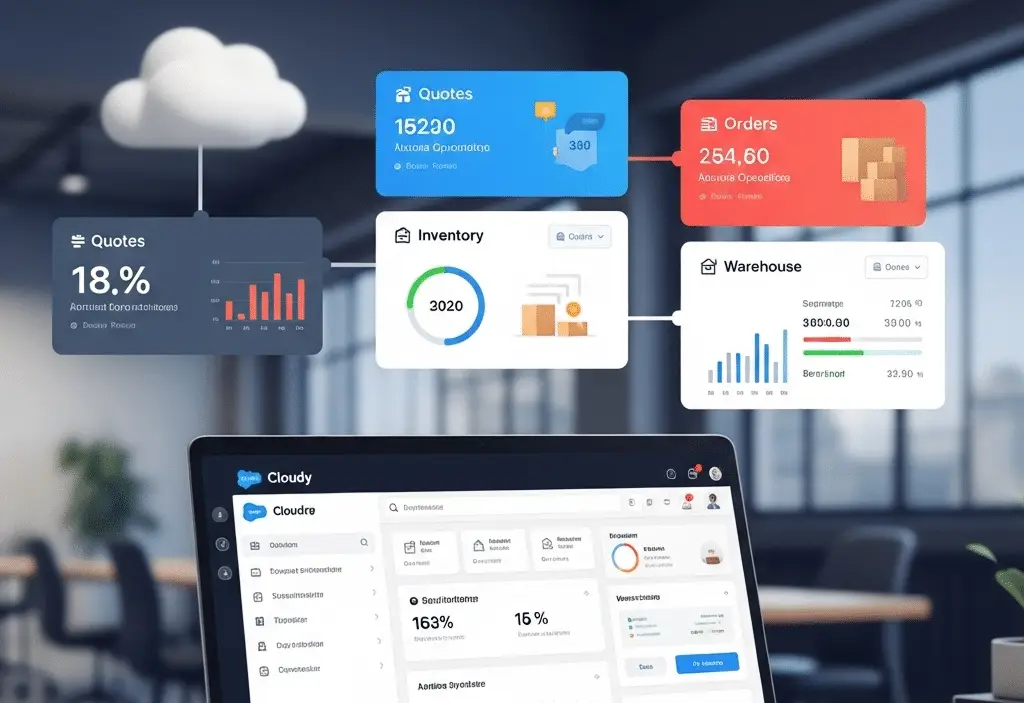
Cloudy Wave didn't just talk about the Salesforce PaaS — we built on it. Cloudy Business Ops 360 is an all-in-one business operations suite with nine integrated modules — Sales & CPQ, Order Management, Subscriptions & Billing, Inventory, Warehouse, Procurement & Manufacturing, Logistics, Billing & Finance, and Analytics — all running natively on the Salesforce Platform.
It's living proof of what Platform as a Service makes possible: one data model, one security layer, zero middleware, and enterprise-grade scale — delivered as a certified app on Salesforce AppExchange.
100%
Salesforce Native
9
Integrated Modules
1
Source of Truth
∞
Scalability
Open by Design
Built to Connect to the Tools You Already Use
Apps built on the Salesforce PaaS connect to external systems through native, pre-built integrations and open REST APIs.
📊 QuickBooks Online & Desktop
📒 Xero
📗 Zoho Books
💳 Stripe
💳 Authorize.Net
🔗 Open REST APIs
Trust Layer
Your Apps Inherit Salesforce's Security. Period.
Every app built on the Salesforce PaaS runs on the same trust layer that secures the world's largest enterprises — no separate security stack to build or audit.
✓
SOC 2 Type II Compliance
✓
ISO 27001, 27018, 27017
✓
GDPR & HIPAA Ready
✓
Field-Level Encryption
✓
Salesforce Shield Compatible
✓
Native Audit Trails
No separate vendor security review. No extra penetration testing for a bolt-on system. One trust layer, one compliance posture.
Who Builds on Salesforce PaaS
Built for Industries That Run on Salesforce
Organizations across every sector use the Salesforce Platform to build the apps legacy software never delivered.
Manufacturing
BOMs, work orders, and shop-floor apps that extend Salesforce to the production line.
Distribution & Wholesale
Multi-location inventory, channel pricing, and operations apps on one platform.
E-Commerce & D2C
Order capture, fulfillment, and real-time inventory apps connected to CRM.
B2B Services
Recurring billing, project, and subscription apps built on unified customer data.
Healthcare & Regulated
Compliance-ready, audit-friendly apps on the Salesforce trust layer.
Financial Services & Fintech
Secure, scalable apps that meet enterprise compliance from day one.
GET STARTED TODAY
See What's Possible on the Salesforce Platform
Get a personalized walkthrough of how Cloudy Wave builds and delivers apps on Salesforce Platform as a Service — including a live look at Cloudy Business Ops 360.
✓ Salesforce OEM Partner
✓ Live on AppExchange
✓ 100% Native
✓ Enterprise-grade security